


🌿 The Complete Chaya Tree Spinach Guide

How to Grow, Cook & Choose Chaya or Mayan Tree Spinach
Florida gardeners spend half the year searching for leafy greens that will tolerate heat, humidity, intense rain and sandy soil. Chaya does not merely tolerate those conditions—it can become a long-lived, productive shrub that supplies properly cooked greens while adding tropical structure to the landscape.
Known as Chaya, Tree Spinach or Mayan Spinach, Cnidoscolus aconitifolius is a perennial edible shrub native from Mexico through Central America. It has been cultivated for generations in Maya home gardens and is now valued by food-forest growers throughout Florida and other warm regions.
GreenDreams grows three visually and functionally distinct Chaya selections:
Maple Leaf Chaya — the broadest-leaved and most kitchen-focused choice
Deep Lobed Chaya — the boldest ornamental with the most architectural foliage
Marabou Chaya — a Florida-circulated selection balancing food production and upright landscape form
All three belong to the same species. All three require the same essential food-safety rule:
Chaya leaves must never be eaten raw. They must be thoroughly cooked before consumption.
Once that rule is understood, Chaya becomes one of the most useful perennial vegetables available to warm-climate growers.

🌱 Chaya Quick Facts
Feature | Details |
Botanical Name | Cnidoscolus aconitifolius |
Plant Family | Euphorbiaceae |
Common Names | Chaya, Tree Spinach, Spinach Tree, Mayan Spinach |
Native Range | Mexico through Central America |
Plant Type | Perennial edible shrub or small tree |
GreenDreams Online Size | Rooted starter plant in a 4-inch nursery container |
Other Sizes | Larger nursery sizes, including 1-gallon and larger plants, may be available locally depending on inventory |
Estimated Starter Age | Approximately 3–6 months, depending on propagation batch and pruning |
USDA Zones | Most reliable as a permanent landscape plant in Zones 9–11; protected or seasonal culture may be possible in Zone 8 |
Sun | Full sun to partial shade |
Cold Response | Frost-tender foliage and stems; established roots may resprout after cold damage |
Growth Habit | Fast-growing, branching shrub with succulent stems and milky latex |
Unpruned Height | Commonly 8–15+ ft, depending on selection, climate and growing conditions |
Suggested Managed Height | Approximately 4–8 ft for easier harvesting and storm management |
Typical Width | Approximately 5–10 ft unpruned |
Spacing | 3–4 ft for a managed hedge; 4–6 ft in home gardens; 6–8 ft in food forests |
Soil | Well-drained soil with regular organic matter |
Water | Moderate; drought-tolerant after establishment but more productive with consistent moisture |
Edible Part | Properly cooked leaf blades |
Flavor | Mild, green and spinach-like; texture varies among selections |
Harvest Season in Florida | Strongest from late spring through early fall; potentially longer in frost-free South Florida |
Container Growing | Yes, with progressive up-potting and regular pruning |
Indoor Growing | Not ideal long term; temporary winter protection is possible with strong light |
Pollinator Value | Small flowers may provide nectar for butterflies, bees and other visiting insects |
Primary Uses | Cooked greens, edible hedges, food forests, ornamental foliage, screening and managed biomass |
🌿 Why Chaya Belongs in a Florida Food Garden
It Produces When Cool-Season Greens Struggle
Annual spinach, lettuce and many brassicas decline as temperatures rise. Chaya enters its strongest growth period during warm weather, filling an important seasonal gap.
It Returns Year After Year
In Zones 9–11, established plants can persist as perennial shrubs. A frost may remove the upper canopy, but protected roots often resprout once sustained warmth returns.
It Responds to Harvesting
Moderate tip-pruning and stem harvesting create additional branches and keep new leaves within reach.
It Works as Both Food and Landscape
Chaya can function as:
A kitchen-garden shrub
A food-forest mid-layer
A managed edible hedge
A tropical backdrop
A seasonal screen
A container specimen
A pollinator-supporting flowering plant
A renewable source of chop-and-drop material
It Is Adaptable
Chaya grows in full sun or partial shade, tolerates periods of drought after establishment and performs in a wide range of well-drained soils. UF/IFAS lists it as suitable for full to partial sun with high drought tolerance, while ECHO documents its performance in hot rainy climates as well as regions with seasonal drought.
🌎 An Ancient Maya Vegetable with a Modern Florida Role
The name Chaya is linked to the Yucatec Maya word chay. Ethnobotanical research documents the plant’s longstanding cultivation in the Maya region of Mexico, Guatemala and Belize, where it has been used as a cooked leafy vegetable, living fence, ornamental shrub and home-garden staple.[2]
Chaya leaves have traditionally been incorporated into:
Soups and stews
Corn-based dishes
Beans
Eggs
Tomato and pepper preparations
Foods served with roasted squash-seed sauces
Filled tortillas and tamales
One well-known Yucatecan dish is dzotobilchay, a corn-based preparation containing cooked Chaya. Recipes differ by community and family, but the dish illustrates how deeply the plant is connected to regional food culture.
Historic botanical work recognizes four cultivated Chaya varieties:
Chayamansa
Estrella
Picuda
Redonda
These were distinguished primarily by leaf shape, reproductive traits and the presence or reduction of stinging hairs.
🌿 Cultivar Names vs. GreenDreams Selection Names
Customers commonly use the word “cultivar” for visibly different Chaya plants. For accuracy, GreenDreams describes Maple Leaf, Deep Lobed and Marabou as nursery selections unless formal provenance proves that a plant is one of the historically documented varieties.
Maple Leaf Chaya resembles the broad, overlapping leaf morphology associated with Chayamansa-type plants, but GreenDreams does not claim formal authentication without documented provenance.
Deep Lobed Chaya resembles traits seen among deeply divided historic forms, but the descriptive name is used rather than assigning an unsupported formal variety.
Marabou Chaya is an informally named Florida community selection, not a registered botanical cultivar.
This approach preserves the useful names growers recognize without turning observation into unsupported botanical certainty.
🌿 The Three GreenDreams Chaya Selections

Maple Leaf Chaya
Maple Leaf Chaya is the first choice for growers focused primarily on eating the leaves.
Its broad, overlapping lobes produce a lush canopy and provide a relatively tender cooked texture when young leaves are harvested. It branches readily and is the easiest of the three to maintain as a compact 4–6 ft harvest shrub.

Deep Lobed Chaya
Deep Lobed Chaya is the visual statement piece.
Its long, deeply divided lobes create an open, architectural canopy. It tends to develop greater vertical presence and is especially useful as a food-forest backdrop, tropical specimen, tall screen or managed biomass plant.

Marabou Chaya
Marabou Chaya sits between the other two in both form and culinary texture.
Its foliage is narrower than Maple Leaf but less dramatically divided than Deep Lobed. Its upright, organized framework makes it attractive in structured edible landscapes.
The name honors Florida grower and author Marabou Thomas. According to the community history carried with the plant, he discovered, propagated and circulated this distinctive Chaya among Central Florida food-forest growers. The story should be understood as regional grower history rather than a formal cultivar-release record.
🌱 GreenDreams Chaya Comparison Chart
The culinary and growth distinctions below are based on GreenDreams nursery observations and grower experience, not a controlled replicated cultivar trial.
Characteristic | Maple Leaf Chaya | Marabou Chaya | Deep Lobed Chaya |
Botanical Species | Cnidoscolus aconitifolius | Cnidoscolus aconitifolius | Cnidoscolus aconitifolius |
Selection Status | Descriptive GreenDreams selection name | Informally named Florida-circulated selection | Descriptive GreenDreams selection name |
Leaf Shape | Broad, overlapping, maple-like lobes | Moderately divided, narrower lobes | Long, deeply divided lobes |
Visual Effect | Full, lush and tropical | Clean, balanced and structured | Open, bold and architectural |
Primary Strength | Tender cooked leaves and frequent harvesting | Balanced edible and landscape performance | Ornamental impact, height and biomass |
Cooked Texture | Most tender within our collection when young | Tender to medium | Firmest; best young or in longer-cooked dishes |
Flavor | Mild and spinach-like | Mild and slightly herbal | Mild, green and substantial |
Growth Habit | Bushy and easily kept compact | Upright and organized | Tall, open and tree-like |
Typical Unpruned Height | Approximately 8–12+ ft | Approximately 8–12+ ft | Approximately 10–15+ ft |
Suggested Managed Height | 4–6 ft | 4–7 ft for harvest or 6–8 ft as a specimen | 4–7 ft for harvest or 6–10 ft as a specimen |
Best Garden Role | Kitchen garden, container or edible hedge | Structured hedge, border or food-forest mid-layer | Backdrop, statement plant or biomass row |
Best Culinary Role | Eggs, fillings, sauces, soups and tender cooked greens | Soups, beans, rice, eggs and mixed greens | Soups, stews, beans and longer-cooked dishes |
Container Suitability | Best of the three | Good with pruning | Requires the strongest height control and largest pot |
Storm Management | Easy to keep low and branched | Good when maintained at 5–8 ft | Requires regular height reduction |
Best Choice For | Maximum kitchen convenience | Equal emphasis on food and landscape form | Maximum ornamental drama |
🌿 Which Chaya Should You Grow?
Choose Maple Leaf Chaya When:
Tenderness is the highest priority.
You plan to grow in a large container.
You expect frequent small harvests.
You prefer broad tropical foliage.
Choose Marabou Chaya When:
You want a Florida food-forest selection with a regional story.
You prefer upright, structured growth.
You want balanced culinary and ornamental performance.
You are creating a productive hedge or formal edible border.
Choose Deep Lobed Chaya When:
You want the most architectural foliage.
You need a food-forest backdrop.
You want renewable pruning material.
Ornamental impact matters as much as edible yield.
Grow All Three When:
You collect unusual edible plants.
You want to compare leaf texture in your own kitchen.
You are building a Chaya hedge with varied foliage.
You want a living educational display.
You enjoy preserving useful plant diversity.
🪴 Sizes Available from GreenDreams
GreenDreams offers all three selections as 4-inch rooted starter plants for online shipping when in stock.
The 4-inch size is economical and establishes well when given a careful recovery period, but it dries faster and has fewer stored resources than a larger plant.
At our Spring Hill retail nursery, customers may find:
1-gallon Chaya
Larger established Chaya
Additional perennial vegetables
Fruit trees
Native and ecological support plants
Plants not currently listed online
Larger sizes vary with season and inventory.
🪴 Sizes Available from GreenDreams
GreenDreams offers all three Chaya selections as 4-inch rooted starter plants for online shipping when in stock.
The 4-inch size is economical, easy to establish, and ideal for growers who enjoy watching a young plant develop. Because it contains less soil and a smaller root system than a larger plant, it may dry more quickly and requires a careful recovery period after shipping.
🌿 Larger Chaya Plants Available at Our Retail Nursery
Growers shopping in person may find larger, more established Chaya plants available for local pickup, including:
3-gallon Chaya
7-gallon Chaya
Larger plants offer greater soil volume, a more developed root system, and a stronger head start for landscape planting. They are especially helpful for customers creating an edible hedge, food forest, privacy screen, or mature perennial vegetable garden.
Our Spring Hill retail nursery also carries:
Additional perennial vegetables
Fruit trees
Native and ecological support plants
Pollinator species
Food-forest companion plants
Plants not currently listed online
Larger Chaya sizes and individual selections vary with the season, propagation cycles, and current nursery inventory.
FOOD SAFETY, HARVESTING, FLAVOR, NUTRITION & RECIPES
🔥 The Non-Negotiable Chaya Food-Safety Rule:
Chaya leaves contain naturally occurring cyanogenic glycosides. When raw plant tissue is chewed, crushed or blended, these compounds can release hydrogen cyanide.
Never eat Chaya raw.
Do not:
Taste raw leaves in the garden
Use raw Chaya in salads
Add raw leaves to smoothies
Assume young leaves are safe without cooking
Rely on citrus, fermentation, drying or blending as a substitute for heat
Allow children, pets or livestock to browse the plant
A 2026 food-science study found that boiling reduced hydrogen cyanide in Chaya leaves by 99.94%, reinforcing that boiling is a critical safety step. The study also documented a trade-off: some nutrients are lost during boiling, but detoxification must take priority.

🍲 GreenDreams Conservative Cooking Method
Select healthy leaves.
Remove the petioles and thick stem material.
Wash the leaf blades thoroughly.
Chop or tear the leaves.
Place them in stainless-steel, enamel or other non-aluminum cookware.
Cover with plenty of boiling water.
Boil uncovered for 15–20 minutes.
Drain the cooked leaves.
Add them to the final recipe.
ECHO reports that boiling for 15 minutes effectively removes cyanide components and cautions that a quick stir-fry may not be adequate.[4]
For clear, repeatable household preparation, GreenDreams recommends:
Boil first, drain, then sauté or add the cooked leaves to another dish.
Kitchen Safety
Use good ventilation.
Avoid aluminum cookware.
Keep raw Chaya separate from foods served uncooked.
Wash knives, boards, counters and hands afterward.
Do not taste the leaves until cooking is complete.
Refrigerate cooked leftovers promptly.
Begin with leaf blades rather than thick petioles or shoots.
PHOTO PLACEMENT: Insert the Chaya food-safety cooking card immediately after this section. It is the most important graphic in the article.
🥬 What Does Chaya Taste Like?
Properly cooked Chaya is mild, green and adaptable.
Its flavor may remind cooks of:
Spinach
Swiss chard
Collards
Callaloo
Other cooked tropical greens
It pairs well with garlic, onion, tomato, peppers, eggs, beans, rice, corn, coconut milk, broth, cheese, smoked seasonings and citrus added after cooking.
🌿 Flavor & Texture Comparison
Selection | Cooked Flavor | Cooked Texture | Best Kitchen Uses |
Maple Leaf Chaya | Mildest and most spinach-like | Most tender when young | Eggs, quiche, fillings, sauces, sautéed greens after boiling |
Marabou Chaya | Mild with a slightly herbal finish | Tender to medium | Beans, rice, soups, eggs and mixed cooked greens |
Deep Lobed Chaya | Mild, green and substantial | Firmest; select young leaves | Soups, stews, beans, rice and longer-cooked dishes |
These differences are practical GreenDreams observations. Leaf age, sun exposure, water and cooking time also affect texture.
🌿 How to Harvest Chaya
A newly shipped 4-inch plant should not be harvested immediately.
First allow it to:
Recover from shipping
Produce healthy new growth
Develop additional roots
Form several branches
Build a canopy large enough to support leaf removal
Choose Leaves That Are:
Young but fully expanded
Flexible rather than leathery
Bright to deep green
Free from significant pest damage
Free from disease spotting
Not wilted or cold-damaged
Not recently treated with a horticultural product
Harvest Responsibly
Wear gloves.
Use clean scissors or pruners.
Harvest from several branches.
Do not strip one stem bare.
Leave at least half the healthy canopy.
Stop harvesting during drought, transplant stress or cold weather.
Allow the plant to rebuild between major cuts.
Moderate tip-pruning can serve two purposes at once: collect leaves and encourage branching.
🗓️ Chaya Harvest Season
Central Florida and Similar Zone 9 Climates
The main harvest season generally runs from:
Late spring
Through summer
Into early fall
Cool nights slow growth. Frost may end the harvest until spring.
South Florida and Frost-Free Zone 10–11 Sites
Harvest may continue through much of the year if warmth, water and active growth remain consistent.
Zone 8 and Colder Regions
Treat Chaya as:
A warm-season outdoor crop
A protected perennial in a favorable microclimate
Or a container plant moved above freezing
The main harvest window usually lasts from late spring until the first significant cold event.
Container Plants Overwintered Indoors
Low winter light normally limits production. Reduce harvesting and focus on keeping the plant alive until outdoor conditions improve.
🌿 Nutritional Value Without Exaggerated Claims
Chaya leaves have been studied for their content of:
Protein
Calcium
Iron
Phosphorus
Carotenoids
Vitamin C
Fiber
Phenolic compounds
Other vitamins and minerals
Nutrient levels vary with plant genetics, leaf age, soil, climate, irrigation, harvest timing and preparation method.[2][5]
The 2026 boiling study found high retention of beta-carotene but substantial losses of several water-soluble vitamins and potassium. The practical lesson is not to shorten cooking unsafely—it is to eat a diverse diet and use Chaya as one properly prepared green among many.
Medicinal & Folk Applications
Chaya has a long history of folk use, and modern researchers are investigating its phytochemicals and possible metabolic effects. However:
Traditional use is not proof of clinical effectiveness.
Extract studies do not establish a safe household treatment.
Chaya should not be marketed as a cure.
Properly cooked leaves are food, not a replacement for medical care.
Chaya is a nutrient-dense traditional cooked green with active scientific interest, not a proven treatment for disease.
🍳 Recipe 1: Chaya & Garden-Vegetable Egg Scramble
Prep Time: 15 minutes
Cook Time: 25 minutes
Servings: 2
Ingredients
8–10 young Chaya leaves
4 eggs
¼ cup diced onion
¼ cup diced sweet pepper
1 small garlic clove, minced
1 tablespoon butter or cooking oil
Salt and black pepper
Optional cheese, tomato or hot pepper
Directions
Remove the petioles and wash the Chaya.
Boil the leaves uncovered for 15–20 minutes in non-aluminum cookware.
Drain and chop.
Sauté onion, pepper and garlic.
Stir in the cooked Chaya.
Add beaten eggs and cook until fully set.
Season and serve.
Garden Tip: Maple Leaf Chaya is especially convenient for this recipe because its young leaves generally cook to the softest texture within our collection.
🍲 Recipe 2: Florida Black Bean & Chaya Soup
Prep Time: 20 minutes
Cook Time: 40 minutes
Servings: 4–6
Ingredients
12–15 young Chaya leaves
2 cans black beans, drained and rinsed
1 small onion, diced
1 sweet pepper, diced
2 garlic cloves, minced
1 teaspoon ground cumin
½ teaspoon smoked paprika
4 cups vegetable or chicken broth
1 cup diced tomato
Salt and pepper
Lime wedges for serving
Optional cooked rice, avocado or cilantro
Directions
Remove petioles, wash the Chaya and boil uncovered for 15–20 minutes.
Drain and chop the cooked leaves.
Sauté onion and pepper until softened.
Add garlic, cumin and paprika.
Add beans, broth and tomato.
Simmer for approximately 20 minutes.
Stir in the cooked Chaya and simmer 5 additional minutes.
Season and finish with lime after cooking.
Garden Tip: Marabou Chaya holds enough texture to remain visible in the soup without feeling tough when young leaves are selected.
🌽 Recipe 3: Yucatán-Inspired Chaya Corn Cakes
This is a GreenDreams home-garden recipe inspired by Chaya’s historic pairing with corn. It is not presented as one definitive version of traditional dzotobilchay.
Prep Time: 25 minutes
Cook Time: 35 minutes
Servings: 6 small cakes
Ingredients
10–12 young Chaya leaves
1½ cups masa harina
Approximately 1¼ cups warm water
½ teaspoon salt
¼ cup finely diced onion
¼ cup crumbled cheese or cooked black beans
1 tablespoon cooking oil
Tomato salsa or roasted squash-seed sauce for serving
Directions
Remove petioles, wash the Chaya and boil uncovered for 15–20 minutes.
Drain thoroughly and chop finely.
Mix masa harina, salt and warm water into a soft dough.
Fold in the cooked Chaya and onion.
Divide into six portions and flatten into cakes.
Add a small amount of cheese or beans to the center if desired.
Cook on a lightly oiled skillet over medium heat until firm and lightly browned on both sides.
Serve with salsa or a squash-seed sauce.
Garden Tip: Deep Lobed Chaya works well when chopped finely because its firmer texture stands up to the masa.
🍽️ More Ways to Use Cooked Chaya
After boiling and draining, add Chaya to:
Omelets and frittatas
Quiche
Bean dishes
Rice bowls
Coconut-milk stews
Chicken soup
Lentil soup
Tamale fillings
Quesadillas
Enchiladas
Savory hand pies
Vegetable patties
Cooked-green sauces
Pasta fillings
The safest habit is simple: complete the Chaya boiling step first, then treat the cooked leaves as a versatile ingredient.

USDA ZONES, SITE SELECTION, PLANTING, WATERING, FERTILITY & CONTAINERS
🌡️ Where Can Chaya Grow in the United States?
USDA zones are based on average annual extreme minimum winter temperatures, not the coldest temperature that can ever occur. The USDA also cautions that wind, soil moisture, microclimates, plant health and duration of cold influence survival.
GreenDreams recommends Zones 9–11 for the most dependable permanent landscape use.
UF/IFAS lists Chaya for Zones 8A–11, but Zone 8 growers should understand that survival may depend on microclimate, root protection and the severity of individual winters.
🗺️ Zone-by-Zone Chaya Guide
The regional examples below are broad. Always check the current USDA zone for your ZIP code.
Zone | Chaya Expectation | Broad U.S. Examples |
Zone 8 | Experimental or protected perennial; severe winter dieback or loss is possible | Florida Panhandle, portions of Georgia, Alabama, Mississippi, Louisiana, Texas, the Carolinas and parts of the Pacific Northwest |
Zone 9 | Good candidate with frost planning; top growth may die back | Much of Central Florida, Gulf Coast areas, lower Texas, southern Arizona and warm parts of coastal California |
Zone 10 | Strong perennial performance; occasional cold damage depends on site | South Florida, warm coastal Southern California, far South Texas and protected subtropical pockets |
Zone 11 | Nearly frost-free perennial culture | Florida Keys, the warmest South Florida microclimates, Hawaii and select coastal locations |
Zone 7 or Colder | Grow as a seasonal crop or overwinter in a heated protected space | Much of the central, northern and mountainous United States |
Florida Reality Check
A zone number does not tell the entire story.
In Central Florida, a plant beside a south-facing wall may remain warmer than one in an open field. A low frost pocket may be several degrees colder than a nearby slope. Inland locations often experience stronger freezes than coastal sites in the same general zone.
🌞 Sunlight: Full Sun or Partial Shade?
Chaya grows in full sun to partial shade.
Full Sun Usually Produces:
Faster growth
Shorter internodes
More compact branching
Greater flowering potential
Higher water demand
Slightly firmer leaves
Partial Shade May Produce:
Larger leaves
Softer culinary texture
Reduced afternoon wilt
Lower water demand
A more open canopy
For many Florida properties, morning through midday sun with light afternoon shade offers an excellent balance.
Avoid Deep Shade
Too little light may cause:
Long weak stems
Sparse foliage
Leaning
Reduced harvests
Poor flowering
Greater storm breakage
🌿 Where to Plant Chaya
Choose a location with:
Well-drained soil
Room for mature width
Easy pruning access
Easy harvesting access
Drip-irrigation access
Protection from the strongest winter wind
Distance from heavy foot traffic
No standing water at the crown
Avoid planting:
Directly beside narrow walkways
Where pets or livestock browse
Beneath a low roofline
Against siding
In a drainage depression
Over septic components
Where winter leaf loss would eliminate the property’s only privacy screen
Where milky sap could contact frequently used seating or play areas
🌬️ Wind & Hurricane Considerations
Chaya tolerates ordinary wind when maintained as a low, branched shrub. Tall plants can become top-heavy, and succulent stems may split during severe storms.
Improve resilience by:
Maintaining plants around 4–8 ft
Encouraging multiple low branches
Tip-pruning tall leaders
Avoiding excessive nitrogen
Reducing height before major storms
Integrating Chaya behind wind-firm trees and clumping grasses
Chaya can contribute to a layered wind-filtering system, but it is not a hurricane-proof windbreak.
🌊 What About Salt?
Published horticultural guidance is not perfectly consistent. A UF/IFAS Florida-Friendly Landscaping guide lists Chaya with medium salt tolerance, while other growers use more conservative language.[7]
The safest practical advice is:
Do not treat Chaya as a primary beachfront plant.
Protect it from direct salt spray.
Avoid saline irrigation.
Use a buffer of proven salt-tolerant vegetation near exposed coastlines.
Flush container soil if soluble salts accumulate.
🌾 Soil & Drainage
Chaya tolerates a broad soil-pH range but needs drainage. UF/IFAS lists well-drained soil across approximately pH 4.5–8.0.
In Sandy Florida Soil
Use:
Finished compost as a surface top-dressing
Charged biochar blended with compost
Hardwood mulch
Drip irrigation
Living groundcovers
Modest organic fertility
Repeated organic-matter additions
In Heavy or Compacted Soil
Use:
A broad raised mound
A wider loosened planting area
Surface compost rather than a rich isolated planting pocket
Organic matter over time
Reduced equipment traffic
Drainage correction before planting
Avoid the “Bathtub Hole”
Do not replace the entire planting hole with rich potting soil. A sharply different soil pocket can hold water differently from the surrounding native soil and may discourage outward root growth.
🌱 GreenDreams High & Tight Planting Method
Do not plant a newly shipped Chaya immediately.
Keep it in the original pot for approximately 30 days or until healthy new growth appears, whichever takes longer.
Once recovered:
Water the plant several hours before planting.
Dig a hole only slightly wider than the root ball.
Keep the hole approximately the same depth as the container.
Remove the plant without pulling the stem.
Loosen only severely circling exterior roots.
Set the root ball level with or slightly above the surrounding grade.
Backfill primarily with the native soil removed from the hole.
Firm the soil gently to eliminate large air pockets.
Never bury the stem.
Top-dress with compost, charged biochar, azomite and an organic nutrient source as appropriate.
Apply hardwood mulch around the planting area.
Keep mulch several inches away from the stem.
Water thoroughly at soil level.
Planting too deeply can contribute to crown rot, oxygen loss, slow establishment and weak anchoring.
🎥 GreenDreams High & Tight Planting Video:
PHOTO PLACEMENT: Add a simple two-panel diagram labeled Correct: Root Ball Slightly High and Incorrect: Stem Buried Below Grade.
💧 Watering Chaya
The GreenDreams Rule
Water at soil level during the morning. Avoid routine overhead watering.
Overhead irrigation may:
Splash soil onto foliage
Encourage leaf spotting
Waste water
Fail to wet the full root ball
Increase foliar disease pressure
Damage hot leaves when used during the afternoon
Use dripline, drip emitters, a slow hose or a watering wand aimed at the soil.
Suggested Establishment Schedule
Adjust this starting point for rainfall, soil type, temperature and drainage.
Stage | Suggested Watering |
4-inch container | Check daily; water thoroughly when the upper mix begins drying |
Planting day | Deep watering at soil level |
First 2 weeks | Check daily; water whenever the root ball begins drying |
Weeks 3–6 | Approximately every 2–3 days during dry weather |
Months 2–3 | Deep watering 1–2 times weekly when rainfall is insufficient |
Established plant | Water during prolonged dry periods; increase irrigation for maximum leaf production |
Extreme heat in sandy soil | Daily drip may be appropriate if the root zone is actually drying |
Underwatering Signs
Drooping leaves
Folded foliage
Crispy edges
Small new leaves
Premature leaf drop
Slow recovery after harvest
Overwatering Signs
Persistently wet soil
Yellow lower leaves
Soft tissue near the crown
Sour-smelling mix
Fungus gnats
Dark roots
Lack of new growth
Chaya may survive drought after establishment, but consistent moisture produces larger, more tender leaves.
🌿 Fertility & Organic Soil Building
Chaya survives in modest soil, but sustained harvests remove nutrients.
Spring
Wait for active growth.
Remove confirmed cold-damaged wood.
Apply finished compost.
Feed lightly with balanced organic nutrition.
Refresh mulch.
Summer
Maintain moisture.
Add compost if harvesting frequently.
Avoid forcing tall, weak growth with excessive nitrogen.
Early Fall
Complete major feeding early.
Reduce nitrogen as cold weather approaches.
Winter
Do not fertilize dormant or frost-damaged plants.
Resume only when active growth returns.
GreenDreams Top-Dressing Approach
Use modest amounts of:
Finished compost
Charged biochar
Worm castings
Azomite or another trace-mineral source
Balanced organic nutrients
Hardwood mulch
Keep concentrated amendments and mulch away from the stem.
✂️ Pruning Chaya
Pruning controls height, harvest access, branch density, wind resistance and landscape form.
Tip-Pruning
Remove the active tip above a healthy node to create additional side branches.
Harvest Pruning
Cut a leafy stem back above a node rather than repeatedly stripping one branch.
Structural Pruning
Remove:
Broken stems
Crossing branches
Dead wood
Weak inward growth
Excessively tall leaders
Growth blocking pathways
Rejuvenation Pruning
An established Chaya can tolerate strong warm-season cutting, but avoid combining severe pruning with:
Drought
Transplanting
Cold weather
Heavy fertilization
Root stress
Hurricane Preparation
Reduce excessive height before severe weather threatens. A 5–7 ft multi-branched shrub is generally easier to manage than a 12 ft top-heavy plant.
Wear gloves, long sleeves and eye protection because cut Chaya releases milky latex.
🪴 Growing Chaya in Containers
Chaya can be maintained in a container, especially Maple Leaf and Marabou.
Pot Progression
4-inch starter pot
1-gallon pot
3-gallon pot
7-gallon pot
10–15-gallon pot
20-gallon or larger for long-term culture
Move up when:
Roots circle the container
Roots emerge through drainage holes
The plant dries unusually fast
Growth slows during warm weather
The plant becomes top-heavy
Avoid moving a 4-inch plant directly into an enormous wet container. Progressive sizing makes moisture management easier.
Potting Mix
Use a mix containing:
Peat moss or coconut coir
Aged pine bark
Perlite, pumice or another aeration material
Moderate finished compost
Organic slow-release nutrition when appropriate
Avoid:
Dense garden soil
Pure compost
Containers without drainage
Saucers that remain filled with water
Fine media that stays saturated
Container Care
Water thoroughly at soil level.
Expect frequent summer watering.
Prune to maintain 3–6 ft.
Rotate the pot for balanced light.
Protect from severe wind.
Flush periodically with plain water to reduce salts.
Refresh organic nutrition during active growth.
🏠 Can Chaya Grow Indoors?
Chaya is not an ideal permanent houseplant.
Challenges include:
High light demand
Large mature size
Leaf drop after environmental changes
Spider mites and scale in protected conditions
Irritating sap
Access by pets or children
In cold climates, overwinter Chaya in:
A heated greenhouse
A bright sunroom
A protected enclosed porch
A growing area with strong supplemental light
Reduce watering during slow winter growth and focus on survival rather than harvesting.
Return the plant outdoors gradually over 7–14 days after frost danger passes.
SEASONAL CARE, TROUBLESHOOTING, ORGANIC GUILDS & LANDSCAPE USE
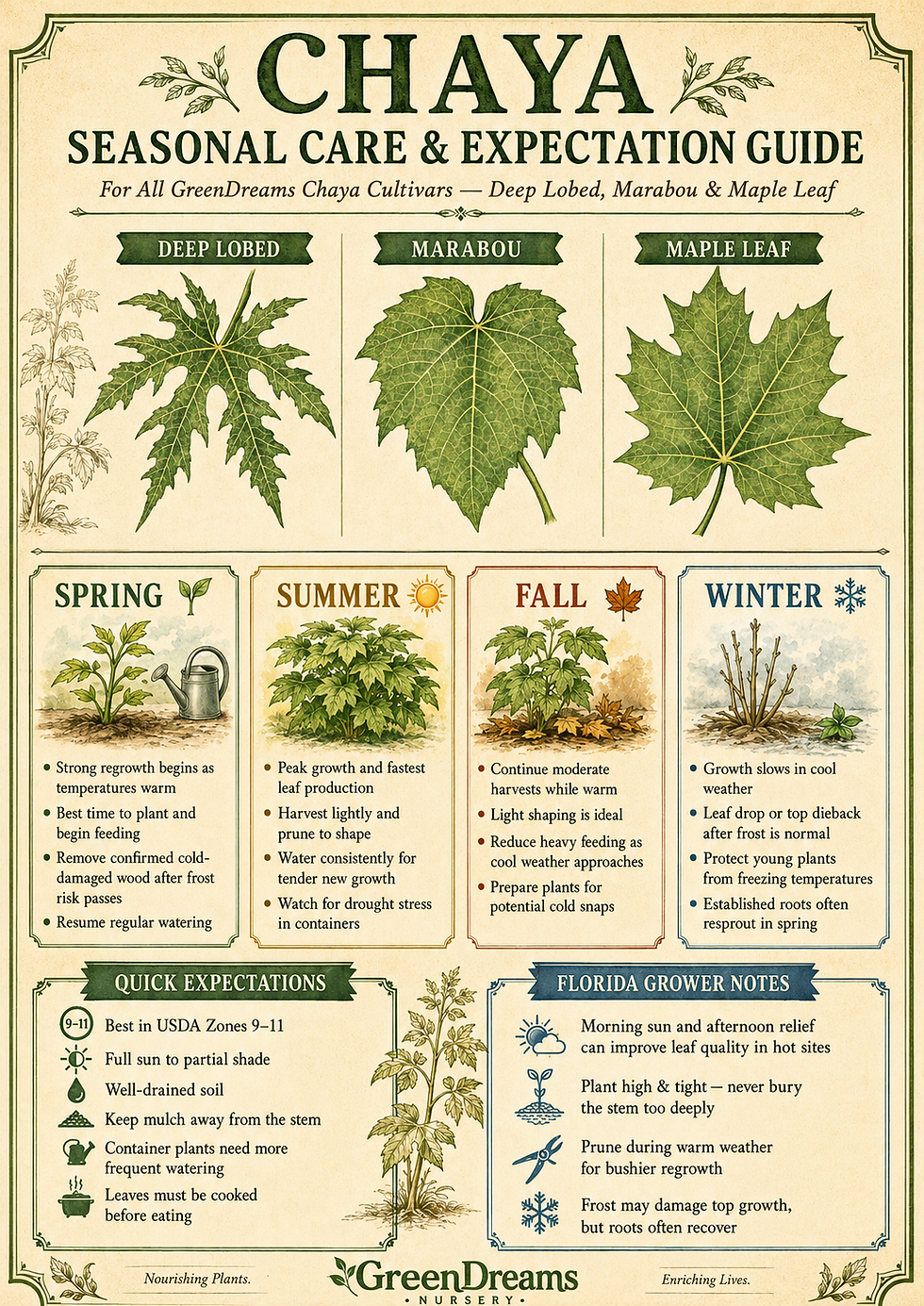
🌦️ Chaya Seasonal Care Guide for Florida
Chaya may remain evergreen in frost-free weather. Across Central and North Florida, it may become semi-evergreen, drought-deciduous or fully dormant after frost.
Seasonal leaf loss is not automatically plant death.
Season | What Growers May See | Recommended Care |
Winter | Slower growth, yellow leaves, spotting, leaf drop, frost burn or bare stems | Reduce watering, protect roots, avoid fertilizer and delay major pruning |
Early Spring | Bud swelling and new shoots from stems or roots | Wait until freeze danger passes, then remove confirmed dead wood |
Late Spring | Rapid leaf expansion and new branching | Apply compost, resume irrigation and begin light harvesting |
Summer | Peak growth, high water use, vigorous regrowth and flowering | Harvest moderately, tip-prune, maintain mulch and monitor pests |
Early Fall | Continued growth with shorter days | Complete major shaping early enough for recovery |
Late Fall | Slower growth and increasing cold sensitivity | Reduce nitrogen and prepare frost protection |
❄️ What Frost Damage Looks Like
After mild cold:
Yellow leaves
Dark spotting
Temporary wilt
Slower growth
After frost:
Blackened leaves
Collapsed shoot tips
Bare stems
Upper-branch dieback
After a hard freeze:
Loss of most visible growth
Damage to thick stems
Delayed spring recovery
Wait for sustained warmth before deciding the plant is dead.
Frost Protection
Water dry soil earlier in the day.
Maintain 3–4 inches of mulch over the root zone.
Keep mulch away from the stem.
Cover young plants to the ground with frost cloth.
Secure the covering against wind.
Do not allow plastic to rest directly on foliage.
Move containers into a protected structure.
Avoid heavy pruning immediately before a freeze.
🌿 Organic Pest & Disease Management
Chaya often experiences relatively little pest pressure. ECHO reports that it has few pest problems and rarely becomes weedy because many cultivated forms seldom produce seed
Problems can still occur, especially on stressed plants.
Caterpillars & Chewing Insects
Look for:
Missing leaf sections
Ragged edges
Droppings
Larvae beneath leaves
Organic response:
Inspect after sunset.
Hand-pick when practical.
Preserve beneficial insects.
Use a species-appropriate labeled biological control only when necessary.
Aphids, Scale & Other Sap Feeders
Look for:
Sticky leaves
Clusters on new growth
Ant activity
Distorted shoots
Organic response:
Prune heavily infested tips.
Address ants protecting honeydew-producing insects.
Use horticultural soap according to the label.
Avoid spraying during peak heat or while pollinators are active.
Spider Mites
Look for:
Fine stippling
Dull leaves
Fine webbing
Stress during hot, dry, protected conditions
Organic response:
Improve airflow.
Correct drought stress.
Rinse leaf undersides during the morning.
Use a labeled miticide or horticultural product only when needed.
Leaf Spot & Fungal Pressure
Look for:
Expanding dark spots
Persistent wet foliage
Disease concentrated in dense shaded growth
Organic response:
Stop overhead watering.
Increase airflow.
Remove badly affected leaves.
Avoid handling wet plants.
Improve drainage and reduce crowding.
🔍 Chaya Troubleshooting Guide
⚠️ Issue | 🧠 Likely Cause | 🌿 Response |
🍂 Yellow lower leaves | Natural aging, cold, wet soil or crowded roots | Check moisture and roots before fertilizing |
🍃 Sudden leaf drop | Shipping, drought, transplant stress, cold or rapid light change | Stabilize conditions and wait for new growth |
🫣 Afternoon wilt | Dry root ball, reflected heat, small pot or wind | Water deeply in the morning and provide temporary protection |
💦 Soil remains wet | Dense mix, blocked drainage or excessive irrigation | Improve drainage and allow the upper soil to begin drying |
🪣 Soft stem at soil line | Crown planted too deeply or chronic saturation | Pull wet mulch back and improve drainage |
☀️ Bleached patches | Sudden sun exposure | Return to gentler light and acclimate gradually |
🔥 Brown margins | Drought, fertilizer burn, salt or root damage | Flush soil and reassess irrigation |
❄️ Black foliage | Frost damage | Protect roots and delay pruning until cold danger passes |
🌬️ Broken branches | Excessive height, wind or weak nitrogen-forced growth | Make clean cuts and retrain lower branches |
🌱 Long weak stems | Too little light or too much nitrogen | Increase light gradually and tip-prune |
🐛 Chewed leaves | Caterpillars, beetles or grasshoppers | Inspect, hand-pick and use targeted controls |
🪲 Sticky leaves | Aphids or scale | Address ants and use labeled horticultural soap if necessary |
🕷️ Stippling and webbing | Spider mites | Improve airflow and reduce heat or drought stress |
🍄 Spreading spots | Leaf wetness and poor airflow | Stop overhead watering and thin crowded growth |
🌱 No growth after shipping | Normal recovery, cool weather, immature roots or excess water | Maintain warmth and stable moisture |
🪴 Pot dries within hours | Rootbound plant | Up-pot after recovery and active growth |
✂️ Slow recovery after harvest | Too much foliage removed | Stop harvesting and rebuild the canopy |
🌿 Companion Plants & Chaya Guilds
A strong guild does more than look attractive. It contributes nutrients, protects soil, supports pollinators, creates biomass and produces additional food.
Function | Suggested Plants | Role |
Nitrogen & Biomass | Pigeon Pea, Sunn Hemp, suitable native legumes | Renewable pruning material and soil-building support |
Fast Chop-and-Drop | Mexican Sunflower | Abundant warm-season biomass and nectar |
Silica & Carbon | Lemongrass, Vetiver where appropriate, clumping grasses | Fibrous mulch material and soil stabilization |
Living Groundcover | Perennial Peanut, Sunshine Mimosa | Soil shading and erosion reduction |
Pollinator Support | Tropical Sage, Native Porterweed, Firebush, Coreopsis | Nectar, flowers and beneficial-insect habitat |
Perennial Greens | Okinawan Spinach, Longevity Spinach, Katuk, Surinam Spinach, Edible Hibiscus | Diverse warm-season leafy harvests |
Tropical Food Layer | Banana, Papaya, Moringa | Additional food and tropical structure |
Fruit-Tree Canopy | Mulberry, Guava, Loquat, Avocado | Long-term layered food-forest canopy |
Color Contrast | Cranberry Hibiscus, Roselle, Purple Muhly Grass | Contrasting foliage and seasonal color |
A Simple Florida Chaya Guild
Combine:
One Chaya as the central edible shrub
One Pigeon Pea for nitrogen-rich pruning material
One Mexican Sunflower for fast biomass
Three Tropical Sage plants for pollinators
One clump of Lemongrass
Perennial Peanut as a living groundcover
A nearby Mulberry or Guava as a developing canopy tree
Maintain open space around the Chaya stem for airflow, irrigation and inspection.
PHOTO PLACEMENT: Use an illustrated guild diagram with arrows identifying food, nitrogen, pollinator habitat, biomass, groundcover and canopy functions.
🌸 Ornamental & Ecological Value
Chaya is not merely a utility crop.
Foliage
Maple Leaf creates a lush tropical mass.
Marabou creates a clean upright silhouette.
Deep Lobed creates a dramatic architectural texture.
Flowers
Small pale flowers may rise above the foliage during warm weather. They may attract butterflies, bees and other visiting insects.
Treat Chaya as a supplementary nectar plant, not a replacement for native butterfly host plants.
Landscape Uses
Productive hedge
Tropical border
Food-forest mid-layer
Summer privacy screen
Patio backdrop
Pollinator-garden background
Container specimen
Educational edible garden
Regenerative biomass row
Design Around Winter Dieback
In frost-prone Zone 9 landscapes, place Chaya:
Behind evergreen shrubs
Among mixed food-forest layers
Along productive fences
Near clumping grasses
Behind lower perennial vegetables
This prevents temporary winter dormancy from leaving the landscape without structure.
✨ Is Chaya Right for You?
✅ Chaya Is Ideal For:
Florida and Gulf Coast gardeners
USDA Zones 9–11
Food-forest growers
Permaculture and agroforestry projects
Gardeners seeking summer greens
Tropical plant collectors
Edible landscape designs
Managed hedges
Large containers
Growers comfortable with pruning and proper cooking
❌ Chaya Is Not Ideal For:
Anyone seeking a raw salad green
Households unwilling to follow cooking requirements
Unprotected cold-climate landscapes
Permanently saturated soil
Locations where animals browse freely
Low-light indoor culture
Gardeners unwilling to manage a large shrub
Landscapes requiring evergreen screening after every frost
❓ Chaya Frequently Asked Questions
Is Chaya the same as spinach?
No. Chaya is a perennial shrub in the Euphorbiaceae family. It is used as a cooked leafy green but is not botanically related to ordinary spinach.
Can Chaya be eaten raw?
No. Raw Chaya contains cyanogenic glycosides and must be thoroughly cooked.
How long should Chaya be cooked?
GreenDreams recommends boiling the leaf blades uncovered for 15–20 minutes in non-aluminum cookware, then draining them before further use.
Can Chaya go into a smoothie?
Only after it has been properly cooked and cooled. Raw Chaya must never be blended into a smoothie.
Can I quickly sauté raw Chaya?
GreenDreams recommends boiling first. A brief stir-fry may not process every piece evenly or long enough.
Which Chaya has the most tender leaves?
Within the GreenDreams collection, young Maple Leaf Chaya generally provides the tenderest cooked texture.
Which Chaya is the most ornamental?
Deep Lobed Chaya provides the boldest architectural foliage and greatest vertical impact.
What makes Marabou Chaya special?
Marabou is a Florida-circulated selection with upright, balanced growth and a community history associated with grower and author Marabou Thomas.
Are these three formally registered cultivars?
Not necessarily. GreenDreams uses Maple Leaf and Deep Lobed as descriptive selection names. Marabou is an informally named regional selection. All belong to Cnidoscolus aconitifolius.
How large does Chaya grow?
Depending on selection and climate, unpruned plants commonly reach approximately 8–15+ ft.
Can Chaya be kept at 5 ft?
Yes. Regular tip-pruning and warm-season structural pruning can maintain an established plant around 4–7 ft.
Does Chaya survive frost?
Foliage and tender stems are frost-sensitive. Established roots may resprout in Zones 9–11, but severe or prolonged freezes can kill the plant.
Is Chaya evergreen?
It may remain evergreen in frost-free climates. In Central Florida, it may become semi-evergreen or dormant after frost or drought.
Can Chaya grow in Zone 8?
Possibly in a protected microclimate, but it should be considered experimental. Container culture or seasonal growing is safer.
Can Chaya grow in partial shade?
Yes. Partial shade may produce larger, softer leaves. Deep shade creates weak, stretched growth.
Is Chaya drought-tolerant?
Established plants tolerate periodic drought, but regular moisture improves leaf production and tenderness.
Does Chaya tolerate wet soil?
It tolerates heavy rainfall but should not remain waterlogged.
Is Chaya salt-tolerant?
Some Florida guidance lists medium salt tolerance, but direct salt spray and saline irrigation are still risky. Use protection near exposed coastlines.
Is Chaya wind-tolerant?
Compact, branched plants tolerate ordinary wind. Tall succulent branches may break in severe storms.
Can Chaya grow in a container?
Yes. Use progressive up-potting and eventually provide a 10–15-gallon or larger container.
Can Chaya grow indoors?
It is not an ideal permanent houseplant. Bright protected indoor culture can keep a container plant alive during winter.
When should I transplant a shipped starter?
Wait approximately 30 days or until healthy new growth appears, whichever takes longer.
How soon can I harvest?
Wait until the plant is well rooted, actively growing and large enough to retain at least half its canopy after harvesting.
Does Chaya attract pollinators?
Its small flowers may provide nectar for butterflies, bees and other insects.
Does Chaya produce fruit or seed?
Many cultivated Chaya plants rarely produce viable seed and are maintained through cuttings.
Is Chaya invasive?
ECHO reports that it is unlikely to become weedy because many cultivated forms rarely set seed. Stem pieces can root, so dispose of prunings thoughtfully.
Does Chaya have medicinal value?
Chaya has traditional folk uses and active research interest, but it should not be used as a substitute for medical care or promoted as a cure.
🚚 Ordering Chaya Online from GreenDreams
GreenDreams offers Maple Leaf, Deep Lobed and Marabou Chaya as rooted 4-inch starter plants for online shipping when available.
🏡 Shop for Chaya in Spring Hill, Florida
GreenDreams Nursery & Farm
GreenDreams grows Chaya alongside a broad collection of fruit trees, perennial vegetables, native plants, ecological support species and useful plants from subtropical regions around the world.
Our retail nursery may carry:
Larger Chaya plants
Multiple Chaya selections
Plants not listed online
Fruit trees
Perennial vegetables
Pollinator plants
Native species
Food-forest support plants
Organic garden amendments
📍 18709 US Hwy. 41, Spring Hill, FL 34610
🕘 Tuesday–Friday: 9AM–5PM
🌞 Saturday: 8AM–3PM
🌿 Beyond the Plant: GreenDreams Services
We help Florida growers move from individual plants to functional edible ecosystems.
Consulting & Planning
Onsite ecological landscape consultations
Edible landscape and food-forest planning
Plant-selection guidance
Phasing and project prioritization
Soil-building and water-management recommendations
Design & Installation
Ecological and edible landscape design
Full landscape installation
Food-forest installation
Planting and establishment
Project management
Project Help & Day Labor
Skilled day-labor support
Planting assistance
Mulching
Soil-building work
Pruning and property projects
Help advancing owner-led installations
Bulk Delivery
Bulk plants
Compost
Hardwood mulch
Biochar
Soil blends
Garden amendments
Materials for regenerative landscape projects
A Chaya plant can be the beginning of a much larger system. GreenDreams can help design the canopy, understory, support species, irrigation, soil-building strategy and long-term management around it.


Comments