


🌿 South Sea Salad Trees & Bele: Complete Growing Guide to Abelmoschus manihot (Edible "Hibiscus")

Kiko’s Crump, Aunt Lillie’s, Chief Kubo’s Prize & Long Leaf Edible Hibiscus
What if one of your most productive summer greens grew more like a shrub than a vegetable?
That is the appeal of Abelmoschus manihot.
Known around the world by names including Bele, Aibika, Pele, Tongan Spinach, Island Cabbage, Slippery Cabbage, Edible Hibiscus and South Sea Salad Tree, this tropical leafy vegetable can grow rapidly through the heat and humidity that bring many traditional greens to a stop.
For Florida gardeners, that makes it especially interesting.
By the time lettuce is bolting and traditional spinach has disappeared from the garden, Salad Trees can be entering their most productive growing season.
But Abelmoschus manihot is more than a substitute for summer spinach.
It is an old and remarkably diverse food crop with cultivated forms selected across generations for differences in:
leaf shape
leaf size
tenderness
branching
stem coloration
vigor
mature size
culinary qualities
ornamental value
That diversity is easy to see in the GreenDreams collection.
We currently maintain five distinct selections:
Tongan Spinach / Bele — currently out of stock
Aunt Lillie’s South Sea Salad Tree
Kiko’s Crump South Sea Salad Tree
Long Leaf Edible Hibiscus
Chief Kubo’s Prize
They are all Abelmoschus manihot.
They do not all look or grow exactly alike.
And that is precisely what makes this collection so interesting.
🌺 SOUTH SEA SALAD TREE QUICK FACTS
FEATURE | DETAILS |
Botanical Name | Abelmoschus manihot |
Family | Malvaceae — the mallow family |
Related Plants | Okra, roselle, cotton and hibiscus |
Common Names | Bele, Aibika, Pele, Tongan Spinach, Island Cabbage, Slippery Cabbage, Edible Hibiscus, South Sea Salad Tree |
Primary Crop | Tender young leaves and growing shoot tips |
Flavor | Mild, green and spinach-like |
Texture | Tender when young; silky and naturally mucilaginous when cooked |
Growth Habit | Vigorous tropical shrub or subshrub |
Mature Height | Approximately 3–12+ ft depending on selection, climate and pruning |
Maintained Height | Most vigorous forms can be maintained around 3–6 ft |
Sun | Full sun to partial sun |
Soil | Fertile, moisture-retentive and well drained |
Water | Consistent moisture during active growth |
Typical Spacing | About 3–5 ft for most vigorous forms |
USDA Zones | Best perennial potential in Zones 9–11 |
Frost Tolerance | Frost-tender; foliage and stems may be damaged by freezes |
Florida Harvest | Primarily spring through fall; longer in frost-free areas |
Propagation | Stem cuttings or seed |
Container Culture | Yes |
Indoor Culture | Best used for protected overwintering rather than as a permanent houseplant |
Landscape Uses | Leaf crop, edible shrub, tropical accent, food-forest layer and seasonal screen |
🌏 WHAT EXACTLY IS A SOUTH SEA SALAD TREE?

Despite the name, it is not a true tree.
Abelmoschus manihot is generally a fast-growing shrub-like or herbaceous perennial.
The nickname becomes easier to understand once you see a mature plant.
Rather than bending down to harvest spinach from the ground, you can walk up to a large branching plant and harvest tender greens at waist, chest or even shoulder height.
That changes the way we think about leafy vegetables.
Instead of:
SEED → SMALL ANNUAL → HARVEST → REMOVE
the Salad Tree can function more like:
PLANT → ESTABLISH → HARVEST → BRANCH → REGROW → HARVEST AGAIN
It is a leafy vegetable behaving like a productive edible shrub.
🌿 ONE SPECIES — EXTRAORDINARY DIVERSITY
There is no single standard “Salad Tree” appearance.
Cultivated Abelmoschus manihot is extraordinarily variable.
Abelmoschus manihot bloom
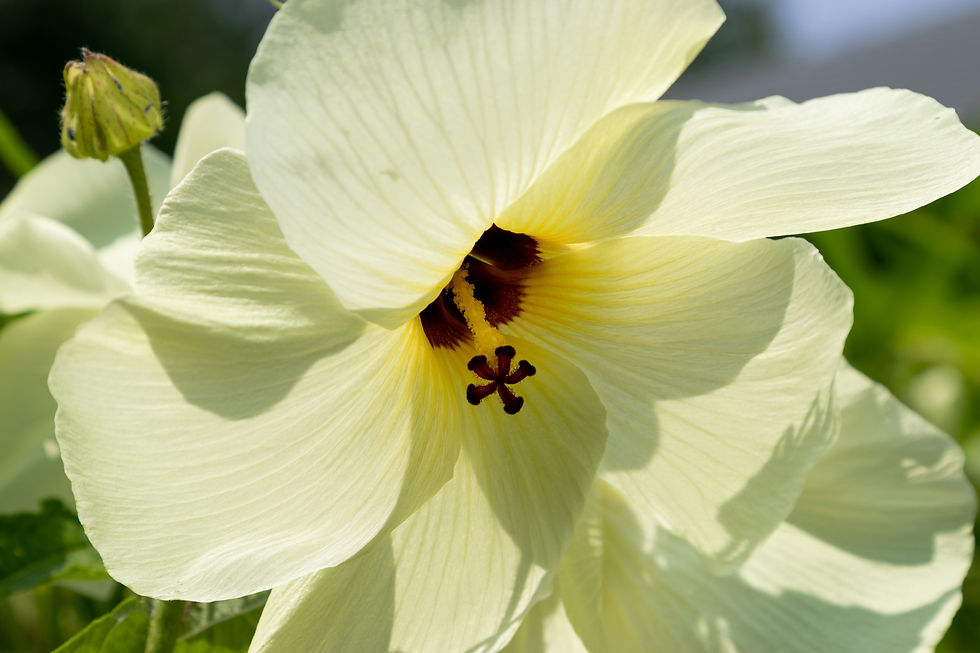
Different selections can vary in:
broad vs. narrow foliage
shallow vs. deeply lobed leaves
green vs. colorful stems
compact vs. vigorous growth
branching density
mature height
leaf size & tenderness
ornamental value
That variation reflects a long history of cultivation and selection.
Modern germplasm studies of aibika collections from Melanesia and Polynesia have documented tremendous genetic and morphological diversity within the crop.
This is important for gardeners.
If two Abelmoschus manihot plants look very different, that does not necessarily mean one has been mislabeled.
They may simply represent different selections within an exceptionally diverse cultivated species.
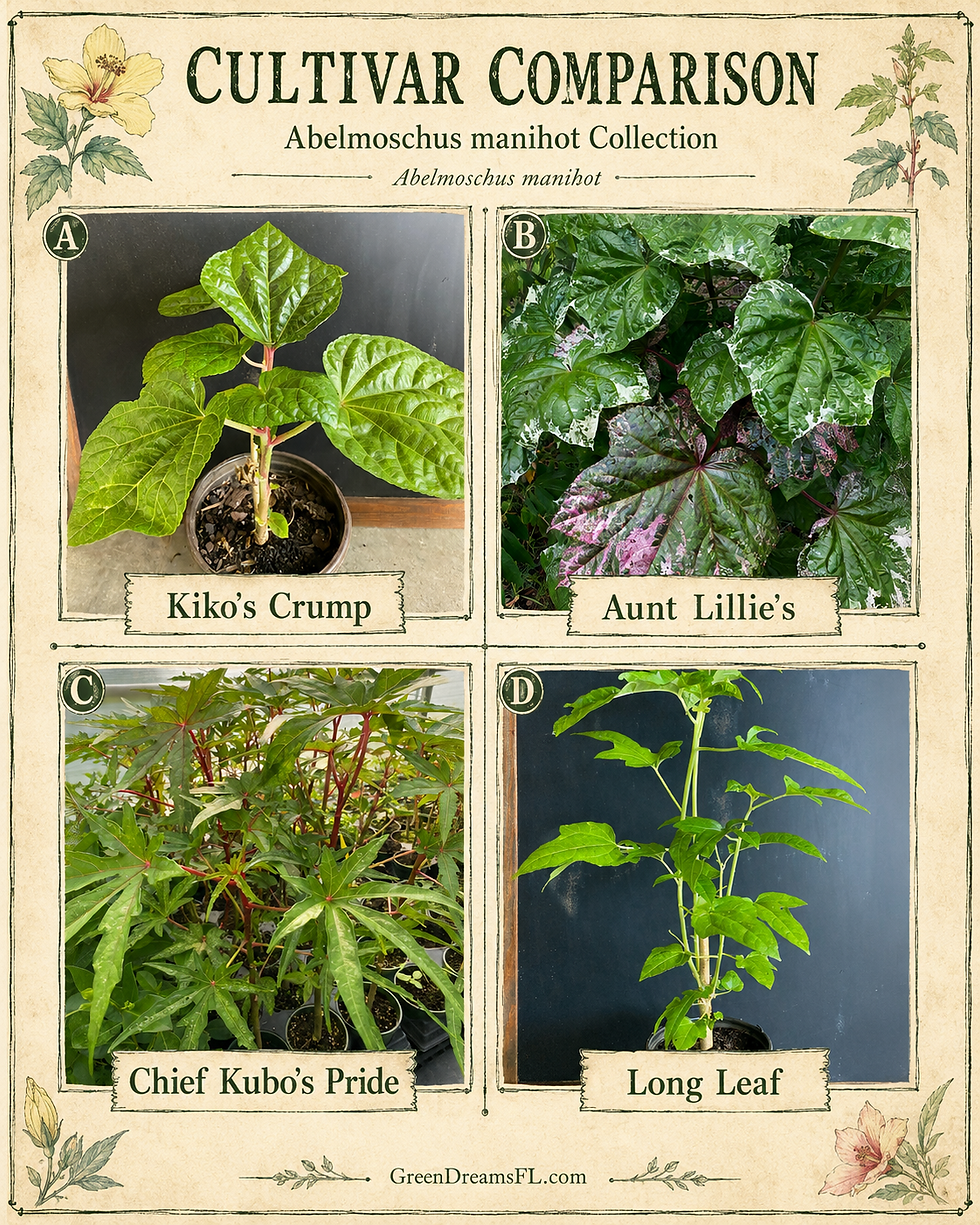
🌿 MEET THE GREENDREAMS SALAD TREE COLLECTION
AT-A-GLANCE COMPARISON
SELECTION | WHAT STANDS OUT | APPROX. UNPRUNED SIZE | BEST LANDSCAPE ROLE |
Aunt Lillie’s | Variegated foliage and compact habit | About 3–4 ft | Edible ornamental / container plant |
Kiko’s Crump | Large foliage, strong venation and colorful stems | About 6–8+ ft | Productive shrub / tropical foliage accent |
Long Leaf Edible Hibiscus | Distinctively long, narrow foliage | About 7-8 ft | Tall edible accent / screening |
Chief Kubo’s Pride | Vigorous green foliage with colorful stems | About 6–8 ft | Food forest / productive edible shrub |
There is not necessarily one “best” Salad Tree.
The better question is:
WHAT ROLE DO YOU WANT THE PLANT TO PLAY?
Maximum leaf production?
Compact edible ornamental?
Food-forest shrub?
Seasonal screen?
Container plant?
Collector specimen?
Different selections can fill different niches.
🌺 AUNT LILLIE’S SOUTH SEA SALAD TREE
Abelmoschus manihot selection

If most Salad Trees demonstrate that a vegetable can become a landscape plant, Aunt Lillie’s takes the idea even further.
Its foliage can display a remarkable mixture of:
🌿 green
🤍 cream
🌸 pink
🍷 burgundy
🌺 rose tones
It is the ornamental standout of our Salad Tree collection.
GROWTH HABIT
Aunt Lillie’s tends to remain considerably more compact than many vigorous green forms.
Approximate mature size:
3–4 FT
With regular harvesting and shaping, it may be maintained closer to:
2–3 FT
That makes it especially useful where space is limited.

BEST USES
edible ornamental beds
patios
container gardens
collector gardens
kitchen gardens
food-forest edges
mixed tropical plantings
BEST LIGHT IN FLORIDA
Variegated leaves contain less chlorophyll in their pale sections.
Those areas can be more sensitive to intense heat and sunlight.
In Central Florida, we prefer locations with:
MORNING SUN + AFTERNOON PROTECTION
or
BRIGHT PARTIAL SUN
Avoid extremely hot situations beside:
west-facing walls
reflective pavement
unshaded masonry
drought-prone containers
WHY AUNT LILLIE’S IS SPECIAL
This is an excellent choice when someone says:
“I want an edible landscape, but I don’t want it to look like a vegetable garden.”
Aunt Lillie’s can genuinely function as both ornamental foliage and food crop.
🌿 KIKO’S CRUMP SOUTH SEA SALAD TREE
Abelmoschus manihot ‘Kiko’s Crump’
Kiko’s Crump makes the term “Salad Tree” feel especially appropriate.
It combines substantial edible foliage with a dramatic tropical appearance.
Our plants are recognizable for:
large leaves
prominent leaf venation
colorful reddish to pinkish stems
vigorous warm-season growth
bold tropical foliage

GROWTH HABIT
Kiko’s Crump can become a significant shrub during the Florida growing season.
Approximate mature size:
6–8 FT
with particularly vigorous plants potentially growing taller when left completely unpruned.
For easy harvesting, maintaining the plant around:
3–5 FT
is much more practical.
WHY THE LARGE LEAVES MATTER
Large tender foliage expands the culinary possibilities.
Leaves can be:

chopped
sautéed
steamed
simmered
incorporated into soups
experimented with as wraps when young and flexible
BEST USES
high-production leafy vegetables
edible landscapes
food forests
seasonal screening
tropical foliage beds
collector gardens
LANDSCAPE PERSONALITY
Kiko’s Crump has enough visual presence that it does not need to be hidden in the vegetable garden.
Its colorful stems and oversized leaves can become part of the ornamental design.
🌿 LONG LEAF EDIBLE HIBISCUS
Abelmoschus manihot selection

Long Leaf Edible Hibiscus demonstrates how dramatically foliage can vary within one species.
Instead of the broader leaves associated with many Bele forms, this selection produces noticeably:
LONGER + NARROWER FOLIAGE
That creates an entirely different texture in the garden.
MATURE SIZE
This is one of the larger selections in our collection.
Plants may reach approximately:
10–12 FT
when allowed to grow without regular pruning.
That does not mean you need a twelve-foot leafy vegetable.
Routine harvesting can keep the plant around 4–6 FT
where the foliage remains much easier to reach.
SPACING
Allow approximately:
2–3 FT MINIMUM
with additional space when growing plants as broad shrubs.
BEST USES
food forests
tropical vegetable gardens
edible screening
foliage contrast
collector gardens
repeated leaf production
WHY GROW LONG LEAF?
Plant it beside one of the broader-leaf forms.
The contrast makes the remarkable diversity within Abelmoschus manihot immediately obvious.
🌿 CHIEF KUBO’S PRIZE

Abelmoschus manihot selection
Chief Kubo’s Pride is another vigorous green-leaf selection maintained within the GreenDreams collection.
It combines:
large edible foliage
vigorous growth
colorful stem tones
strong tropical character
MATURE SIZE
When allowed to grow freely:
APPROXIMATELY 6–8 FT
With regular harvesting:
APPROXIMATELY 3–5 FT
is much easier to maintain.
SPACING
Allow roughly:
3–5 FT
depending on how much branching you plan to permit.
BEST USES
productive edible shrubs
food forests
tropical vegetable gardens
edible screening
mixed edible landscapes
repeated summer greens

WHY GROW IT?
Chief Kubo’s Prize offers the versatility many edible landscape gardeners are looking for.
Allow it to grow large and architectural.
Or continually shape it into a compact leaf-production plant.
📖 WHAT DO WE KNOW ABOUT THESE NAMED SELECTIONS?
There is limited reliable published documentation detailing the original breeder or selection history of names including:
Aunt Lillie’s
Kiko’s Crump
Chief Kubo’s Prize
Long Leaf
Rather than inventing stories that cannot be documented, we prefer to describe them accurately as:
NAMED CULTIVATED SELECTIONS OF ABELMOSCHUS MANIHOT
Their distinctive vegetative characteristics are part of what makes them worth maintaining.
This also explains why propagation method matters.
A SEEDLING IS NOT AUTOMATICALLY THE SAME CULTIVAR.
When preserving a named selection, vegetative propagation from stem cuttings is preferable because the new plant remains genetically identical to the parent.
🥗 WHAT DOES SOUTH SEA SALAD TREE TASTE LIKE?
Despite the “hibiscus” nickname, Salad Tree does not taste like tart roselle tea.
Its leaves are much milder.
FLAVOR PROFILE
Think:
MILD • GREEN • SPINACH-LIKE • GENTLE
without the pronounced bitterness found in some conventional cooking greens.
TEXTURE
Young leaves are tender.
Cooking releases natural mucilage, giving the foliage a:
SOFT • SILKY • LIGHTLY THICKENING TEXTURE
This quality comes from the same broader botanical family traits that make okra famous.
Some people describe mucilage as “slimy.”
In many traditional cuisines, it is considered useful.
It can add body to:
soups
broths
curries
coconut milk dishes
stews
🍃 WHAT PART OF SALAD TREE DO YOU EAT?
The premium harvest is:
YOUNG LEAVES + TENDER SHOOT TIPS
Young growth generally provides:
better tenderness
less fiber
mild flavor
quicker cooking
Larger mature leaves can still be used but generally benefit from cooking.
Good preparation methods include:
steaming
sautéing
braising
simmering
stir-frying
Mature plants may also produce yellow hibiscus-like flowers, often with darker centers.
Flowers can eventually lead to seed capsules.
For these cultivars, however:
THE LEAF IS THE PRIMARY CROP.
We do not recommend treating immature capsules exactly like okra merely because the plants are related.
✂️ THE SECRET TO A PRODUCTIVE SALAD TREE: HARVEST THE TIPS
One of the most important techniques for growing Abelmoschus manihot is understanding how pruning affects growth.
DON’T JUST REMOVE INDIVIDUAL LEAVES.
Harvest tender growing tips as well.
Removing the terminal growing point reduces apical dominance.
That encourages dormant buds lower on the stem to develop into branches.
The cycle becomes:
HARVEST → BRANCH → REGROW → HARVEST AGAIN
More branches mean more growing tips.
More growing tips mean more future harvests.
✂️ HOW TO HARVEST
For an established plant:
Select a healthy branch with several mature leaves.
Identify a tender terminal shoot.
Cut immediately above a healthy node.
Harvest the tender tip and usable leaves.
Leave sufficient foliage below the cut.
Allow new side branches to develop.
Harvest those branches again once established.
Avoid stripping a young plant bare.
It still needs enough mature foliage to photosynthesize and rebuild.
📏 PRUNING TECHNIQUES
TIP PRUNING
Use regularly during active growth.
Best for:
increasing branching
controlling height
creating additional harvest points
maintaining dense foliage
SELECTIVE BRANCH REDUCTION
Shorten excessively long stems back to a healthy node or lateral branch.
Useful for:
pathway clearance
improving airflow
controlling width
preventing plants from becoming top-heavy
REJUVENATION PRUNING
Older plants that have become tall, woody or difficult to harvest can be cut back more substantially.
Perform major rejuvenation during warm growing weather.
Avoid severe pruning immediately before:
drought
transplanting
cold fronts
freezing weather
Give the plant sufficient warmth and resources to recover.
☀️ HOW MUCH SUN DOES SALAD TREE NEED?
Most vigorous green forms perform best in:
FULL SUN TO PARTIAL SUN
In Florida, partial afternoon shade can sometimes be beneficial during periods of extreme heat.
FULL SUN
Usually encourages:
vigorous growth
strong stems
heavy leaf production
provided the root system has adequate moisture.
PARTIAL SUN
Can be particularly useful in:
very hot inland locations
containers
reflected heat situations
plants with variegated foliage
SPECIAL CASE: AUNT LILLIE’S
Protect its lighter variegated foliage from the harshest afternoon exposure.
🌱 BEST SOIL FOR SOUTH SEA SALAD TREE
The goal is not simply “rich soil.”
The goal is:
FERTILE + MOISTURE-RETENTIVE + WELL DRAINED
Salad Trees appreciate consistent moisture but do not perform their best in chronically anaerobic soil.
Florida growing conditions vary dramatically.
Some properties have:
extremely sandy soil
compacted fill
seasonal flooding
construction debris
alkaline soils
nutrient-poor ground
Improving the biological and physical structure of the root zone can make a major difference.
🚫 WHERE NOT TO PLANT SALAD TREE
Avoid locations with:
CHRONIC STANDING WATER
Moist soil is useful.
A permanently saturated crown is not.
DEEP SHADE
Plants may stretch, weaken and produce fewer leaves.
NO ACCESS TO WATER
Young plants establish poorly in extremely dry sand without supplemental irrigation.
NO ROOM TO HARVEST
Do not place a vigorous 8-foot edible shrub directly against a wall or fence if you cannot reach the foliage.
AGGRESSIVE VINE COMPETITION
Fast-growing vines can overwhelm young Salad Trees before they become established.
🌱 HOW WE PLANT: THE GREENDREAMS METHOD
One of the most common planting problems we see in Florida landscapes is planting too deeply.
Our preferred approach is:
HIGH & TIGHT.
The root crown should not disappear beneath several inches of soil.
STEP 1 — DIG WIDE, NOT DEEP
Dig a hole only slightly wider than the nursery root ball.
The hole should not be deeper than the container.
STEP 2 — KEEP THE ROOT BALL AT GRADE
Position the plant so the top of the original root ball remains at surrounding soil level or slightly above grade where drainage is questionable.
Do not bury the lower stem.
STEP 3 — BACKFILL FIRMLY
Backfill with appropriate native soil and amendments as site conditions require.
Firm the soil enough to eliminate major air pockets without excessively compacting it.
STEP 4 — BUILD THE SOIL FROM ABOVE
Depending on the site, our soil-building approach may incorporate:
compost
biochar
organic nutrients
mineral amendments such as azomite where appropriate
Not every property requires the same amendment package.
Evaluate the existing soil first.
STEP 5 — MULCH BROADLY
Apply organic hardwood mulch around the plant.
Mulch helps:
moderate soil temperatures
retain moisture
suppress weeds
feed soil biology
reduce exposed sandy soil
Keep mulch several inches away from the primary stem.
NEVER VOLCANO-MULCH THE PLANT.
STEP 6 — WATER THOROUGHLY
Saturate the original root ball and surrounding planting area after installation.
💧 WATERING SOUTH SEA SALAD TREE
Fast leaf production requires water.
But more water is not always better.
The goal is:
CONSISTENTLY MOIST — NOT WATERLOGGED.
NEWLY PLANTED SALAD TREES
Check the original nursery root ball frequently.
A surprisingly common transplant problem occurs when surrounding soil is moist but the original root ball has dried out.
ESTABLISHED PLANTS
Water deeply enough that moisture reaches beyond the original planting hole.
Encourage roots to expand outward.
During Florida’s rainy season, established plants may require little additional irrigation.
During drought, production may slow substantially without supplemental water.
CONTAINER PLANTS
Containers can dry very quickly during Florida summer.
Large leafy plants may use surprising amounts of water.
Monitor them frequently.
BEST WATERING PRACTICE
Whenever practical, water the soil rather than repeatedly wetting foliage late in the evening.
That reduces prolonged leaf wetness and may help reduce fungal problems.
🌱 HOW TO FERTILIZE SALAD TREE
Remember what you are harvesting:
LEAVES.
Repeated leaf production requires fertility.
For organic gardens, we prefer building the soil first and supplementing according to plant performance.
Useful inputs may include:
compost
biologically active organic matter
slow-release organic fertilizer
nitrogen-containing organic fertilizer during active growth
biochar incorporated appropriately into a fertility program
mineral amendments when justified by soil conditions
Avoid excessive soluble fertilizer around young plants.
Several moderate applications generally make more sense than a large single dose.
SIGNS OF POSSIBLE NUTRIENT STRESS
Watch for:
persistently pale foliage
unusually small new leaves
weak growth
poor recovery after harvesting
But investigate:
WATER + DRAINAGE + ROOT HEALTH
before assuming every yellow leaf means the plant needs fertilizer.
🌦️ SEASONAL CARE GUIDE — CENTRAL FLORIDA
🌱 LATE WINTER + EARLY SPRING
WHAT TO EXPECT
winter-damaged plants may begin resprouting
new growth accelerates as soil warms
overwintered cuttings begin growing strongly
WHAT TO DO
remove confirmed dead material
refresh mulch
add compost
begin feeding as active growth resumes
plant new Salad Trees after major freeze danger decreases
☀️ LATE SPRING
WHAT TO EXPECT
rapid vegetative growth
increasing leaf size
increased water demand
WHAT TO DO
begin regular tip harvesting
establish the desired plant shape early
monitor irrigation
watch for caterpillars and sucking insects
🌧️ SUMMER
PEAK SALAD TREE SEASON.
Heat, moisture and long days can produce tremendous growth.
WHAT TO DO
harvest frequently
tip-prune for branching
maintain mulch
provide consistent water
fertilize moderately as needed
maintain airflow
inspect foliage after extended rainy weather
🍂 FALL
WHAT TO EXPECT
continued production
increasingly woody stems
potential flowering
slowing growth as temperatures decline
WHAT TO DO
take backup cuttings
prepare winter protection
reduce aggressive late-season fertilizing
decide which container plants need protection
❄️ WINTER
CENTRAL FLORIDA
Expect possible:
leaf drop
frost burn
defoliation
stem dieback
temporary dormancy
SOUTH FLORIDA
Plants may continue growing through much of winter during warm conditions.
WINTER CARE
protect during cold events
reduce irrigation when growth slows
avoid heavy fertilization
avoid severe pruning immediately before freezing weather
❄️ PERENNIAL VS. ANNUAL: WHAT DOES THAT REALLY MEAN?
Abelmoschus manihot is biologically capable of living for multiple growing seasons.
That makes it a perennial.
But:
PERENNIAL DOES NOT MEAN WINTER-HARDY EVERYWHERE.
In a warm subtropical or tropical climate, one plant may persist for multiple seasons.
In a colder region, the same plant may function as an annual.
Your local winter determines the practical difference.
🗺️ USDA ZONE GUIDE
USDA zones describe average annual extreme minimum winter temperatures.
They do not account for:
summer heat
rainfall
humidity
freeze duration
soil drainage
wind
microclimates
Use them as a starting point rather than a guarantee.
ZONE 8
Examples include portions of:
Georgia
the Carolinas
Alabama
Mississippi
Louisiana
Texas
other inland Southern regions
Best strategy:
GROW AS A SUMMER CROP.
Preserve cuttings or protected plants before winter.
ZONE 9A
Includes portions of North and Central Florida and other warm Gulf/Southeastern areas.
Best strategy:
TREAT AS A TENDER PERENNIAL.
Expect occasional frost damage.
Maintain backup plants.
ZONE 9B
Includes many warmer portions of Central Florida.
Plants have stronger perennial potential, although freezing weather still occurs.
Protection remains worthwhile.
ZONE 10
Examples include much of South Florida and other very warm coastal regions.
Salad Trees have strong perennial potential and a long harvesting season.
ZONE 11
Examples include the Florida Keys and other near-tropical frost-free locations.
Plants may remain productive through much or all of the year.
🥶 FROST & COLD PROTECTION
Salad Tree foliage is frost-tender.
Cold damage may include:
scorched leaves
blackened foliage
defoliation
stem damage
complete top dieback
At GreenDreams, we prefer becoming proactive when temperatures begin approaching the mid-30s.
That does not mean a plant automatically dies at 35°F.
It means valuable tropical plants are worth preparing before frost develops.
BEFORE A COLD EVENT
water dry soil appropriately
maintain mulch over the root zone
cover plants with frost cloth
extend frost cloth toward the ground
move container plants into protection
preserve backup cuttings
Avoid plastic resting directly on the foliage.
🌺 EVERGREEN OR DECIDUOUS?
This depends on climate.
FROST-FREE TROPICS
Evergreen to semi-evergreen.
CENTRAL FLORIDA
Often effectively:
COLD-DECIDUOUS OR DIEBACK-PRONE
during colder winters.
COLDER CLIMATES
Grow as a warm-season annual or overwinter under protection.
📅 HARVEST SEASON
CENTRAL FLORIDA
Primary harvest:
LATE SPRING THROUGH FALL
with longer seasons possible during mild winters.
SOUTH FLORIDA + FLORIDA KEYS
Harvest may continue:
MOST OR ALL OF THE YEAR
depending on local weather.
NORTHERN GROWERS
Harvest:
SUMMER THROUGH FIRST FROST.
Plants can become surprisingly large during a single warm season.
🪴 GROWING SALAD TREE IN CONTAINERS
Salad Trees can perform very well in containers.

Container growing is especially useful for:
patios
small spaces
collectors
renters
cold-climate gardeners
winter protection
As plants grow, increase root volume gradually.
A useful progression may be:
SMALL STARTER → 1 GAL → 3 GAL → 7 GAL OR LARGER
The goal is not to rush into an enormous container.
Overpotting a small plant into a huge volume of wet soil can create moisture problems.
CONTAINER SUCCESS REQUIRES
excellent drainage
quality potting media
regular irrigation
periodic organic fertility
adequate sunlight
regular pruning
Large plants may also need a sufficiently heavy pot to prevent tipping.
🏠 CAN YOU GROW SALAD TREE INDOORS?
Yes—but think:
OVERWINTERING
rather than:
HOUSEPLANT.
These plants prefer strong light.
A dark indoor room will not support healthy growth indefinitely.
For indoor winter protection, provide:
strong window light or grow lights
warm temperatures
airflow
reduced but consistent watering
regular pest inspection
Common indoor problems can include:
aphids
whiteflies
spider mites
For northern gardeners, it may be much easier to overwinter:
SEVERAL SMALL ROOTED CUTTINGS
rather than one six-foot mother plant.
🌳 USING SALAD TREES IN A FOOD FOREST
This is where Abelmoschus manihot becomes more than another vegetable.
A conventional vegetable garden produces most of its food close to the soil.
A food forest can produce food at several heights.
Salad Trees can occupy the:
LARGE HERBACEOUS / SHRUB LAYER.
They are especially useful around young fruit trees.
A newly planted orchard may take years to develop a closed canopy.
During that period, enormous amounts of sunlight reach the understory.
Use some of that temporary space for productive leafy vegetables.
🌿 BUILDING FUNCTIONAL PLANT GUILDS
Rather than following lists that claim two plants are magically “companions,” we prefer designing guilds by function.
Ask:
What protects the soil?
What attracts beneficial insects?
What provides mulch?
What fixes nitrogen?
What uses a different canopy layer?
What requires similar irrigation?
What will become aggressive?
What can be cut back for biomass?
Useful companion categories may include:
🌱 low edible groundcovers
🌼 flowering native plants
🌳 young fruit trees
🌿 perennial herbs
🍃 other heat-loving leafy vegetables
🐝 insectary plants
The goal is to build relationships between plants based on ecology and management—not folklore.
🏡 USING SALAD TREES AS ORNAMENTALS
Edible plants do not need to look agricultural.
Salad Trees can work beautifully in designed landscapes.
AS AN EDIBLE BACKDROP
Plant behind lower-growing greens.
AS SEASONAL SCREENING
Allow vigorous forms to develop height during summer.
AS TROPICAL FOLIAGE
Large leaves provide strong contrast against fine-textured plants.
AS A COLOR FEATURE
Use:
Aunt Lillie’s variegation
Kiko’s Crump stems
Chief Kubo’s Pride stems
as intentional ornamental features.
AROUND YOUNG FRUIT TREES
Use them while the fruit-tree canopy remains open.
Later, prune them more heavily as shade increases.
🥥 CULTURAL FOOD USE
Aibika has long been an important vegetable throughout parts of Melanesia and the Pacific.
Young foliage is incorporated into meals alongside:
coconut
root crops
starches
seafood
vegetables
Traditional preparations help explain why the crop’s large leaves and natural mucilage are valuable rather than inconvenient.
In Vanuatu, aibika is associated with dishes including:
LAPLAP
and
SIMBORO.
Simboro is particularly useful for understanding the plant.
Leafy greens can be used to wrap starchy fillings before cooking, often in combination with coconut.
Instead of asking:
“Why doesn’t this behave exactly like lettuce?”
ask:
WHAT DOES THIS LEAF DO BETTER?
Its size, tenderness and silky texture suddenly become strengths.
🍲 3 WAYS TO USE SALAD TREE IN THE KITCHEN
🥥 RECIPE 1: COCONUT SALAD TREE GREENS
INGREDIENTS
8–10 young Salad Tree leaves
1 cup coconut milk
½ small onion
1 garlic clove
small piece fresh ginger
salt
optional hot pepper
METHOD
Wash and chop the foliage.
Sauté onion, garlic and ginger.
Add coconut milk.
Bring to a gentle simmer.
Add Salad Tree leaves.
Cook until tender.
Season to taste.
The natural mucilage lightly thickens the coconut broth.
🍳 RECIPE 2: GARLIC-GINGER SALAD TREE STIR-FRY
INGREDIENTS
tender Salad Tree leaves and shoot tips
cooking oil
garlic
fresh ginger
soy sauce or tamari
optional mushrooms
optional peppers
optional sesame oil
METHOD
Wash and slice the greens.
Heat oil in a skillet.
Add garlic and ginger.
Add foliage.
Stir-fry until wilted and tender.
Season near the end.
Serve with:
rice
eggs
tofu
seafood
meat
🌿 RECIPE 3: COCONUT LEAF ROLLS
This is an approachable garden-kitchen recipe inspired by traditional wrapped aibika preparations rather than an attempt to reproduce an exact traditional recipe.
INGREDIENTS
several large tender Salad Tree leaves
cooked sweet potato or taro
scallions
ginger
salt
coconut milk
METHOD
Briefly wilt leaves until flexible.
Mash the cooked root crop.
Mix with scallion, ginger and seasoning.
Place filling into each leaf.
Roll securely.
Arrange seam-side down in a shallow pan.
Add coconut milk.
Cover and simmer gently until completely tender.
Large-leaf selections such as Kiko’s Crump can be especially interesting for experimenting with this type of preparation.
NUTRITIONAL PROFILE
Abelmoschus manihot leaves have attracted scientific interest because they contain a broad range of nutrients and phytochemicals.
Research has documented minerals including:
calcium
iron
potassium
magnesium
manganese
zinc
copper
The leaves also contain varying amounts of:
beta-carotene
folate
protein
polysaccharides
flavonoids
other phytochemicals
That nutritional value helps explain why aibika has remained an important traditional leafy crop.
🌿 WHAT ABOUT MEDICINAL USE?
There is substantial scientific literature investigating extracts of Abelmoschus manihot, especially flower-derived flavonoids and related phytochemicals.
That research is interesting.
But there is an important distinction:
EATING A VEGETABLE IS NOT THE SAME AS TAKING A CONCENTRATED MEDICINAL EXTRACT.
We do not recommend converting pharmaceutical research directly into health claims for garden-grown leaves.
Grow Salad Tree primarily because it is a useful, nutritious leafy vegetable.
📜 A SURPRISING USE: TRADITIONAL JAPANESE PAPERMAKING
Abelmoschus manihot has another fascinating history far removed from the vegetable garden.
In Japan, the plant is known as:
TORORO-AOI.
Mucilage produced from its roots has traditionally been used to make neri, an important material in handmade washi papermaking.
The viscous material helps keep paper fibers suspended evenly in water during sheet formation.
That means one species connects:
🥗 tropical leafy vegetables
🌿 food-plant diversity
🌺 ornamental horticulture
📜 traditional Japanese paper craftsmanship
Plants become much more interesting when we understand how different cultures have learned to use them.
🐞 TROUBLESHOOTING GUIDE
SYMPTOM | POSSIBLE CAUSE | WHAT TO DO |
Pale foliage | Root stress, excess water or nutrient deficiency | Check drainage and irrigation first; feed if appropriate |
Wilting in dry soil | Underwatering | Deeply water and restore mulch |
Wilting despite wet soil | Poor drainage / root stress | Allow soil to drain and correct drainage problems |
Long weak stems | Too little light or insufficient pruning | Increase light and begin tip pruning |
Tall plant with few branches | Strong apical dominance | Harvest growing tips |
Burned pale sections on Aunt Lillie’s | Excess afternoon sun | Provide stronger afternoon protection |
Holes in leaves | Caterpillars, snails or slugs | Inspect and hand-pick; use targeted controls if needed |
Sticky leaves | Aphids or whiteflies | Rinse foliage, support predators, treat if necessary |
Fine stippling / webbing | Spider mites | Reduce plant stress and address infestation early |
White powder on leaves | Powdery mildew | Increase airflow and reduce prolonged leaf wetness |
Black foliage after cold | Frost injury | Wait, then remove confirmed dead growth after freeze danger passes |
🌿 ORGANIC PEST MANAGEMENT
Because the leaves are the crop, minimize unnecessary pesticide use.
Our preferred progression is:
1. GROW A HEALTHY PLANT
Healthy soil, appropriate light, proper water and adequate spacing create the foundation.
2. IDENTIFY THE PROBLEM
Do not spray simply because a leaf has a hole.
Find the pest.
3. USE PHYSICAL CONTROL
Options include:
hand-picking caterpillars
pruning damaged foliage
spraying aphids with water
removing heavily affected leaves
4. SUPPORT BENEFICIAL INSECTS
Include flowering plants that support:
lacewings
predatory wasps
lady beetles
other beneficial insects
5. USE TARGETED ORGANIC PRODUCTS ONLY WHEN NECESSARY
Always ensure the product is labeled appropriately for edible plants and follow harvest intervals.
⚠️ IMPORTANT CAUTIONS
POSITIVELY IDENTIFY THE PLANT
Do not assume every ornamental called “hibiscus” has identical culinary uses.
HARVEST TENDER GROWTH
Young foliage generally provides the best eating quality.
EXPECT MUCILAGE
This is a natural characteristic of the plant.
If you dislike okra-like textures, begin with:
quick sautéing
stir-frying
finely chopped mixed greens
rather than a long-simmered soup.
USE FOOD-SAFE GARDEN PRODUCTS
Do not consume foliage treated with pesticides that are not labeled for edible crops.
DO NOT ASSUME MEDICINAL RESEARCH EQUALS A HOME REMEDY
Concentrated extracts used in research are not the same as normal culinary use.
🌺 WHAT ABOUT OUR OTHER EDIBLE HIBISCUS?
GreenDreams also grows several other edible members of the mallow family.
They are fascinating plants—but they are not Salad Trees.
PLANT | BOTANICAL NAME | PRIMARY USE |
Salad Tree / Bele | Abelmoschus manihot | Mild leafy greens |
Cranberry Hibiscus | Hibiscus acetosella | Tart burgundy edible foliage |
Roselle | Hibiscus sabdariffa | Tart leaves and fleshy red calyces |
Kenaf | Hibiscus cannabinus | Young greens, biomass and fiber |
If your main goal is:
REPEATED PRODUCTION OF MILD WARM-SEASON GREENS
the Abelmoschus manihot Salad Tree collection is where we recommend starting.
❓ SOUTH SEA SALAD TREE FAQ
IS SOUTH SEA SALAD TREE REALLY SPINACH?
No.
“Tongan Spinach” is a culinary common name.
Botanically, Salad Tree is Abelmoschus manihot, a relative of okra.
IS SOUTH SEA SALAD TREE ACTUALLY A TREE?
No.
It is a vigorous shrub or subshrub.
Its ability to grow tall while producing harvestable leafy shoots inspired the nickname.
ARE BELE, AIBIKA AND TONGAN SPINACH THE SAME PLANT?
These names are commonly associated with Abelmoschus manihot and cultivated forms of the species.
Common-name usage varies considerably between countries and cultures.
HOW TALL DOES SALAD TREE GROW?
Depending on selection and growing conditions:
APPROXIMATELY 3–12+ FT
is possible across the group.
Routine harvesting can keep vigorous plants much shorter.
CAN I KEEP A SALAD TREE AROUND 4 OR 5 FEET?
Yes.
Regular tip harvesting is one of the best ways to manage height while simultaneously increasing branching.
HOW FAR APART SHOULD I PLANT SALAD TREES?
For most vigorous forms:
APPROXIMATELY 3–5 FT.
Compact plants such as Aunt Lillie’s can be grown somewhat closer.
DOES SALAD TREE NEED FULL SUN?
Most green selections perform well in full sun when provided sufficient water.
Partial sun is also useful in hot climates.
Aunt Lillie’s generally appreciates greater afternoon protection.
CAN SALAD TREE GROW IN ZONE 9A?
Yes.
But expect frost risk.
Protect valuable plants and maintain backup cuttings.
CAN I GROW SALAD TREE IN ZONE 8?
Yes—as a warm-season crop.
Outdoor winter survival becomes much less reliable.
CAN I GROW IT IN ZONES 5, 6 OR 7?
Yes.
Treat it as a summer vegetable.
Start plants early, transplant after frost and preserve cuttings indoors before winter.
CAN SALAD TREE GROW IN A CONTAINER?
Absolutely.
Container culture is especially useful for collectors and gardeners outside the plant’s perennial range.
CAN IT GROW INDOORS?
It can be overwintered indoors with very strong light.
It is not an ideal low-light houseplant.
HOW DO I PROPAGATE SALAD TREE?
Stem cuttings are one of the easiest methods.
Seed is also possible, but seedlings may not remain identical to named parent cultivars.
HOW OFTEN CAN I HARVEST?
During vigorous warm-season growth, established plants can be harvested regularly.
Allow enough foliage to remain for strong regrowth.
CAN SALAD TREE LEAVES BE EATEN RAW?
Tender young foliage has traditionally been used both fresh and cooked.
Cooking is extremely common and is generally the most versatile approach, especially for larger leaves.
WHY DO THE LEAVES BECOME SILKY WHEN COOKED?
The plant naturally contains mucilage.
This characteristic is related to what you find in okra.
The mucilage can lightly thicken soups, curries and stews.
IS SALAD TREE THE SAME AS ROSELLE?
No.
Roselle is Hibiscus sabdariffa.
Salad Tree is Abelmoschus manihot.
They are related but distinctly different crops.
🌎 THE BIGGER IDEA: GROW GREENS THAT ACTUALLY FIT THE CLIMATE
This is the larger lesson behind our Living Salad Garden series.
Florida gardening becomes easier when we stop asking every crop to behave like it evolved somewhere else.
Instead of asking:
“HOW CAN I FORCE SPINACH THROUGH AUGUST?”
try asking:
“WHAT LEAFY VEGETABLE ALREADY LIKES AUGUST?”
That opens an entirely different world of edible plants.
Salad Trees.
Chaya.
Katuk.
Moringa.
Longevity Spinach.
Okinawa Spinach.
Malabar Spinach.
Surinam Spinach.
Lagos Spinach.
And many more.
Different plants.
Different cultures.
Different flavors.
One shared principle:
GROW SOMETHING THAT WANTS TO BE HERE. 🌿
🪴 FIND SOUTH SEA SALAD TREES AT GREENDREAMS
GreenDreams maintains a diverse collection of Abelmoschus manihot selections for growers interested in:
tropical vegetables
heat-loving leafy greens
edible landscaping
food forests
perennial vegetables
unusual cultivated plant genetics
Our collection includes:
Tongan Spinach / Bele — currently out of stock
Aunt Lillie’s South Sea Salad Tree
Kiko’s Crump South Sea Salad Tree
Long Leaf Edible Hibiscus
Chief Kubo’s Pride
SHIPPING-FRIENDLY PLANTS
Depending on the cultivar and current crop, our online store may offer:
4-inch starter plants
1-gallon plants
Select plants are available for UPS shipping across the continental United States.
Availability changes throughout the season.
LOOKING FOR SOMETHING LARGER?
Our Spring Hill retail nursery frequently carries larger established plants and a much broader collection than we can economically package for shipping.
Retail inventory and in-person pricing may differ from our online shipping store.
📍 VISIT GREENDREAMS NURSERY & FARM
GreenDreams Nursery & Farm
18709 Hwy. 41
Spring Hill, FL 34610
Tuesday–Friday: 9AM–5PM
Saturday: 8AM–3PM
Our retail nursery specializes in:
🌳 fruit trees
🌿 perennial vegetables
🌺 unusual edible plants
🌱 native and ecological plants
🍃 edible landscape species
🪴 larger nursery plants
🌳 WANT HELP BUILDING AN EDIBLE LANDSCAPE?
Buying the right plants is only one part of creating a successful edible ecosystem.
GreenDreams also works with homeowners, growers and landowners throughout Florida to design and implement landscapes built around food production, ecology and long-term function.
🌿 ONSITE CONSULTATIONS
We can help evaluate:
property conditions
soil
sun exposure
drainage
irrigation
existing vegetation
plant placement
project priorities
phased implementation
🌳 EDIBLE LANDSCAPE + FOOD FOREST DESIGN

We help develop thoughtful plans incorporating:
fruit trees
perennial vegetables
support species
native plants
pollinator habitat
pathways
irrigation
soil improvement
long-term plant succession
🌱 INSTALLATION
Our team can help turn plans into functioning landscapes.
🧤 DAY-LABOR ASSISTANCE
Already have a plan?
Our field team can assist with customer-led planting, garden development and ecological landscape projects.
🪴 BULK PLANT SALES
We can help source plant material for:
larger properties
farms
food forests
community projects
phased landscape installations
🚚 MULCH, COMPOST, BIOCHAR + GARDEN AMENDMENT DELIVERY

Healthy landscapes begin below ground.
We provide soil-building materials for pickup or delivery, including:
mulch
compost
biochar
selected garden amendments
The goal is not simply to install more plants.
It is to build a landscape where:


Comments