


Sissoo Spinach: The Edible Groundcover You’ll Wish You Planted Sooner

Brazilian Spinach for Florida & Warm-Climate Gardens — Standard + Long Leaf Forms
WHAT IF THE SPACE UNDER YOUR FRUIT TREES COULD BECOME PART OF THE HARVEST?
Most gardeners think of groundcovers as ornamental plants.
They cover soil.
They soften edges.
They fill awkward spaces.
But Sissoo Spinach does something much more interesting:
🌿 It covers the ground.
🥗 It produces edible greens.
☀️ It thrives through warm weather.
💧 It helps shade the soil.
🌱 It can function as a living mulch.
✂️ And the more intelligently you harvest it, the more useful it becomes.
For Florida gardeners especially, this is one of those plants that can completely change the way you think about a productive landscape.
Traditional spinach prefers cool weather.
Sissoo Spinach does not.
Instead, this tropical leafy perennial forms a dense, glossy green mat during the months when many familiar salad greens are struggling with heat, humidity and long summer days.
At GreenDreams, we currently grow two leaf forms of Sissoo Spinach:
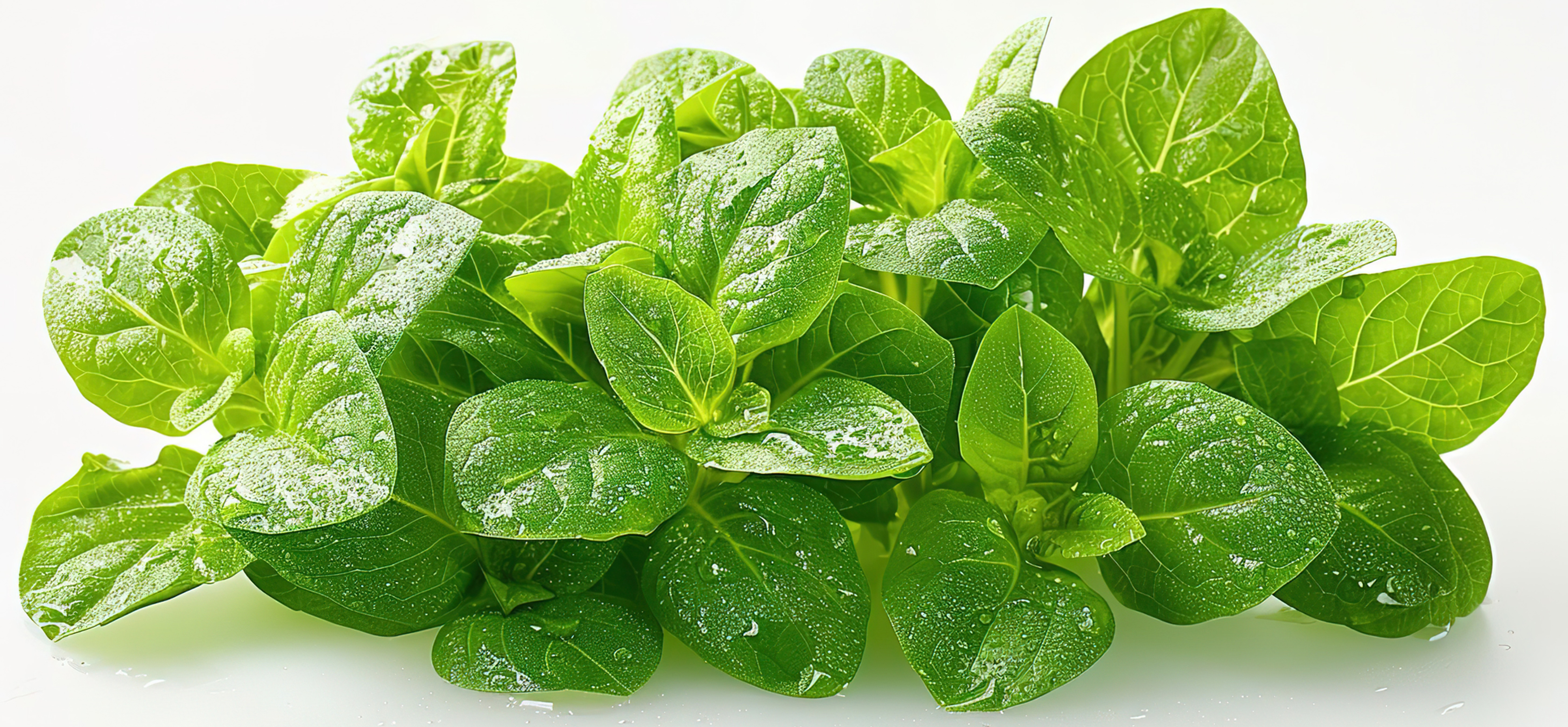
🌿 Standard / Crinkled Leaf Sissoo Spinach — glossy, rounded to heart-shaped foliage with the characteristic wrinkled texture associated with the plant commonly called Brazilian Spinach.
🌿 Long Leaf Sissoo Spinach — the same general edible groundcover type in our collection, but with noticeably longer, narrower foliage that gives the planting a softer, more flowing landscape texture.
We currently treat Long Leaf as a horticultural selection or leaf form, rather than claiming it as a separate species or formally registered cultivar.
And that distinction matters — because the botanical story behind Sissoo Spinach is surprisingly complicated.
1.) Classic Crinkled leaves of Sissoo, 2.) Elongated edible leaves of the Long Leaf Cultivar
🌿 Quick Facts: Sissoo Spinach
Category | Details |
Best Botanical Treatment | Alternanthera ‘Sissoo’ |
Common Trade Name | Alternanthera sissoo |
Common Names | Sissoo Spinach, Brazilian Spinach, Brazil Spinach, Sabu Spinach, Samba Lettuce |
Plant Family | Amaranthaceae |
GreenDreams Forms | Standard / Crinkled Leaf + Long Leaf |
Plant Type | Frost-tender perennial edible groundcover |
Typical Height | About 8–12 in. |
Maintained Height | Approximately 6–10 in. with regular harvesting/pruning |
Typical Spread | Approximately 20–40 in.; stems may continue outward where allowed |
Growth Habit | Low, mounding, spreading and node-rooting |
Foliage | Glossy green; Standard form crinkled/heart-shaped; Long Leaf form elongated |
Evergreen or Deciduous? | Evergreen in warm, frost-free conditions; not truly deciduous |
Best Outdoor Climate | Tropical/subtropical; especially reliable in Zones 10–11 |
Zone 9 | Grow as a protected perennial; frost can damage or kill exposed foliage |
Colder Zones | Warm-season crop, container plant or overwintered indoor/greenhouse specimen |
Best Light | Partial shade, filtered sun or morning sun |
Full Sun? | Possible with sufficient moisture, but intense summer sun can reduce leaf size and tenderness |
Water | Consistent moisture with good drainage |
Soil | Organic-rich, fertile and moisture-retentive without staying waterlogged |
Spacing | 12–18 in. for fast fill; 18–24 in. for more defined patches |
Propagation | Extremely easy from stem cuttings and rooted nodes |
Seed | Cultivated Sissoo commonly produces little or no viable seed |
Primary Harvest | Tender leaves, shoots and soft stem tips |
Flavor | Mild, fresh and green |
Texture | Crisp to lightly succulent; generally much less mucilaginous than Malabar Spinach |
Florida Harvest | Strongest spring through fall; potentially much longer in protected warm sites |
Best Landscape Role | Edible groundcover, living mulch, understory crop, bed edging and container spiller |
Primary Caution | Contains oxalates; larger portions are better cooked |
🌱 WHY AREN’T MORE PEOPLE GROWING THIS?
That may be the most appropriate question for Sissoo Spinach.
It solves several garden problems at the same time.
Instead of growing a plant solely because it covers bare soil, you can grow one that also produces food.
Instead of fighting summer to keep cool-season spinach alive, you can change the crop.
Instead of leaving the ground beneath a young fruit tree as bare mulch, you can eventually establish a productive edible layer.
Instead of growing another ornamental spiller in a patio container, you can grow something you can actually harvest.
Top reasons we love Sissoo Spinach:
🥗 Edible leaves and tender shoots
🔥 Excellent warm-season productivity
🌿 Dense groundcover habit
✂️ Cut-and-come-again harvesting
🌱 Extremely easy propagation
🏡 Beautiful enough for ornamental landscapes
🌳 Excellent potential beneath open-canopy edible plantings
🪴 Fantastic container plant
💧 Helps keep soil shaded
🌾 Useful in regenerative and food-forest systems
For edible landscaping, this combination is difficult to beat.
🌿 STANDARD SISSOO vs. LONG LEAF SISSOO
These are best understood as two expressions of the same horticultural idea.
Standard / Crinkled Leaf Sissoo
This is the form most people recognize as Brazilian Spinach.
The foliage is:
Glossy
Medium green
Rounded to somewhat heart-shaped
Slightly succulent
Strongly wrinkled, crinkled or undulating
When grown densely, it creates an almost quilted green carpet.
It is especially attractive beneath tropical fruit trees, bordering a pathway or spilling across the edge of a planter.
Long Leaf Sissoo
Our Long Leaf form has:
Longer foliage
Narrower leaves
A smoother visual texture
A slightly more flowing appearance
The same general low, spreading landscape function
From a design perspective, Long Leaf feels a little lighter.
Standard Sissoo creates texture.
Long Leaf creates movement.
Which one should you grow?
Why choose?
Planting the two near each other can create subtle foliage variation while maintaining essentially the same landscape function.
For collectors, edible landscapers and people who simply appreciate unusual plants, growing both is especially fun.
A PLANT WITH A COMPLICATED BOTANICAL PASSPORT
Here is where Sissoo Spinach gets interesting.
For years, nurseries and gardeners have commonly used the botanical name:
Alternanthera sissoo
Major botanical authorities now associate that name with Alternanthera sessilis.
But horticultural authorities studying the familiar cultivated Sissoo form have also pointed out that it differs substantially from typical wild A. sessilis.
For that reason, one of the more useful modern treatments is:

Alternanthera ‘Sissoo’
That wording recognizes what gardeners actually grow without pretending the taxonomic question has been completely resolved.
It also helps explain why photographs online can be confusing.
Search for Alternanthera sessilis and you may see plants that look surprisingly different from the glossy, crinkled Sissoo found in tropical edible gardens.
Is Brazilian Spinach actually from Brazil?
The answer is more complicated than the common name suggests.
The accepted A. sessilis complex has an enormous tropical and subtropical distribution including portions of:
Tropical America
Brazil
Mexico
The Caribbean
India
Sri Lanka
Southeast Asia
Southern China
Northern Australia
Pacific regions
The exact origin and early distribution of the particular cultivated ‘Sissoo’ clone is much less clearly documented.
So while “Brazilian Spinach” is an excellent and widely recognized common name, it should not be interpreted as proof that this exact cultivated form originated exclusively in Brazil.
Sometimes plants travel faster than their paperwork.
🌎 A LEAFY VEGETABLE WITH A GLOBAL FOOD HISTORY
Plants associated with the Alternanthera sessilis group have been eaten for generations across several tropical cultures.
That makes this much more interesting than a novelty “spinach substitute.”
🇱🇰 Sri Lanka — Mukunuwenna
In Sri Lanka, Alternanthera sessilis is known as Mukunuwenna and is an established leafy vegetable crop.
One of the classic preparations is mallung, in which finely chopped greens are combined with ingredients such as:
🥥 Coconut
🌶️ Chile
🧅 Onion or shallot
🌿 Herbs and spices
🍋 Lime
Different households prepare it differently, but the basic idea is brilliant:
Take a highly productive leafy plant and turn it into a flavorful everyday vegetable.
🇮🇳 South India — Ponnanganni
In southern India and Tamil culinary traditions, related A. sessilis greens are commonly known as Ponnanganni Keerai.
Young shoots and leaves are prepared as cooked greens, stir-fries and other vegetable dishes.
Traditional medicine systems have also attributed many health properties to the plant.
Those traditions are culturally important, but they should be understood as ethnobotanical history rather than proof that the plant treats or prevents disease.
🇧🇷 Brazil
The cultivated Sissoo type is strongly associated with Brazil in modern horticultural literature.
Tender leaves may be used fresh in salads or cooked as a leafy vegetable.
And that may be one reason the plant became so successful internationally:
It does not require a complicated culinary learning curve.
If you know what to do with spinach, lettuce, chard or tender Asian greens, you already have plenty of ways to use Sissoo.

🥗 WHAT DOES SISSOO SPINACH TASTE LIKE?
This may be its strongest selling point.
Some tropical leafy vegetables are incredibly productive but require growers to adapt to:
Very strong flavors
Tough leaves
Bitter notes
Mucilaginous textures
Sissoo is comparatively approachable.
Flavor
Expect:
Mild
Fresh
Green
Slightly vegetal
Occasionally faintly bitter depending on growing conditions and plant selection
Texture
Young leaves are:
Crisp
Tender
Lightly succulent
Pleasantly juicy
It does not normally have the pronounced slippery texture associated with Malabar Spinach.
That makes Sissoo one of the easiest tropical greens to introduce to people accustomed to conventional salad greens.
🍽️ WHICH PARTS DO YOU HARVEST?
The primary edible portions are:
🌿 Young leaves
✂️ Tender shoot tips
🌱 Soft young stems
The plant is not grown for fruit.
Small flowers may occur, but cultivated Sissoo is primarily a vegetatively propagated leafy crop and commonly produces little or no viable seed.
Best eating quality
Harvest young growth regularly.
Older patches can develop:
Smaller leaves
More fibrous stems
Coarser texture
Increased pest pressure
Less uniform growth
This is one plant where harvesting is part of the maintenance program.

✂️ THE SECRET TO REALLY GOOD SISSOO:
PRUNE IT
Growers sometimes assume a groundcover should simply be allowed to spread forever.
Sissoo performs better with management.
Research examining Brazilian Spinach pruning found that maintaining several stem internodes substantially affected plant architecture, yield and eating quality.
A very useful practical method:
Once plants are established:
Select vigorous stems.
Harvest the tender upper portion.
Leave approximately 3–4 healthy nodes/internodes on the lower stem.
Allow those nodes to produce new lateral shoots.
Rotate your harvest throughout the patch rather than cutting everything at once.
A published trial found that leaving approximately three internodes produced excellent regrowth and yield, while plants maintained with four internodes scored particularly well in sensory evaluation.
That gives home gardeners something more useful than “trim occasionally.”
Think:
HARVEST → BRANCH → REGROW → HARVEST AGAIN
Frequent harvesting keeps Sissoo:
🌿 Lower
🌿 Denser
🌿 Younger
🌿 More attractive
🥗 More tender
🥗 3 EASY SISSOO SPINACH RECIPES
1. 🥥 Sissoo Coconut Mallung-Inspired Greens
A Florida-grown interpretation inspired by Sri Lankan leafy-green preparations.
Ingredients
4 cups chopped Sissoo leaves and tender shoots
½ cup unsweetened shredded coconut
2 tablespoons finely chopped shallot
1 small chile, finely sliced
1 clove garlic, minced
Pinch turmeric
Salt
Squeeze of lime
Method
Lightly wilt the Sissoo in a skillet.
Add coconut, shallot, chile, garlic and turmeric.
Cook briefly until everything is just tender.
Finish with salt and fresh lime.
Serve with:
🍚 Rice
🫘 Beans or lentils
🐟 Fish
🥚 Eggs
2. 🧄 5-Minute Garlic Sissoo Spinach
This may be the easiest introduction to the plant.
Ingredients
4 cups tender Sissoo leaves
1 tablespoon olive, avocado or coconut oil
2–3 garlic cloves
Salt
Black pepper
Fresh lemon or lime
Method
Heat oil.
Add garlic briefly.
Add Sissoo.
Toss just until wilted.
Season and finish with citrus.
That is it.
Serve anywhere you would normally use sautéed spinach.
3. 🥭 Tropical Sissoo + Mango Salad
Best with young tender leaves and moderate fresh portions.
Ingredients
2 cups young Sissoo leaves
1 mango - your preference of ripe or green
Thinly sliced red onion
Cucumber
Toasted cashews
Fresh cilantro
Lime juice
Olive oil
Pinch of salt
Toss immediately before serving.
The crisp foliage works beautifully against sweet mango and citrus.
For larger quantities of Sissoo, cooking is recommended because the leaves naturally contain oxalates.
🌿 NUTRITIONAL & PHYTOCHEMICAL PROFILE
The broader Alternanthera sessilis group has attracted increasing research interest because its leaves contain a diverse mixture of nutrients and phytochemicals.
Studies have reported:
🥬 Protein
🦴 Calcium
⚡ Potassium
🌱 Phosphorus
🌿 Iron
🍊 Vitamin C
✨ Vitamin E
🧡 Carotenoids
🌿 Polyphenols
🌱 Amino acids
A 2026 nutritional analysis also found that leaves contained considerably more protein and minerals than stems in the material evaluated.
That fits what gardeners already understand:
This is primarily a LEAF crop.
The youngest, best-managed foliage is what you are trying to produce.
🌱 PERENNIAL vs. ANNUAL — WHY THIS MATTERS
This concept is especially important for Florida gardeners.
An annual vegetable
Typically:
Germinates
Grows
Produces
Flowers or declines
Dies within one growing cycle
Think lettuce or conventional spinach.
A perennial vegetable
Can survive for multiple growing seasons when conditions are suitable.
Instead of repeatedly starting from seed, you maintain an established root system and harvest new growth again and again.
Sissoo is a tropical or frost-tender perennial.
That qualifier matters.
It may behave like a long-lived evergreen groundcover in warm climates but like a seasonal annual in colder regions.

🌎 USDA ZONE GUIDE
USDA zones measure average annual extreme minimum winter temperature.
They do not measure:
Summer heat
Humidity
Rainfall
Soil drainage
Wind
Microclimate
So think of the zone number as one piece of the puzzle.
🌿 Zone 11
Examples include some of the warmest portions of:
Florida Keys
Extreme South Florida microclimates
Very limited warm coastal locations elsewhere
Sissoo performance:
Excellent perennial potential.
Growth may continue through winter when temperatures remain warm.
🌿 Zone 10
Examples include:
South Florida
Portions of coastal Southern California
Some warm Gulf and South Texas microclimates
Sissoo performance:
Generally excellent as a perennial.
Occasional cold events may temporarily slow growth.
🌿 Zone 9
Examples include significant portions of:
Central Florida
Gulf Coast Florida
Coastal and southern Texas
Southern Louisiana
Coastal Mississippi and Alabama
Warm portions of Arizona and California
Sissoo performance:
This is where the word frost-tender matters.
In a protected Zone 9 microclimate it may persist successfully for years.
But freezing weather can damage foliage or kill exposed growth.
Use:
Heavy mulch around the root zone
Protected south-facing locations
Tree-canopy microclimates
Frost protection
Backup cuttings
🌿 Zones 8 and Colder
Do not automatically rule Sissoo out.
Change the strategy.
Grow it as:
🪴 A container plant
☀️ A summer annual
🏡 A porch plant
🌱 A plant you propagate each autumn
💡 An indoor grow-light crop
🌿 A greenhouse perennial
One established plant can provide plenty of material for overwintering cuttings.
❄️ IS SISSOO SPINACH DORMANT IN WINTER?
Not really.
This is different from a fig or mulberry.
Sissoo does not have a strong programmed deciduous dormancy where winter leaf drop is expected.
Instead:
Warm temperatures = growth.
Cool temperatures = slower growth.
Frost = potential foliage injury.
Hard freezing = serious damage or loss.
In frost-free locations it can remain evergreen.
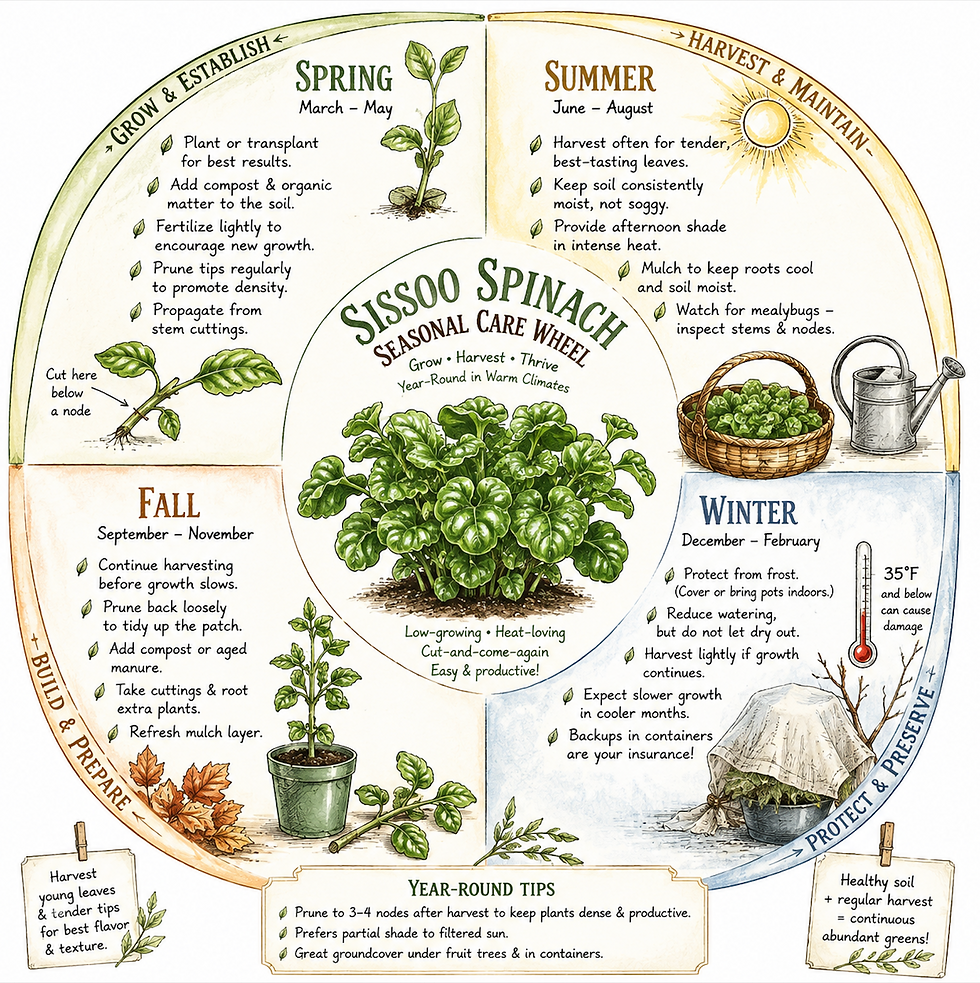
🗓️ FLORIDA SEASONAL CARE WHEEL
🌱 SPRING — WAKE IT UP
Spring is ideal for:
Planting
Propagating
Dividing patches
Fertilizing lightly
Rejuvenation pruning
Establishing new groundcover areas
As temperatures rise, growth accelerates quickly.
☀️ SUMMER — HARVEST MODE
This is where Sissoo earns its place.
While lettuce and conventional spinach struggle, Sissoo can be producing aggressively.
Focus on:
💧 Consistent moisture
✂️ Frequent harvesting
🌿 Partial afternoon protection
🌱 Compost and soil biology
🐛 Regular pest scouting
Do not confuse “heat-loving” with “drought-loving.”
It appreciates moisture.
🍂 FALL — BUILD YOUR INSURANCE POLICY
Keep harvesting while warm weather continues.
Before winter:
Root extra cuttings
Establish a backup container
Reduce overly sprawling growth
Refresh mulch
Identify your warmest microclimate
This is especially useful in Zone 9.
❄️ WINTER — PROTECT THE ROOTS
Before forecast frost:
Move containers indoors or under protection
Cover in-ground plants
Protect from wind
Keep roots mulched
Avoid heavy fertilization before freezes
If foliage burns:
Do not immediately assume the plant is dead.
Wait for warmer weather before deciding how much material needs to be removed.
☀️ HOW MUCH SUN DOES SISSOO WANT?
This is another feature that makes the plant particularly useful.
Many vegetables demand full sun.
Sissoo does not.
Sweet spot:
🌤️ Bright filtered light
🌅 Morning sun
🌳 Open tree canopy
🏡 Afternoon shade
Research and horticultural references consistently place Sissoo around semi-shade or approximately 50% shade for excellent foliage quality.
It can grow with direct sunlight.
But intense Florida summer sun can result in:
Smaller leaves
Frequent midday wilting
Tougher foliage
Increased water demand
If your goal is tender leafy production, blazing reflected afternoon heat is rarely the ideal site.
🌳 ONE OF THE BEST USES: UNDER FRUIT TREES
This is where Sissoo gets exciting.
Imagine a young:
🥭 Mango
🍊 Citrus
🍒 Barbados Cherry
🍈 Guava
🖤 Jaboticaba
🍌 Banana planting
Instead of seeing nothing beneath it except bare mulch, you create another productive layer.
Sissoo can function as the low layer while the fruiting plant occupies the canopy.
Benefits can include:
Shading exposed soil
Producing food
Softening the planting visually
Reducing open niches where weeds establish
Catching fallen organic matter
Creating another layer of biological activity
But leave space immediately around the trunk of woody plants.
We never recommend piling wet vegetation or mulch against tree trunks.
🌿 ORNAMENTAL VALUE
Even if Sissoo were not edible, it would still be useful.
The foliage has a polished tropical appearance.
Standard Sissoo
Creates:
Bold texture
Crinkled leaves
Dense glossy coverage
Long Leaf Sissoo
Creates:
Finer texture
Longer foliage
A softer visual transition
Use them:
🌿 Along pathways
🌿 Under small trees
🌿 At the front of tropical borders
🌿 Around raised beds
🌿 Beneath taller perennial vegetables
🌿 In wide planters
🌿 Along patio edges
🌿 Between larger edible shrubs
The goal is a landscape that looks intentional — not simply a vegetable garden hidden in the backyard.

📏 SPACING
For rapid ground coverage
Plant approximately:
12–18 inches apart
The plants will knit together relatively quickly under favorable conditions.
For distinct plants
Use:
18–24 inches apart
This allows you to see individual mounds longer.
Remember:
Sissoo stems can root when nodes touch moist soil.
The real question is not always:
“How wide will one plant get?”
It may eventually become:
“How much of the bed are you willing to give it?”
✂️ HOW TO CONTROL THE SPREAD
Fortunately, Sissoo is easy to prune.
Edge your patch regularly.
Cut runners before they enter:
Walkways
Other crop crowns
Drainage areas
Natural areas
Beds where you do not want them
Because detached stems root easily, do not casually discard fresh pieces into moist areas where establishment is unwanted.
Manage it like a productive crop, not an abandoned groundcover.
🪴 GROWING SISSOO IN CONTAINERS
Sissoo is excellent in pots.
In fact, containers may be the best option for gardeners outside its reliable perennial range.

Choose width over extreme depth.
A broad:
3-gallon
5-gallon
7-gallon
Window box
Patio bowl
Hanging basket
can create a large harvestable canopy.
Soil
Use a high-quality organic potting medium that:
Holds moisture
Drains freely
Contains organic matter
Does not collapse into anaerobic mud
Container watering
Check containers frequently during summer.
Sissoo has a shallow root system and leafy plants can move considerable amounts of water.
Hot containers may require daily watering.
Small pots dry especially quickly.
🏡 CAN SISSOO BE GROWN INDOORS?
Yes.
But “indoors” needs to mean bright indoors.
Best situations include:
☀️ Bright sunroom
🌿 Greenhouse
💡 Strong grow lights
🏡 Very bright south- or west-facing exposure
Indoor problems usually come from:
Insufficient light
Overwatering
Poor airflow
Pest buildup
Warm dry air
If growth becomes long and thin, increase light and prune.
🌱 HOW WE LIKE TO PLANT: HIGH & TIGHT
At GreenDreams, we generally encourage a High & Tight planting approach.
That principle is especially important for woody fruit trees, but the drainage concept applies to herbaceous crops too.
For Sissoo:
Dig a hole only slightly wider than the root ball.
Do not dig unnecessarily deep.
Place the plant at the same grade it was growing in the pot — or just slightly high in areas with drainage concerns.
Never bury the crown beneath several inches of soil.
Backfill firmly enough to eliminate large air pockets without compacting the soil into concrete.
Water thoroughly.
Top-dress rather than burying amendments deeply.
Our preferred soil-building approach may include:
🌿 Finished compost
🌑 Biochar
🌱 Appropriate organic nutrients
🪨 Mineral amendments where appropriate
We frequently use azomite and related amendments within larger soil-building programs, but mineral products should complement — not replace — good soil structure and organic matter.
MULCH
Finish with hardwood mulch.
Keep mulch:
✅ Across the surrounding soil
❌ Away from the immediate crown and woody trunks of companion plants
The purpose is to create a moist, biologically active soil surface — not a permanently wet stem base.
💧 WATERING SISSOO SPINACH
Newly planted
Keep the root zone consistently moist during establishment.
Do not allow a recently transplanted plant to repeatedly wilt hard.
Established in-ground plants
Water according to:
Soil type
Rainfall
Shade
Temperature
Root competition
Florida sand may require more frequent irrigation than a moisture-retentive organic soil.
The target:
Moist — not stagnant.
Sissoo enjoys moisture.
It can still develop root problems in poorly drained, constantly saturated potting soil.
Best irrigation
Drip or low-volume irrigation is ideal.
Benefits include:
💧 Water applied directly to roots
🌿 Drier foliage
🌱 Less evaporation
🍄 Reduced duration of leaf wetness
If overhead watering is necessary, morning is preferable to keeping foliage wet through the night.
🌱 DOES SISSOO NEED FERTILIZER?
Not necessarily much.
In rich soil with steady compost inputs, plants may grow vigorously without frequent packaged fertilizer.
But this is a leafy crop.
If you want leaves, nitrogen matters.
Useful feeding program
During active growth:
Add finished compost
Use gentle organic nitrogen when needed
Feed lightly after major harvests
Watch the plant rather than feeding blindly
A light feeding approximately every 6–8 weeks during vigorous growth is reasonable where plants need it.
Signs plants may need nutrition:
Pale foliage
Reduced vigor
Very small new leaves
Weak regrowth following harvest
Before adding fertilizer, also rule out:
Root rot
Cold soil
Overwatering
Drought
Excessive shade
Not every yellow leaf means “add fertilizer.”
🌾 ORGANIC GROWING + REGENERATIVE GUILD IDEAS
Sissoo is particularly well suited to layered systems.
Think vertically.
Upper canopy
Fruit trees
Mid layer
Shrubs and perennial vegetables
Herbaceous layer
Basil, ginger, turmeric and flowering herbs
Ground layer
Sissoo Spinach
That creates far more biological activity than maintaining every tree in an isolated circle of bare mulch.
Useful companions can include:
🌳 Fruit trees with reasonably open canopies
🌿 Pigeon Pea
🌺 African Blue Basil
🌻 Mexican Sunflower where sufficient room is available
🌺 Blue Porterweed nearby for pollinator habitat
🌱 Ginger and turmeric
🥬 Okinawan Spinach
🌿 Longevity Spinach
🍠 Other managed edible ground-layer plants
The point is not that one “magical companion plant” repels every pest.
Good ecological design creates:
Diverse root systems
Continuous soil cover
Organic matter
Beneficial insect habitat
Multiple harvest layers
🐛 TROUBLESHOOTING SISSOO SPINACH
Problem | Most Likely Causes | What To Do |
Midday wilting | Intense sun, heat or dry soil | Check soil moisture; add afternoon shade if needed |
Constant wilting | Root stress or severe moisture deficit | Inspect root zone and drainage |
Yellow leaves | Root stress, excess moisture, low nutrition or old foliage | Check drainage first, then fertility |
Small/tough leaves | Old patch, excessive sun, drought or low fertility | Prune hard enough to stimulate young growth |
Long/leggy stems | Too much shade or inadequate pruning | Increase filtered light and harvest regularly |
Chewed leaves | Caterpillars, slugs or other chewing insects | Scout frequently and identify before treatment |
White insects beneath leaves | Possible whiteflies | Improve airflow and use an integrated pest-management approach |
Stem/root decline | Saturated soil or root rot | Improve drainage and reduce watering frequency |
Cold-burned foliage | Frost | Protect before future freezes; prune after damage becomes clear |
Patch spreading too far | Rooting runners | Edge regularly and remove unwanted rooted stems |
🐛 ORGANIC PEST MANAGEMENT
The most reliable organic pest management strategy begins before a pesticide bottle is opened.
1. IDENTIFY THE PEST
Look beneath leaves.
Check growing tips.
Inspect at night for slugs.
2. REMOVE HEAVILY INFESTED GROWTH
Sissoo regrows quickly.
Sometimes pruning is easier than repeatedly treating old foliage.
3. USE THE MOST TARGETED CONTROL POSSIBLE
Examples may include:
🐛 Bt products for appropriate caterpillars
🐌 Iron-phosphate slug baits where appropriate
🌿 Horticultural soaps for susceptible soft-bodied insects
💧 Strong water sprays for small infestations where practical
Always follow the product label, particularly on edible crops and regarding harvest intervals.
4. CREATE CONDITIONS FAVORING THE PLANT
Healthy plants tolerate occasional chewing far better than stressed plants.
🌱 SISSOO AS A LIVING MULCH
This term deserves some explanation.
A living mulch is a low plant used to perform some of the functions normally provided by dead organic mulch.
Sissoo can:
🌿 Shade soil
💧 Reduce direct sun hitting the soil surface
🌱 Occupy ecological space
🍂 Catch falling organic matter
🥗 Produce food at the same time
But living mulch does not completely replace wood mulch everywhere.
Young trees still benefit tremendously from deep organic mulch.
The best system may actually combine both:
FRUIT TREE + WOOD MULCH + MANAGED SISSOO GROUND LAYER
⚠️ IMPORTANT FOOD CAUTION: OXALATES
Like a number of leafy vegetables, Sissoo contains oxalic acid/oxalates.
That does not automatically make a plant unsafe.
Spinach, beet greens and other familiar foods also contain oxalates.
Practical approach:
🥗 Enjoy tender leaves raw in reasonable portions.
🍳 Cook larger servings.
🌿 Eat a diverse diet rather than relying on one green every day.
People who have been medically instructed to limit dietary oxalates should follow the advice of their healthcare professional.
⚠️ IMPORTANT IDENTIFICATION CAUTION
The genus Alternanthera contains numerous species and ornamental plants.
Do not assume every plant labeled:
“Alternanthera”
“Joyweed”
or
“Joseph’s Coat”
is your edible Sissoo Spinach.
Correct identification matters when eating plants.
⚠️ TAXONOMY + REGULATORY NOTE
Sissoo Spinach has an unusually complicated botanical history.
The plant is widely sold horticulturally under the name Alternanthera sissoo, while major taxonomic databases associate that name with Alternanthera sessilis.
Other horticultural authorities recognize the familiar cultivated Sissoo as morphologically distinct and use the name:
Alternanthera ‘Sissoo’
Because plant regulations may use botanical names rather than nursery trade names, growers should verify current federal, state and local restrictions before moving or propagating plants across jurisdictional boundaries.
GreenDreams will follow applicable plant-shipping regulations and current eligible destinations.
🌿 SISSOO vs. OTHER HEAT-LOVING “SPINACH” PLANTS
Plant | Habit | Texture | Best Feature |
Sissoo Spinach | Low groundcover | Crisp, tender | Edible living mulch |
Long Leaf Sissoo | Low groundcover | Crisp, tender | Finer ornamental texture |
Okinawan Spinach | Spreading | Tender | Purple-backed ornamental foliage |
Longevity Spinach | Spreading/mounding | Lightly succulent | Easy propagation + containers |
Malabar Spinach | Climbing vine | Succulent/mucilaginous | Vertical summer production |
Surinam Spinach / Waterleaf | Upright/spreading | Juicy | Heavy warm-season leaf production |
Chaya | Large shrub | Cooked leafy green | Perennial shrub architecture |
Katuk | Upright shrub | Tender young shoots | Productive shade-tolerant shrub |
This is why we do not look for ONE replacement for lettuce or spinach.
Warm-climate edible gardening works best when we build a collection of crops adapted to different landscape niches.
🌟 WHO SHOULD GROW SISSOO SPINACH?
Sissoo is especially useful for:
✅ Florida gardeners
✅ Tropical and subtropical food forests
✅ Homeowners wanting edible landscaping
✅ People with partial shade
✅ Container gardeners
✅ Growers tired of summer lettuce failures
✅ Plant collectors
✅ Small-space gardeners
✅ Regenerative landscape projects
✅ Families looking for approachable tropical greens
It may not be ideal for:
❌ Extremely dry landscapes without irrigation
❌ Direct heavy salt-spray environments
❌ Cold gardens without an overwintering strategy
❌ People who want a completely static groundcover
❌ Landscapes where spreading stems cannot be managed
❓ SISSOO SPINACH FAQ
Is Sissoo Spinach the same as regular spinach?
No.
True spinach is Spinacia oleracea.
Sissoo belongs to the Amaranthaceae family and is a warm-climate leafy vegetable used similarly in the kitchen.
Is Brazilian Spinach perennial?
Yes, under sufficiently warm conditions.
It behaves as a tropical frost-tender perennial rather than a cold-hardy perennial.
Can Sissoo Spinach survive Florida summer?
That is one of its biggest advantages.
It is particularly useful during warm weather when traditional spinach becomes difficult to grow.
Will Sissoo Spinach grow in Zone 9?
Yes, but winter protection can become important.
A warm microclimate, mulch, frost protection and backup cuttings greatly improve your odds.
Is Sissoo Spinach evergreen?
In frost-free warm climates, yes.
Cold weather may slow growth or damage foliage.
Does Sissoo Spinach need full sun?
No.
Partial shade is often better, particularly in Florida.
How much shade will Sissoo tolerate?
Bright filtered light or approximately 50% shade works particularly well.
Very deep shade may create weak, stretched growth.
Does Sissoo Spinach spread?
Yes.
Stems spread horizontally and may produce roots where nodes touch moist soil.
Is Sissoo invasive?
The cultivated Sissoo form commonly propagates vegetatively and should be actively managed.
Its nomenclature also overlaps with regulated A. sessilis, making correct identification and compliance particularly important.
Never intentionally release cultivated plants into natural areas.
Can I eat Sissoo Spinach raw?
Young tender foliage is traditionally eaten fresh in some regions.
Because the plant contains oxalates, larger servings are better cooked.
What does Sissoo Spinach taste like?
Mild, crisp, fresh and green.
Is Sissoo slimy like Malabar Spinach?
Generally no.
Its lack of heavy mucilage is one reason many growers find it especially approachable.
How often should I harvest it?
During vigorous warm-season growth, harvest frequently enough to maintain tender branching.
Rather than removing the entire plant, rotate your harvesting through different sections.
How tall does Sissoo Spinach get?
The cultivated Sissoo form usually stays around 8–12 inches tall.
Regularly harvested patches are commonly maintained around 6–10 inches.
Its more dramatic growth occurs horizontally rather than vertically.
Can Brazilian Spinach grow indoors?
Yes, provided it receives strong light.
A dim windowsill is generally not enough for maximum production.
How do I propagate Brazilian Spinach?
Stem cuttings are the easiest method.
Include several nodes and keep the rooting medium warm and moist.
Does Brazilian Spinach grow from seed?
The familiar cultivated Sissoo commonly produces little or no viable seed.
Vegetative propagation is the dependable method.
What is the difference between Standard Sissoo and Long Leaf Sissoo?
The primary difference in our collection is foliage structure.
Standard Sissoo has the characteristic crinkled, broad foliage.
Our Long Leaf selection has narrower, elongated leaves and a finer landscape texture.
We currently treat Long Leaf as a horticultural selection rather than a separate botanical species.
🛒 SHOP SISSOO SPINACH AT GREENDREAMS
At GreenDreams, we grow both:
🌿 Standard / Crinkled Leaf Sissoo Spinach
🌿 Long Leaf Sissoo Spinach
Our online nursery currently offers both selections in:
🌱 Economy 4-inch starter plants
A great way to begin establishing your collection.
🌿 Established 1-gallon plants
A fuller plant with a more developed root system for gardeners wanting a stronger head start.
Availability changes seasonally.
We frequently have larger plants and additional varieties available exclusively through our retail nursery that are not practical to ship.
Check current inventory before visiting for specific sizes.

📍 VISIT GREENDREAMS NURSERY IN SPRING HILL, FLORIDA
Want to see these plants growing before deciding where they belong in your landscape?
Come shop with us in person.
GreenDreams Nursery & Farm
18709 Hwy. 41
Spring Hill, FL 34610
🕘 Tuesday–Friday: 9 AM–5 PM
🌞 Saturday: 8 AM–3 PM
Our retail nursery carries a much larger collection than what can practically be represented online, including:
🥭 Tropical + subtropical fruit trees
🥗 Perennial vegetables
🌺 Pollinator plants
🌿 Florida native species
🌳 Ecological landscape plants
🌱 Rare edible plants
🪴 Larger nursery sizes
If your goal is to turn more of your property into something beautiful, productive and ecologically useful, this is where the fun really begins.
🌳 WANT MORE THAN A PLANT? WE CAN HELP BUILD THE SYSTEM.

A Sissoo plant is easy to buy.
Knowing exactly where it should go within a whole property can be another matter.
GreenDreams provides ecological landscaping services throughout Florida for homeowners, farms, businesses and organizations that want landscapes capable of doing more.
🌿 CONSULTATIONS
We can walk your property with you and help evaluate:
Existing trees
Sun patterns
Drainage
Soil
Irrigation
Plant selection
Food-production opportunities
Native habitat
Pollinator needs
Long-term maintenance
Project priorities
🌳 CUSTOM DESIGN + INSTALLATION
Want a complete plan?
Our team designs and installs:
🥭 Edible landscapes
🌳 Food forests
🌺 Native + pollinator gardens
🥗 Kitchen gardens
🌱 Regenerative landscapes
🌿 Mixed edible + ornamental systems
We specialize in landscapes where every layer has a reason to exist.
🌾 PROJECT HELP + DAY LABOR
Already have a plan but need experienced hands?
We can provide project assistance for Florida growers who need help with:
🌳 Planting
🌿 Garden expansion
✂️ Landscape rejuvenation
🌱 Soil preparation
🚜 Larger garden projects
🚚 BULK PLANT + SOIL PRODUCT DELIVERY
Building something larger?
Ask us about delivery of:
🌳 Bulk plant orders
🌑 Biochar
🌿 Compost
🍂 Mulch
🌱 Garden and soil amendments
A productive landscape begins underground.


Comments