


🌿 Moringa Tree Growing Guide: How to Grow, Harvest & Use Moringa oleifera in Florida & Beyond

The “Tree of Life” That Helped Start GreenDreams
Before GreenDreams became a nursery filled with fruit trees, perennial vegetables, medicinal and useful plants, Florida natives, and edible landscape species from around the subtropical world…
there was Moringa.
Moringa oleifera was one of the very first plants that helped shape the direction of GreenDreams.

What caught our attention was not simply that Moringa was unusual.
It was the realization that one remarkably fast-growing tree could provide:
🥬 Repeated harvests of edible leaves
🌿 Tremendous amounts of plant biomass
🌸 Fragrant flowers that attract insects
🥘 Long edible “drumstick” pods
🌳 Light, filtered canopy
♻️ Material for chop-and-drop and composting
🌱 An introduction to perennial food production
It helped change the question we asked about landscaping.
Instead of simply asking:
“What will look good here?”
We began asking:
“What can this landscape actually do?”
Can it feed people?
Can it create habitat?
Can it produce useful materials?
Can it become more productive over time?
Can the yard itself become part of a resilient food system?
Moringa helped start that conversation for us — and it remains one of the most interesting edible trees for warm-climate growers willing to manage it properly.

🌿 Moringa Quick Facts
Category | Moringa Information | |
Botanical Name | Moringa oleifera | |
Family | Moringaceae | |
Common Names | Moringa, Drumstick Tree, Horseradish Tree, Ben Oil Tree, Tree of Life | |
Plant Type | Fast-growing tropical/subtropical edible tree | |
Online Sizes at GreenDreams | 4-inch starter plants and 1-gallon plants when available | |
Retail Nursery Sizes | Larger plants may be available seasonally at our Spring Hill nursery | |
Mature Height Unpruned | Approximately 15–35 ft. | |
Recommended Managed Height | Approximately 6–12 ft. for home harvesting | |
Growth Rate | Extremely fast during warm weather | |
Sun | Full sun preferred | |
Best In-Ground Climate | USDA Zones 10–11 | |
Zone 9 | Possible as a managed, cold-sensitive perennial with winter dieback risk | |
Zones 8 & Colder | Best treated as an annual, seasonal crop, or container plant overwintered indoors | |
Cold Tolerance | Frost sensitive; freezes can cause severe top dieback | |
Growth Habit | Upright, open, airy, fast-growing and highly responsive to pruning | |
Typical Spacing | Approximately 8–12 ft. for managed landscape plants | |
Soil | Adaptable, but excellent drainage is essential | |
Water Needs | Moderate during establishment; relatively drought tolerant once established | |
Evergreen or Deciduous? | Deciduous to semi-deciduous depending on climate, drought and winter temperatures | |
Container Friendly | Yes — especially when regularly pruned | |
Indoor Growing | Possible for overwintering; not ideal as a permanent low-light houseplant | |
Primary Harvests | Leaves, young pods and flowers | |
Main Limitation | Cold sensitivity + very rapid growth requiring pruning |
🌎 Where Does Moringa Come From?
Moringa oleifera is native to the northwestern Indian subcontinent, with its native range centered from northeastern Pakistan into northwestern India.
From South Asia, people carried and cultivated Moringa across tropical and subtropical regions of the world.
Today it can be found throughout parts of:
India
Southeast Asia
the Philippines
Africa
the Caribbean
Central America
South America
Florida
other warm regions of the Americas
Its global spread makes sense.
Moringa is exceptionally useful.
It grows quickly, tolerates seasonal drought once established, responds aggressively to pruning and produces edible vegetation during weather that is too hot for many traditional temperate vegetables.
In South Asia, the long pods became deeply embedded in regional cooking.
In the Philippines, the leaves — commonly known as malunggay — are used as a familiar leafy vegetable.
Across parts of Africa and other tropical regions, Moringa has been promoted as a food crop, small-farm resource, livestock feed ingredient and agroforestry species.
This is much more than a modern “superfood.”
For many cultures, Moringa has simply been food.
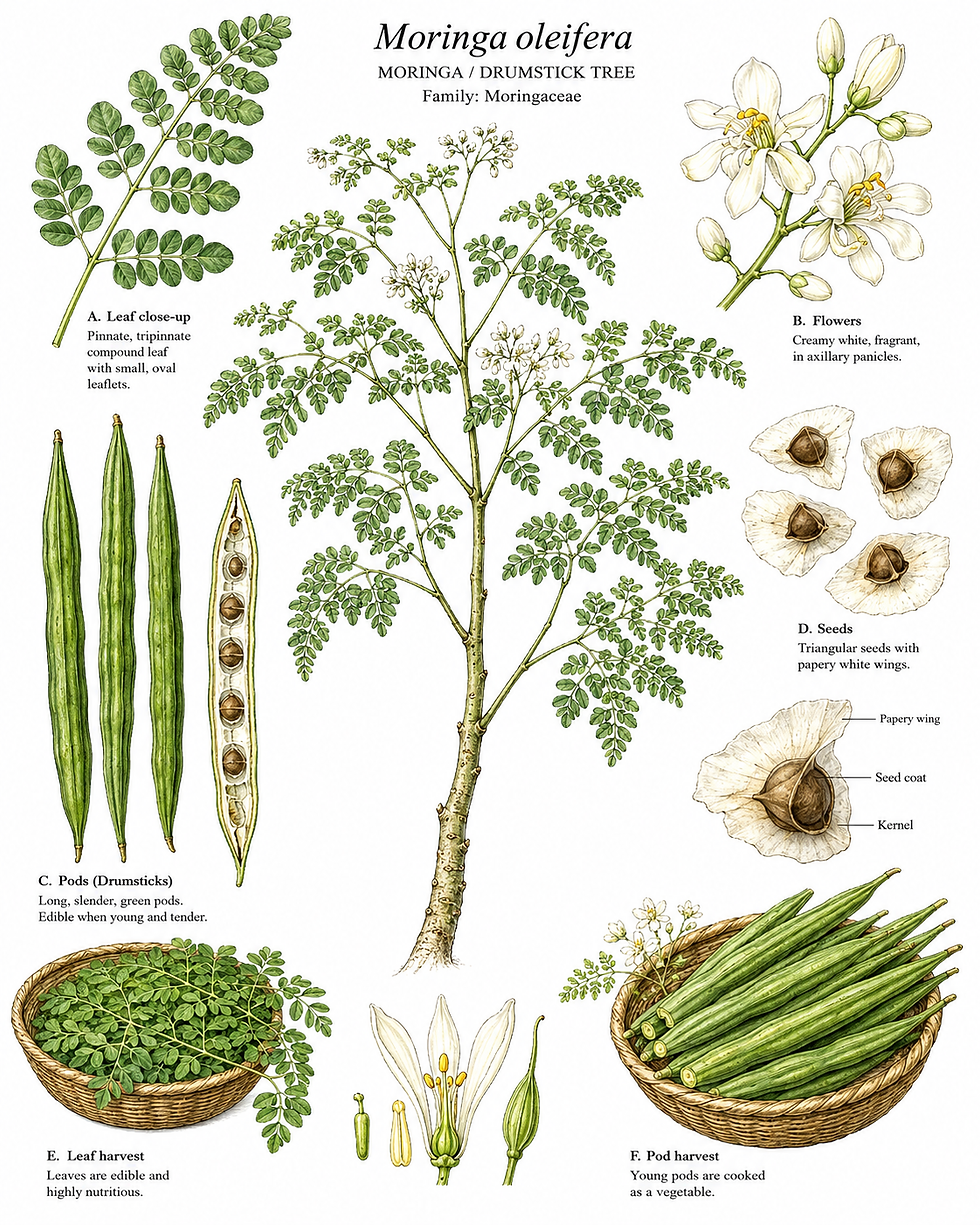
🌱 What Does a Moringa Tree Look Like?
Moringa has an appearance unlike most conventional North American fruit trees.
Its architecture is light and almost tropical-ferny.
🌿 Leaves
The leaves are large and compound, but they are divided into many small rounded or oval leaflets.
From a distance, this gives the canopy a soft, delicate texture.
The individual leaflets are:
Small
Green
Thin
Tender when young
Easy to strip from the leaf stems for cooking
Because the foliage is finely divided, sunlight filters through the canopy rather than creating extremely dense shade.
That characteristic can be useful in a managed edible landscape.

🌸 Flowers
Moringa produces clusters of small, fragrant flowers that are generally:
White to creamy white
Sometimes lightly yellowish
Delicately scented
Attractive to insect visitors
Flowering is strongest under warm conditions and can be prolonged in tropical climates.
🌾 The Famous “Drumstick” Pods
Once pollinated, the flowers can develop into long, narrow seed capsules.
These are the “drumsticks” that give Moringa one of its most recognizable common names.
Young pods are harvested while:
Green
Relatively tender
Still easy to cut
Before the outer shell becomes extremely woody and fibrous
As the pods mature, they become increasingly tough and eventually dry around winged seeds.
🌳 Trunk & Branch Structure
Moringa develops:
Relatively soft wood
Rapid vertical shoots
A light, open crown
Thickening trunks with age
Branches that respond vigorously to heading cuts
This is important for Florida landscapes.
Moringa should not be treated like a live oak or long-term structural shade tree.
Its rapid growth and softer wood mean we prefer growing it low and regularly managed, especially in hurricane-prone areas.

🍽️ What Does Moringa Taste Like?
🌿 Leaves
Moringa leaves have a distinctly green flavor.
Depending on leaf age and preparation, people describe them as:
Spinach-like
Green and vegetal
Slightly earthy
Mildly bitter
Slightly pungent
Young growth is generally more tender.
Cooking softens the flavor.
🌾 Young Pods
Young drumstick pods are mild and vegetable-like.
They are sometimes compared with:
Asparagus
Green beans
Artichoke-like vegetable flavors
The important distinction:
The outer pod becomes increasingly fibrous with age.
Traditional dishes often cook sections of pod until tender enough that the inner pulp can be scraped or sucked away from the tougher shell.
Do not expect a mature drumstick pod to eat like a snap bean.
🌸 Flowers
Flowers have wasabi/horseradish flavor and can be used in small quantities in cooked dishes.
🌱 How Big Does Moringa Get?
This is one of the most important expectations to understand before planting.

Unpruned Moringa
Given enough warmth, water and time, an unmanaged tree can reach approximately:
15–35 feet tall
The problem is not simply height.
Unpruned Moringa frequently becomes:
Tall
Narrow
Leggy
Sparse lower down
Difficult to harvest
More vulnerable to wind damage

Managed Moringa
For most homeowners, we prefer:
6–12 feet tall
A frequently harvested tree can be maintained even lower.
The goal is not to see how tall you can grow Moringa.
The goal is to create:
a dense, accessible food-producing framework.
✂️ The Secret to Growing Great Moringa: PRUNE IT
If there is one Moringa-growing lesson worth remembering, it is this:
Harvesting and pruning are part of the same system.
Moringa naturally responds to cutting by producing new shoots.
Professional production systems use:
Topping
Heading cuts
Coppicing
Pollarding
Repeated harvest pruning
to keep productive growth within reach.
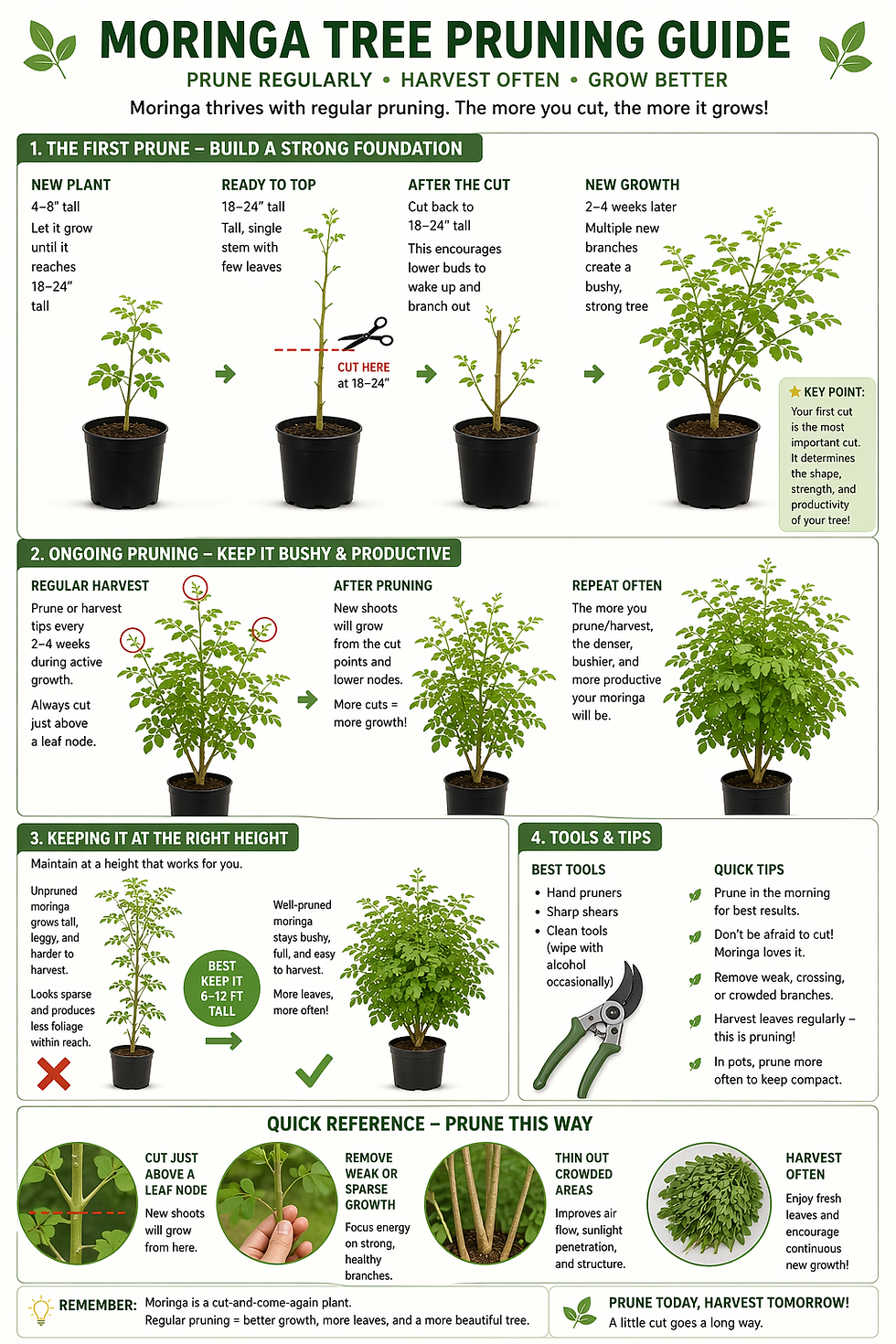
✂️ How to Prune Moringa
Young Plants
When a young Moringa becomes established and starts producing strong vertical growth, begin tip-pruning rather than allowing one stem to race upward indefinitely.
Once the plant reaches roughly 30–36 inches, growers can begin encouraging lateral branching.
You do not necessarily need to make one dramatic cut at exactly 30 inches.
The principle matters more:
Remove the dominant vertical tip → encourage multiple lower branches.
Established Plants
As new branches extend:
Tip-prune actively growing shoots
Harvest whole tender shoots periodically
Thin crowded interior branches
Remove broken growth
Remove crossing branches
Reduce overly vigorous vertical leaders
For a backyard leaf-production tree, repeated pruning at approximately chest to head height can make harvesting dramatically easier.
Coppicing
Moringa can regenerate after being cut substantially lower.
This makes it useful for intensive biomass or leaf production.
A hard regenerative cut can be useful when a plant has become:
Too tall
Bare at the bottom
Wind damaged
Poorly structured
Allow several vigorous new shoots to develop, then selectively retain the strongest framework.
Pollarding
Another option is to develop a permanent trunk and repeatedly cut back new branches from an established framework.
This can create a compact “harvest tree.”
⚠️ One Important Pruning Rule
Do not repeatedly allow the tree to reach 20–30 feet and then make enormous emergency cuts.
It is much easier on:
You
The tree
Your equipment
Your surrounding landscape
to keep up with Moringa while the growth is young.
Small cuts frequently are better than massive corrective cuts later.
🌞 Sunlight: Where Should You Plant Moringa?
Moringa performs best in:
Full sun
Aim for approximately 6–8+ hours of direct sunlight whenever possible.
More sun generally supports:
Faster growth
Denser leaf production
Better flowering
Stronger structure
Greater pod potential
Light afternoon shade can be tolerated, especially in extremely hot climates, but heavy shade usually creates poorer growth.
🚫 Where NOT to Plant Moringa
Avoid:
❌ Permanently wet areas
❌ Low spots that hold water after storms
❌ Heavy shade
❌ Areas directly below power lines
❌ Tight spaces beside buildings where pruning will be difficult
❌ Locations where a 15–30 ft. unmanaged tree would create problems
❌ Wetland edges or unmanaged natural areas
❌ Locations where mature seed pods will be allowed to drop unnoticed
For Florida homeowners, we prefer Moringa in the actively managed edible portion of the property, not the unmanaged ecological perimeter.
📏 Moringa Spacing
For a regularly pruned backyard specimen:
Approximately 8–12 feet between plants
provides a practical starting point.
Plants can be maintained more closely in intensive leaf-production systems, but spacing them farther apart provides:
Better airflow
Easier harvesting
Better light penetration
Easier pruning access
More room for companion plants
If you intend to let your Moringa develop into a larger tree, provide considerably more room.

USDA Growing Zones: Where Can Moringa Actually Survive?
USDA hardiness zones describe average annual extreme minimum temperatures.
They do not tell you everything about a climate.
Humidity, rainfall, soil drainage, heat, wind and microclimates all matter.
For Moringa, winter temperature is still one of the biggest limitations.
🌴 USDA Zones 10–11: BEST
Examples include parts of:
South Florida
Florida Keys
Warm coastal Southwest Florida
Lower Rio Grande Valley of Texas
Warm coastal Southern California
These areas provide the strongest opportunity for Moringa to behave as a long-term perennial tree.
Occasional cool weather can still trigger leaf drop.
🌿 USDA Zone 9: POSSIBLE — BUT EXPECT WINTER DAMAGE
Examples include portions of:
Central Florida
North-central Florida
Gulf Coast Texas
Louisiana
Mississippi
Alabama
other warm Gulf-region microclimates
Moringa can grow spectacularly during the warm season in Zone 9.
The challenge comes in winter.
A frost can damage foliage.
A harder freeze can kill stems back substantially.
Established root systems may return from lower portions of the plant when warm weather returns, but survival is never guaranteed after a severe freeze.
Think of Zone 9 Moringa as a:
cold-tender, dieback perennial rather than a bulletproof evergreen tree.
That expectation prevents a lot of confusion.
🌾 USDA Zone 8
Examples include portions of:
North Florida
Georgia
Alabama
Mississippi
Texas
coastal Carolinas
Moringa can grow extremely quickly during summer.
However, reliable permanent outdoor survival becomes much less predictable.
We generally suggest:
Grow it as an annual or overwinter it in a container.
❄️ Zones 7 & Colder
Grow Moringa as:
A warm-season annual
A large seasonal container plant
A greenhouse crop
A plant moved into protected winter storage
The upside?
Moringa grows so quickly that gardeners outside the subtropics can still enjoy substantial summer leaf h
harvests.
🪴 Growing Moringa in Containers
Moringa is remarkably adaptable to container culture.
In fact, containers provide several advantages:
Easier height control
Easier winter protection
Easier relocation
Reduced volunteer seedlings
Excellent option outside Zones 9–11
Container Progression
A reasonable progression might be:
1 gallon → 3 gallon → 7 gallon → 15–25+ gallon
Do not jump a small plant into an enormous water-retentive container unless you are confident about irrigation.
Overpotting can keep the root zone wet for too long.
Best Container Soil
Use a mix that is:
Fast-draining
Aerated
Structurally stable
Moderately rich in organic matter
Moringa dislikes constantly saturated roots.
Drainage holes must remain open.
Container Watering
During Florida summer, containers may require inspection every day.
But:
Checking daily does not mean watering automatically every day.
Feel the root zone.
Water thoroughly when necessary, then allow excess water to leave the container.
❄️ How to Overwinter Moringa in Cold Climates
Gardeners well outside Moringa’s natural climate can still keep plants for multiple years.
Before serious frost:
Prune the plant to a manageable height.
Move the container into a protected location.
Give it the brightest light available.
Use supplemental grow lighting if natural light is inadequate.
Reduce irrigation significantly as growth slows.
Do not leave the pot sitting in water.
Expect some yellowing or leaf drop.
Resume stronger watering and feeding once warm spring growth returns.
Possible locations include:
Heated greenhouse
Bright sunroom
Protected porch where temperatures remain safely above freezing
Indoor room with strong grow lights
Moringa is not an ideal low-light houseplant.
Its goal indoors is often survival until warm weather returns — not maximum winter growth.
🍂 Is Moringa Evergreen?
The most accurate answer is:
It depends on the climate.
Moringa can behave as:
Deciduous
Semi-deciduous
Nearly evergreen in favorable tropical conditions
Leaf loss can be triggered by:
Cold
Frost
Drought
Seasonal stress
In Central Florida, winter thinning or complete leaf loss should not automatically be interpreted as plant failure.
🌱 Moringa: Perennial vs. Annual
A perennial is a plant that lives for multiple years.
An annual completes its useful life cycle within one growing season.
Moringa is biologically a perennial tree.
But climate changes how gardeners use it.
South Florida:
Long-term perennial.
Central Florida:
Cold-sensitive perennial with possible winter dieback.
Northern United States:
Often grown functionally as an annual unless overwintered.
This distinction is important.
The same plant can behave very differently in Miami, Spring Hill, Atlanta and Chicago.
🌱 GreenDreams Planting Method
Good planting starts with one fundamental rule:
Do not plant too deep.
This applies to fruit trees and many of the other woody edible plants we grow.
Step 1: Choose the Location
Look for:
☀️ Full sun
💧 Good drainage
🌿 Plenty of room for future growth
✂️ Easy access for pruning and harvesting
Step 2: Dig the Hole
Dig a hole:
Only slightly wider than the existing root ball
No deeper than the root ball
Do not create a deep planting pit.
Step 3: Plant High & Tight
Position the plant so the existing root crown remains at natural grade or slightly high where drainage is a concern.
Never bury the trunk.
Planting too deeply can promote:
Poor oxygen exchange
Excessive stem moisture
Root stress
Rot problems
Step 4: Backfill Firmly
Use the surrounding soil to eliminate major air pockets around the root ball.
We want good soil-to-root contact.
Do not bury the plant in an isolated pocket of extremely rich material surrounded by completely different native soil.
Step 5: Top-Dress
Depending on the site, GreenDreams commonly incorporates soil-building materials such as:
🌱 Quality compost
⚫ Biochar
🪨 Mineral amendments such as azomite where appropriate
🌿 Organic nutrients
We prefer building the soil biologically rather than relying on heavy synthetic feeding.
Step 6: Mulch
Add a generous mulch layer around the root zone.
Hardwood mulch can:
Moderate soil temperature
Reduce moisture loss
Suppress weeds
Feed soil organisms
Slowly return organic matter to the soil
Keep mulch away from direct contact with the trunk.
No mulch volcanoes.
🎥 Learn the GreenDreams Planting Method
Our fruit-tree planting video demonstrates the same “High & Tight” philosophy we use throughout many of our edible landscape installations.
Recommended internal link: GreenDreams “High & Tight” Planting Video
💧 How to Water Moringa
Moringa is often called drought tolerant.
That is true after establishment.
It does not mean a newly planted tree should be abandoned without water.
Newly Planted Moringa
During establishment:
Water thoroughly after planting
Monitor the root ball closely
Keep the soil evenly moist but never waterlogged
Increase frequency during hot, windy weather
Reduce irrigation during extended rain
Florida’s sandy soil can dry rapidly.
Heavy clay soils present the opposite problem.
Irrigation should respond to the actual soil — not a rigid calendar.
Established Moringa
Once well rooted:
Deep watering is preferable to frequent shallow sprinkling
Allow some drying between irrigation
Increase water during prolonged drought
Reduce or stop supplemental watering during extended wet weather
An established tree can tolerate considerable dryness.
However:
Drought survival and maximum leaf production are not the same goal.
Trees grown for repeated leafy harvest perform better when they receive reasonable water during dry periods.
🌧️ Florida Summer Watering
Summer often presents the opposite problem:
too much water.
When thunderstorms are already saturating the soil:
🚫 Do not keep running irrigation automatically.
Moringa can suffer badly in chronically wet root zones.
🌿 Fertilizing Moringa Organically
Moringa is not an especially difficult plant to feed.
Start with:
Healthy soil
Compost
Mulch
Organic matter
Appropriate mineral balance
During active growth, a light balanced organic fertilizer can support repeated harvesting.
For Leaf Production
Moderate nitrogen supports vegetative growth.
Useful inputs may include:
Compost
Worm castings
Organic granular fertilizer
Compost extracts when appropriate
Well-managed chop-and-drop biomass
For Flowers & Pods
Constantly forcing luxurious nitrogen-heavy growth is not always desirable if your goal is pod production.
Instead focus on:
Full sun
Good plant maturity
Balanced nutrition
Adequate potassium
Consistent but not excessive water
Pollinator activity
A soil test is always more useful than blindly adding fertilizer.
Zone 9 Fall Fertilizing
As winter approaches, avoid aggressively pushing tender new growth immediately before frost season.
Reduce strong nitrogen applications as cool weather approaches.

🌿 Moringa Seasonal Care Wheel — Florida
Season | What to Expect | What to Do |
🌱 Spring | Dormant plants awaken; rapid shoots begin | Remove confirmed dead wood after major freeze danger passes; compost; mulch; begin irrigation as needed |
☀️ Summer | Maximum vegetative growth and repeated harvesting | Tip-prune, harvest frequently, monitor containers closely, reduce irrigation during heavy rain |
🌾 Fall | Continued growth while temperatures remain warm | Continue harvesting; begin reducing aggressive fertilizer; harvest pods before unwanted seed dispersal |
❄️ Winter | Slower growth, yellowing, leaf drop or freeze dieback | Protect young plants; reduce irrigation; avoid panic-pruning immediately after freezes |
❄️ What Should You Do After Frost Damage?
After a freeze, Moringa foliage may become:
Black
Brown
Limp
Dry
Completely defoliated
Do not assume the root system is dead.
In Zone 9:
Wait.
Allow the weather pattern to stabilize.
Once warmer conditions return, inspect stems.
Scratch a small section of bark.
Green tissue underneath indicates living wood.
Prune back to healthy growth after the danger of repeated hard freezes has largely passed.

Harvesting Moringa Leaves
Young and mature leaves can both be harvested.
For regular production:
Select healthy green shoots.
Harvest tender branch tips or whole compound leaves.
Strip the smaller leaflets from tougher stems.
Wash thoroughly.
Use promptly or preserve appropriately.
Frequent harvesting doubles as structural pruning.
📅 Moringa Harvest Season
Florida
Leaves:
Primarily spring through fall, with harvest potentially continuing much longer in frost-free South Florida.
Flowers:
Warm-season flowering; timing varies considerably with climate, pruning and rainfall.
Pods:
Typically produced during sustained warm weather after flowering. Fruiting timing varies greatly by location and tree maturity.
Colder States
Expect most production during:
Late spring → summer → early fall
Cold climates may produce abundant leaves but have insufficient warm-season length for heavy pod crops.
🌸 Fruiting & Pod Production
Moringa flowers are bisexual and the species is capable of some self-pollination, so one tree may produce pods.
However, Moringa commonly outcrosses.
Bees and other insect visitors help move pollen between flowers and plants.
For strong pod production:
☀️ Provide full sun
🌸 Encourage pollinators
✂️ Avoid repeatedly removing every flowering branch
💧 Avoid severe drought during flowering
🌿 Maintain balanced fertility
🌱 Grow more than one genetically different plant where pod production is a priority
Remember:
A tree managed aggressively for continuous leafy shoots may produce fewer pods than one allowed to flower and mature.
Decide what you want.
Leaf tree or drumstick tree?
You can balance both, but management changes the outcome.

🍲 How Moringa Is Used Around the World
🇮🇳 India
The long pods are famously used in:
Sambar
Dal
Vegetable curries
Coconut-based dishes
Soups and stews
Moringa leaf preparations are also widespread.
🇵🇭 Philippines
Known as malunggay, Moringa leaves are commonly incorporated into:
Soups
Broths
Vegetable dishes
Chicken and seafood preparations
Leafy mixed dishes
🌍 Africa
Moringa leaves are used fresh, cooked and dried in multiple regional food traditions.
Leaf powders have also been investigated as nutrient-dense food ingredients.
🌴 Caribbean & Tropical Americas
Moringa is increasingly grown as:
Leafy vegetable
Tea plant
Food-forest crop
Multipurpose backyard tree
🍲 3 Moringa Recipes to Try
Recipe 1: 🌿 Garlic-Sautéed Moringa Leaves
Ingredients
3–4 cups fresh Moringa leaflets
2–3 cloves garlic
1 tablespoon olive or coconut oil
Salt to taste
Optional chili flakes
Optional sliced onion
Directions
Strip leaflets from coarse stems.
Wash thoroughly and drain.
Sauté garlic and onion briefly.
Add Moringa leaves.
Cook approximately 2–4 minutes until wilted.
Season lightly.
Serve alongside:
Eggs
Rice
Beans
Grilled vegetables
Fish
Curry dishes
Recipe 2: 🥘 Moringa Leaf Dal
Ingredients
1 cup lentils
2–3 cups fresh Moringa leaves
Onion
Garlic
Ginger
Turmeric
Cumin
Tomato
Salt
Water or stock
Directions
Cook lentils until tender.
Sauté onion, garlic, ginger and spices separately.
Add tomato and cook down.
Combine with lentils.
Add washed Moringa leaves near the end of cooking.
Simmer until tender.
Serve with rice or flatbread.
This is one of the easiest ways to let Moringa function as what it has traditionally been:
a vegetable.
Recipe 3: 🌾 Drumstick Coconut Curry
Ingredients
Young Moringa pods
Coconut milk
Onion
Garlic
Ginger
Turmeric
Curry spices
Tomato
Salt
Optional chili
Directions
Select green pods before they become extremely woody.
Wash and cut into approximately 2–3 inch sections.
Sauté aromatics and spices.
Add tomato.
Add coconut milk and pod sections.
Simmer until the interior of the pods is tender.
The cooked pod sections are traditionally eaten by removing or scraping the soft interior rather than swallowing tough mature shell fibers.
🥗 Nutritional Profile of Moringa Leaves
Moringa earned enormous attention because the leaves contain an unusual combination of:
Protein
Carotenoids
Vitamin C
Calcium
Iron
Potassium
Magnesium
Multiple amino acids
Polyphenols
Flavonoids
The concentrations vary significantly according to:
Growing conditions
Leaf age
Cultivar
Drying method
Storage
Preparation
That variability is why we avoid repeating sensational claims such as:
“X times more calcium than milk.”
Those comparisons often mix dry powders with fresh foods or compare completely different serving weights.
There is no need to exaggerate Moringa.
The plant is impressive enough on its own.
Moringa’s Interesting Phytochemistry
Researchers have identified numerous plant compounds in Moringa, including:
Glucosinolates
Including compounds associated with the characteristic Moringa chemistry.
Isothiocyanates
Produced when certain glucosinolates are enzymatically broken down.
Flavonoids
Including compounds such as:
Quercetin
Kaempferol derivatives
Phenolic compounds
Carotenoids
Tocopherols
These compounds are one reason Moringa continues to attract research interest.
🌿 Is Moringa Medicinal?
Moringa has a very long ethnobotanical history.
Different cultures have traditionally used various plant parts for a wide range of health-related purposes.
Modern laboratory, animal and preliminary human research has investigated possible:
Antioxidant activity
Anti-inflammatory pathways
Metabolic effects
Antimicrobial activity
Cardiovascular effects
Blood-glucose-related effects
But there is an important distinction:
Traditional use and laboratory activity do not automatically equal proven medical treatment.
Most proposed therapeutic applications require considerably more human clinical research.
We therefore prefer describing Moringa as:
a fascinating nutrient-dense food plant with a rich ethnobotanical history.
It should not be promoted as a cure or replacement for medical care.
⚠️ Important Moringa Consumption Cautions
Not every part of the plant should be treated interchangeably.
For routine home culinary use, we recommend focusing on the parts with strong traditional food use:
✅ Leaves
✅ Young pods
✅ Traditionally prepared flowers
Use more caution with:
⚠️ Concentrated extracts
⚠️ Supplements
⚠️ Large amounts of seeds or seed products
⚠️ Bark
⚠️ Roots
Roots and bark contain biologically active compounds and should not be casually promoted as ordinary vegetables.
People who are:
Pregnant
Breastfeeding
Taking prescription medication
Managing chronic medical conditions
should discuss concentrated Moringa supplements or medicinal preparations with a qualified healthcare professional.
2026 Food-Safety Update: Moringa Powder
This is important current information for anyone researching Moringa online.
During 2025–2026, FDA and CDC investigations identified multiple Salmonella outbreaks associated with certain recalled commercial Moringa powders and capsules containing imported Moringa leaf powder.
This does not mean a living Moringa tree is inherently contaminated.
Instead, it highlights an important principle:
Dried leaf products are foods — and food handling matters.
If drying your own Moringa:
Start with clean leaves
Wash appropriately
Use clean equipment
Dry rapidly and thoroughly
Prevent contamination during drying
Store completely dried material in clean containers
Discard material showing mold or moisture problems
Buying a living tree gives growers the advantage of knowing exactly how their leaves were produced and handled.
🌾 Moringa Beyond Food: Industry & Agroforestry Uses
Few plants have been investigated for as many different uses.

🌰 Ben Oil
Moringa seeds contain a high-quality oil historically known as ben oil.
Uses have included:
Culinary applications
Cosmetics
Soap
Lubrication
Personal-care products
Industrial research
💧 Water Clarification Research
Moringa seeds contain proteins capable of helping suspended particles aggregate together.
This has led to extensive research into Moringa-based water clarification.
However:
Home Moringa seed treatment is not a substitute for certified drinking-water purification.
Clarifying water does not automatically guarantee removal of all microorganisms or chemical hazards.
🐐 Livestock & Fodder Research
Moringa foliage has been investigated as livestock feed because of its rapid biomass production and nutrient profile.
♻️ Biomass
Repeated pruning generates substantial:
Leaves
Tender stems
Woody material
Organic matter
This material can become:
Compost
Chop-and-drop
Mulch feedstock
Nutrient cycling material
🌳 Moringa in a Food Forest
Moringa fits best as a highly managed productive species.
It can provide:
🌿 Edible leaves
🌸 Flowers
🌾 Pods
✂️ Biomass
🌤️ Filtered shade
But it should not automatically be treated as an ecological restoration tree.
In Florida especially, responsible management matters.
⚠️ Important Florida Ecological Note
UF/IFAS currently classifies Moringa oleifera as High Invasion Risk for North, Central and South Florida and does not recommend unrestricted landscape planting.
For people who choose to grow Moringa as a managed food crop, we strongly recommend:
Harvesting pods before they dry and split
Preventing seeds from spreading
Pulling volunteer seedlings
Keeping trees away from natural areas
Avoiding waterways and conservation edges
Keeping plants close to actively maintained portions of the property
Considering containers where appropriate
This is another reason we emphasize:
Moringa is a management plant.
Harvest it.
Prune it.
Control seed production.
Use it intentionally.
🌿 Moringa Companion Planting & Food-Forest Guild Ideas
A Moringa guild can include multiple functional layers.
🌾 Possible Support Plants
Pigeon Pea
Fast-growing legume producing:
Edible peas
Flowers
Biomass
Nitrogen-fixing associations
Sweet Potato
Useful for:
Groundcover
Weed suppression
Edible greens
Edible roots
Turmeric
Thrives beneath partial filtered summer canopy.
Ginger
Another useful warm-season understory crop.
Lemongrass
Useful as:
Aromatic crop
Dense clumping grass
Biomass source
Pollinator Plants
Use regionally appropriate flowering species — especially Florida natives — around rather than beneath the tree to increase ecological function.
A Simple Moringa Guild
Upper layer: Moringa
Shrub/support layer: Pigeon pea
Herb layer: Turmeric + ginger
Ground layer: Sweet potato
Edge: Native pollinator flowers + lemongrass
Now the planting is doing more than producing one crop.
It becomes a system.
🚫 Plants to Avoid Crowding Against Moringa
Do not place major permanent fruit trees extremely close to Moringa if both will compete for the same canopy space.
Remember:
Moringa grows astonishingly fast.
Give your:
Mango
Avocado
Citrus
Mulberry
Jaboticaba
Sapodilla
Other long-term fruit trees
enough space to become the permanent structure of the landscape.
Moringa is better used as a managed supporting crop rather than allowed to dominate the entire site.
🐛 Organic Moringa Troubleshooting Guide
Problem | Likely Cause | What to Do |
🍂 Yellow Leaves | Excess water, cold, seasonal leaf drop, nutrient stress | Check soil moisture first; do not automatically fertilize |
💧 Wilting + Wet Soil | Root-zone oxygen problems | Reduce irrigation and improve drainage |
🌿 Tall, Bare Growth | Insufficient pruning | Head back stems and begin regular tip pruning |
🌱 Tiny/Slow Growth | Cold temperatures, shade, root problems | Increase warmth/light and inspect drainage |
❄️ Black Leaves After Frost | Freeze injury | Wait for warm weather, then prune confirmed dead tissue |
🐛 Chewed Leaves | Caterpillars/other foliage feeders | Hand-pick where practical; identify pest before treating |
🪲 Sticky Leaves | Aphids, whiteflies or scale insects | Inspect undersides; use water spray or labeled organic controls |
🕷️ Fine Speckling/Webbing | Spider mites, especially on stressed container plants | Improve plant vigor and use properly labeled controls |
🍄 Leaf Spots | Humidity + fungal/bacterial organisms | Improve airflow; avoid unnecessary overhead watering |
🌧️ Sudden Decline During Rainy Season | Root rot/root stress | Stop unnecessary irrigation and evaluate drainage |
🐛 Organic Pest Management
Start with the least disruptive method.
Step 1: Identification
Do not spray simply because you see an insect.
Many insects are beneficial.
Step 2: Physical Controls
Try:
Hand removal
Pruning heavily infested shoots
Strong stream of water for aphids
Removing diseased foliage
Step 3: Biological Controls
Encourage:
🐞 Lady beetles
🕷️ Predatory arthropods
🐝 Diverse insect habitat
🦋 Pollinators
For confirmed caterpillar problems, appropriately labeled Bt products may be an option.
Step 4: Organic Sprays When Necessary
Possible products include properly labeled:
Insecticidal soap
Horticultural oils
Other OMRI-listed crop products
Always read the label.
Because you are eating Moringa leaves:
Pay particular attention to edible-crop labeling and pre-harvest instructions.
Do not spray open flowers while pollinators are actively visiting them.
🌿 Top Benefits of Growing Moringa
Why do growers continue to become fascinated with this tree?
1. Extremely Fast Production
You do not have to wait years for your first meaningful harvest.
2. Heat-Loving Leafy Food
Moringa grows during weather that sends lettuce and traditional spinach running for cover.
3. Multiple Edible Harvests
Leaves, pods and flowers provide different culinary opportunities.
4. Responds to Heavy Harvesting
Pruning can increase accessible new growth.
5. Excellent Container Candidate
Cold-climate growers can participate too.
6. Significant Biomass Production
Prunings can feed compost and garden systems.
7. Deep Cultural History
Moringa connects the gardener with food traditions spanning continents.
8. Strong Educational Value
Few trees demonstrate the possibilities of perennial food systems as dramatically.
🌟 Is Moringa Right for You?
✅ Moringa Is an Excellent Choice For:
🌿 Food-forest growers
🥬 Perennial vegetable enthusiasts
🌴 Warm-climate gardeners
🪴 Container gardeners
♻️ Regenerative growers
✂️ People comfortable pruning
🍲 Adventurous cooks
🌱 Homesteaders
☀️ Growers needing heat-tolerant food crops
❌ Moringa May Not Be Ideal For:
❄️ Growers expecting a cold-hardy tree
🌑 Deeply shaded properties
🌧️ Permanently wet sites
✂️ People unwilling to prune
🌳 People wanting a massive permanent shade tree
🌲 Unmanaged naturalized landscapes
🏞️ Florida conservation-area plantings

📦 Moringa Plants Available from GreenDreams
GreenDreams offers Moringa in multiple ways depending on current inventory.
🌱 4-Inch Moringa Starter Plants
An economical introduction for growers comfortable establishing younger plants.
Excellent for:
Florida
Warm-season planting
Experienced gardeners
Customers wanting lower shipping weight
🪴 1-Gallon Moringa Trees
Larger established root systems provide:
More plant mass
More stored resources
Faster visual impact
A head start toward harvesting
🌰 Moringa Seeds
We also periodically offer Moringa seed for growers who want to start their own plants.
🌳 Want a Bigger Moringa?
Visit our Spring Hill retail nursery.
Our in-person nursery inventory is much larger than what can realistically be shipped by UPS.
Depending on the season, customers may find:
Larger Moringa plants
Larger fruit trees
Perennial vegetables
Tropical edible plants
Florida native plants
Pollinator species
Rare fruiting plants
Landscape-sized specimens
Plants not listed online
Larger retail sizes vary according to season and current inventory.
🚚 Nationwide Plant Shipping
GreenDreams ships live plants through our online nursery across the continental United States via UPS.
Moringa is especially well suited for growers in:
🌴 Florida
☀️ The Southeast
🌵 Texas and warm Southwestern climates
Growers farther north can still order Moringa — but should understand the climate limitations and plan for:
Seasonal growing
Container culture
Indoor winter protection
Always consider your local temperatures before ordering a tropical plant.
📍 Visit GreenDreams Nursery & Farm
GreenDreams Nursery & Farm
18709 Hwy. 41
Spring Hill, FL 34610
Open to the Public
Tuesday–Friday: 9 AM–5 PM
Saturday: 8 AM–3 PM
Come explore our larger collection of:
🌳 Fruit trees
🌿 Perennial vegetables
🌺 Tropical edibles
🐝 Florida natives + pollinator plants
🌱 Medicinal and useful plants
🍊 Rare fruit species
♻️ Ecological landscape plants
🌎 Want More Than a Plant? We Can Help Build the Whole System.
GreenDreams is more than a nursery.
Our Florida team helps homeowners, growers, farms and landowners create functional landscapes that produce food while improving the surrounding ecology.
🌳 Consultations
Not sure what belongs where?
We can help evaluate:
Sun
Drainage
Existing trees
Soil
Irrigation
Microclimates
Plant selection
Food-forest structure
Orchard layout
Native habitat
Long-term maintenance
✏️ Ecological & Edible Landscape Design
We design:
🍊 Backyard orchards
🌿 Food forests
🥬 Kitchen gardens
🐝 Pollinator landscapes
🌳 Native/ecological landscapes
♻️ Regenerative properties
🌾 Small farms and production spaces
🌱 Installation
Want help turning the plan into reality?
Our team installs edible and ecological landscapes throughout Florida.
🌿 Project Day-Labor Assistance
Already have the vision but need experienced hands?
GreenDreams offers project labor for qualifying garden and landscape projects, including help with:
Planting
Mulching
Garden establishment
Plant relocation
Orchard work
General edible-landscape projects
🚚 Bulk Plant & Soil Deliveries
We can also help with larger projects through delivery of:
🌳 Bulk plant orders
🌿 Mulch
🌱 Compost
⚫ Biochar
🪨 Garden amendments
♻️ Other soil-building materials
❓ Moringa FAQ
Can Moringa grow in Florida?
Absolutely — but Florida is not one climate.
South Florida can grow Moringa as a long-term tropical/subtropical tree.
Central Florida growers should expect occasional winter leaf loss and possible freeze dieback.
North Florida should treat Moringa as substantially more cold-sensitive.
What USDA zone is Moringa?
Moringa performs most reliably as a permanent outdoor tree in Zones 10–11.
Zone 9 growers often succeed when they understand that winter dieback is possible.
Zones 8 and colder should generally grow Moringa seasonally or overwinter it under protection.
Will Moringa survive a freeze?
Sometimes the root system or lower trunk survives.
Sometimes it does not.
Freeze severity, duration, plant maturity, soil moisture and microclimate all influence the outcome.
Do not consider Moringa reliably freeze hardy.
How tall does a Moringa tree grow?
Approximately 15–35 feet if allowed to develop naturally.
For backyard production, we strongly prefer approximately 6–12 feet or even lower.
How fast does Moringa grow?
Extremely fast during warm weather.
Under good tropical or subtropical conditions, growth of several feet within one growing season is normal.
That speed is exactly why early pruning matters.
Can you keep Moringa small?
Yes.
Moringa responds exceptionally well to:
Tip pruning
Heading
Coppicing
Pollarding
Repeated harvest
A carefully managed plant can remain at an easy harvesting height for years.
Can Moringa grow in a pot?
Yes.
Container growing is one of the best approaches for people outside tropical climates.
Use a large container, excellent drainage and regular pruning.
Can you grow Moringa indoors?
Temporarily, yes.
Permanent indoor growing is considerably harder because Moringa wants intense light and warmth.
For cold-climate gardeners, indoor culture is best viewed as winter protection.
How often should Moringa be watered?
Water regularly during establishment.
Once established, allow the soil to dry moderately between deep waterings.
Never leave the root zone constantly saturated.
Why are my Moringa leaves turning yellow?
Common reasons include:
Overwatering
Cold weather
Seasonal leaf drop
Root stress
Nutrient deficiency
Shipping/transplant stress
Check water and temperature before reaching for fertilizer.
Why is my Moringa tall and skinny?
Usually:
Not enough pruning.
Remove the dominant vertical tip and begin encouraging multiple branches lower on the plant.
Why isn’t my Moringa producing pods?
Possible reasons include:
Plant is still young
Too much pruning
Insufficient sunlight
Lack of flowers
Poor pollinator activity
Environmental stress
Excessive vegetative growth
Short growing season
If pod production is your primary goal, allow some mature branches to flower instead of continuously harvesting every shoot.
Can I eat Moringa leaves raw?
Tender leaves are traditionally eaten both fresh and cooked, but cooking is extremely common and generally improves texture and moderates the green flavor.
As with any leafy vegetable, harvest from a correctly identified plant and wash thoroughly.
Are Moringa roots edible?
We do not recommend promoting Moringa roots as a routine home vegetable.
Roots and bark contain potent bioactive compounds and have a different safety profile from ordinary culinary leaf use.
For everyday cooking, focus on traditional food portions such as leaves and young pods.
Is Moringa invasive in Florida?
UF/IFAS currently rates Moringa oleifera as High Invasion Risk in Florida.
Growers choosing to cultivate it should manage mature pods and seedlings carefully and should not plant it where seeds can spread into natural areas.
When should I prune freeze-damaged Moringa?
Avoid immediately cutting everything after the first freeze.
Wait until you can determine which stems remain alive and until the likelihood of repeated hard freezes has diminished.
Then prune back to healthy tissue.
🌿 The GreenDreams Perspective
Moringa is not perfect.
It needs pruning.
It dislikes cold.
It dislikes waterlogged soil.
Florida growers should manage its seed production responsibly.
And despite decades of enthusiastic “miracle tree” marketing, it should not be promoted as medicine capable of curing everything.
None of that makes Moringa less extraordinary.
In many ways, understanding its limitations makes the plant more interesting.
Few trees can turn:
sun + warm weather + pruning
into so much useful plant material so quickly.
And that is exactly what fascinated us about Moringa in the beginning.
It helped GreenDreams start asking what a landscape could become when we stopped treating every plant as decoration and began designing around:
🌿 Food
🐝 Habitat
🌱 Soil
🍊 Diversity
♻️ Regeneration
🌎 Useful ecosystems
For us, Moringa was one of the plants that started it all.
Maybe it becomes the plant that starts something new in your garden too.
🌿 Grow With GreenDreams
Whether you’re starting with one Moringa tree or planning an entire edible landscape, we’re here to help you build something that becomes more productive, diverse and useful over time.
🌱 Shop Moringa plants online
🌰 Grow Moringa from seed
🌳 Visit our Spring Hill retail nursery for larger plants
🍊 Explore our complete fruit tree + perennial edible collection
🌿 Book an edible landscape consultation
✏️ Ask about design + installation
🚚 Order bulk plants, compost, mulch, biochar + soil amendments
GreenDreams Nursery & Farm
18709 Hwy. 41
Spring Hill, FL 34610
Tuesday–Friday: 9 AM–5 PM
Saturday: 8 AM–3 PM


Comments