


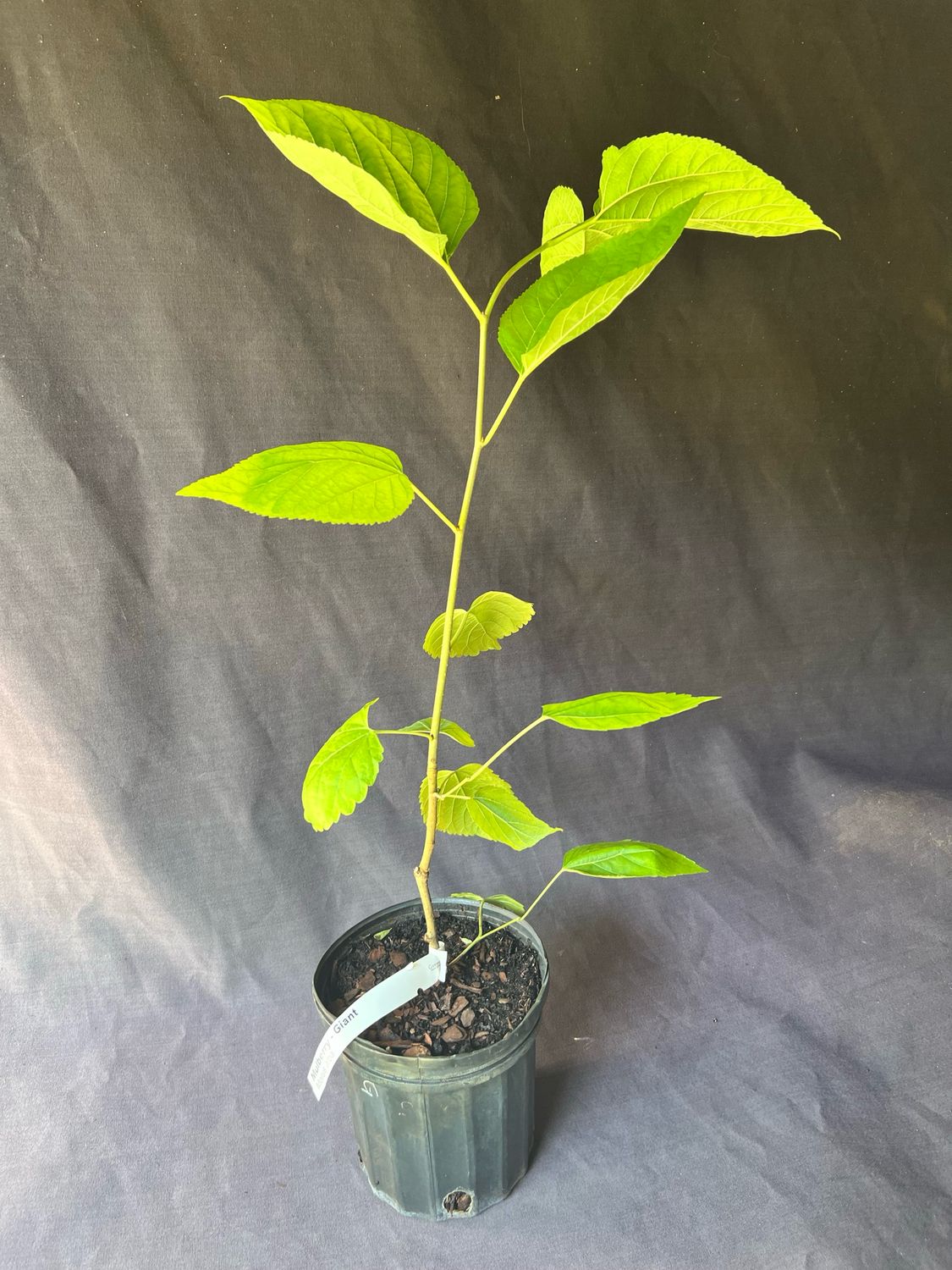
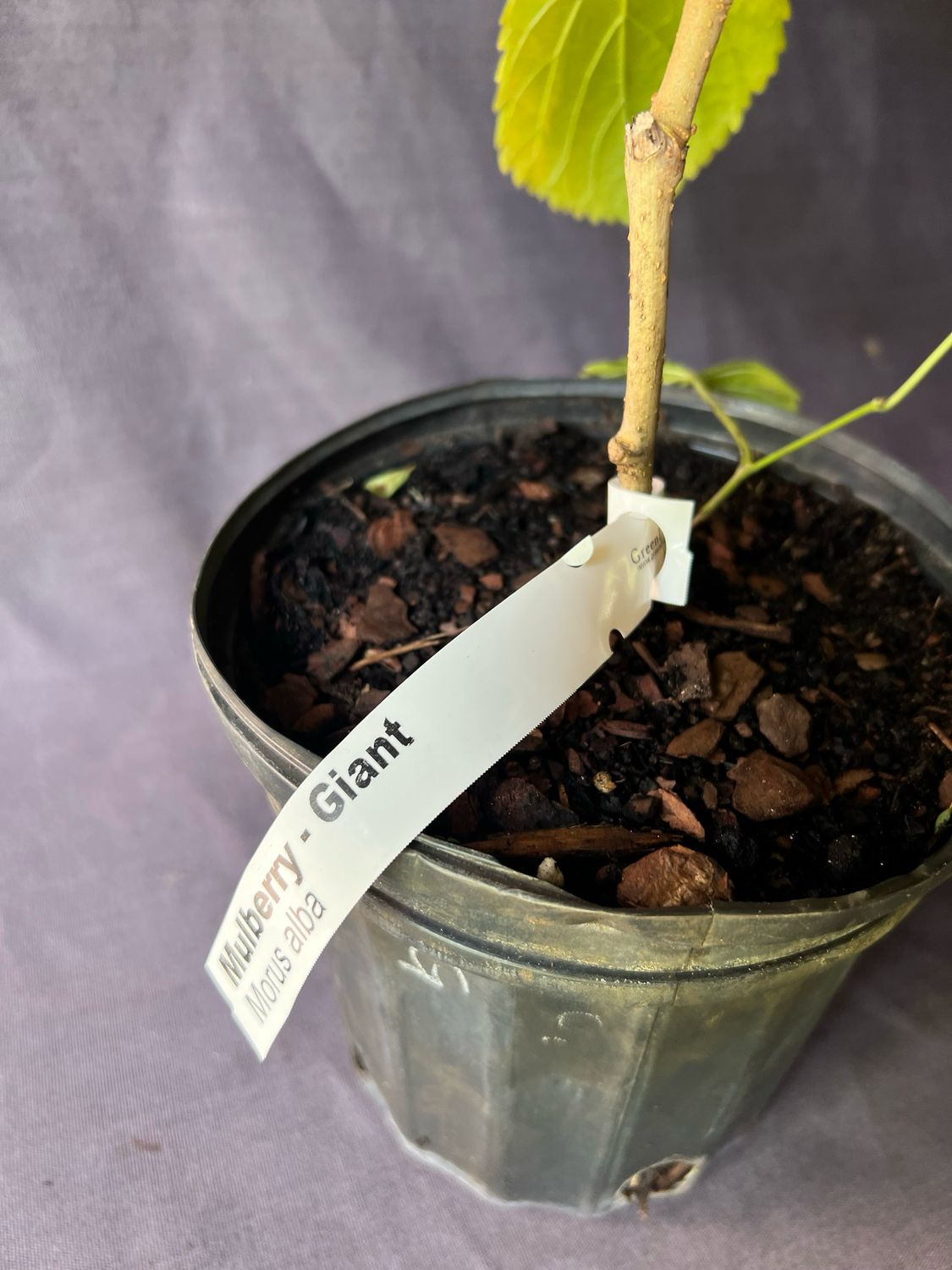
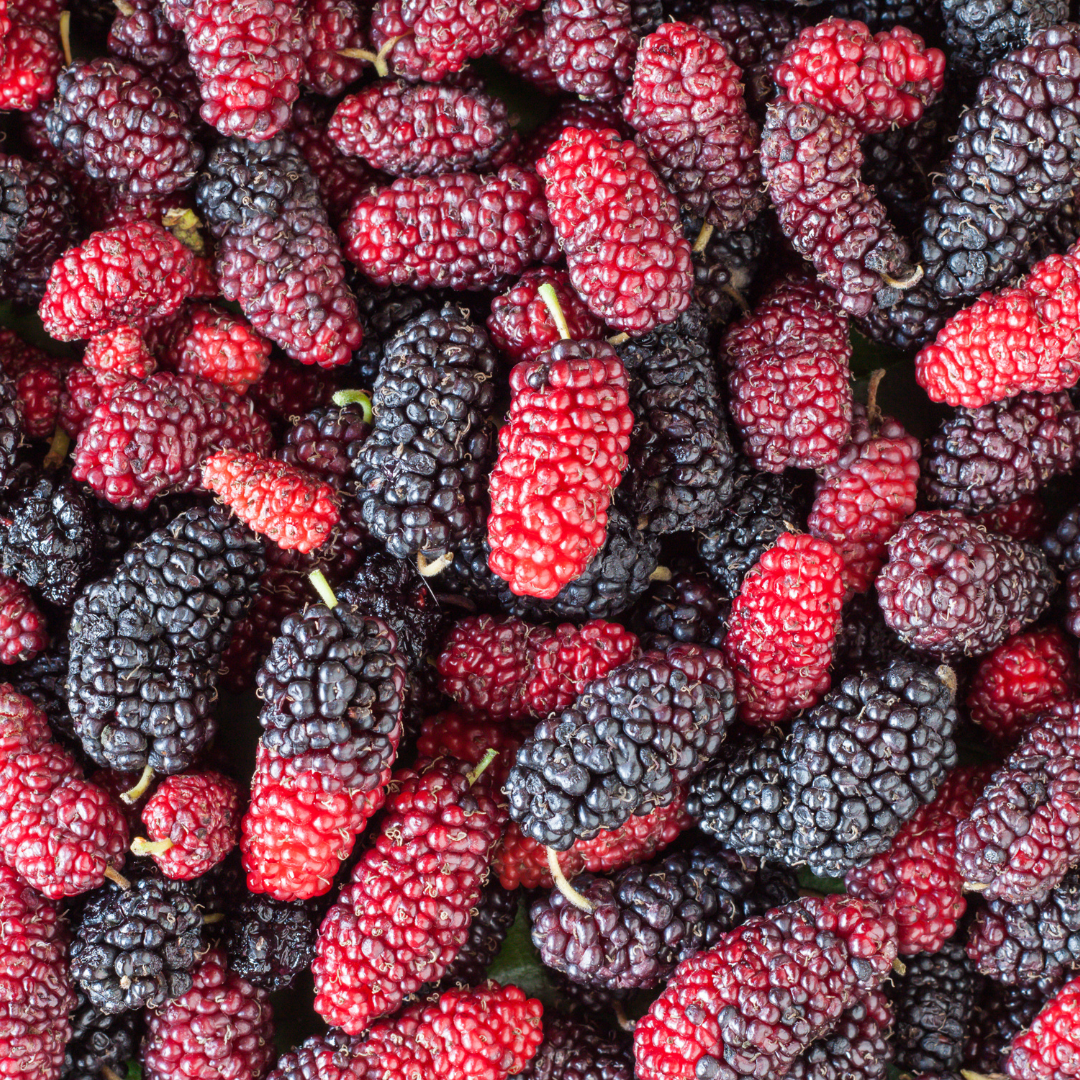
🍇 Giant Mulberry Tree — Oversized Florida Fruit, Fast Shade & Big Harvest Energy
Morus spp. ‘Florida Giant / Estero Giant’ | 1-Gallon Live Mulberry Tree
Long, juicy purple berries. Vigorous Florida growth. A productive edible shade tree that earns its space.
Some fruits simply do not work in the grocery-store system—and that is exactly why they are worth growing.
Giant Mulberry produces tender, juicy berries that are best when they are allowed to fully ripen on the tree, picked at peak softness, and eaten almost immediately. Add rapid growth, a broad leafy canopy, excellent response to pruning, and serious food-forest potential, and this becomes one of those plants that can change how a backyard feels in surprisingly little time.
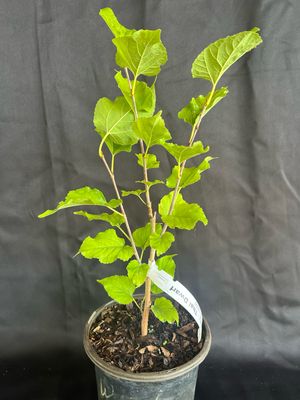
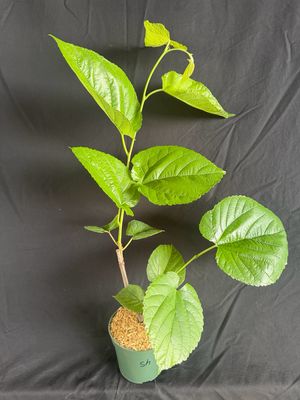
Our 1-gallon Giant Mulberry gives growers a more established starting point than a small starter plant while remaining practical for UPS Ground shipping.
For Florida, the Gulf Coast, the Southeast, and warm parts of Texas, this is an especially useful combination of fruit tree + seasonal shade + wildlife value + fast biomass production.
🌿 Quick Facts Guide — Giant Mulberry 1-Gallon
| Category | Details |
|---|---|
| Botanical Name | Morus spp. ‘Florida Giant / Estero Giant’ |
| Common Names | Giant Mulberry, Florida Giant Mulberry, Estero Giant Mulberry |
| Plant Type | Fast-growing deciduous fruit tree |
| Sale Size | Ships in a 1-gallon nursery container |
| Estimated Age | Approximately 6–18 months; age varies by propagation date, pruning, and season |
| Propagation | Vegetatively propagated from selected fruiting stock / rooted cutting |
| Mature Height — Unpruned | Commonly 25–40+ ft depending on site and genetics |
| Recommended Managed Height | Approximately 8–12 ft with regular pruning |
| Mature Width | Approximately 20–35 ft if allowed to develop naturally |
| USDA Zones | Best suited to Zones 8–10; protected trials may be possible in warmer Zone 7 microclimates |
| Best U.S. Regions | Florida, Gulf Coast, lower Southeast, coastal Southeast, and warmer portions of Texas |
| Sun Requirements | Full sun strongly preferred; 6–8+ hours daily |
| Cold Hardiness | Dormant wood is considerably more cold tolerant than flowers and tender new growth; protect young 1-gallon trees from hard freezes |
| Growth Habit | Vigorous, upright-spreading tree developing a broad canopy |
| Growth Rate | Very fast once established |
| Spacing — Managed Trees | Approximately 10–15 ft apart |
| Spacing — Natural Trees | Approximately 20–30 ft apart |
| Soil Preference | Adaptable; best in fertile, biologically active, well-drained soil |
| Water Needs | Moderate during establishment; lower once established, with added moisture helpful during flowering and fruit development |
| Wind Tolerance | Moderate once rooted; structural pruning is important because rapid growth can create long branches |
| Salt Tolerance | Limited to moderate coastal tolerance; avoid direct salt spray, brackish flooding, and saline soil |
| Pollination | A second mulberry cultivar is not normally required for this selected fruiting clone |
| Typical Florida Harvest | Primarily late winter through spring |
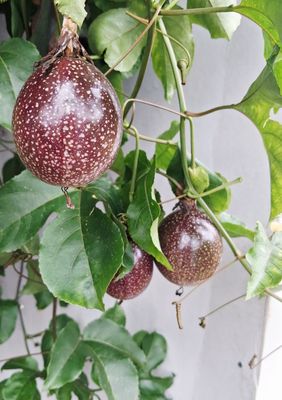
| Fruit Color | Red-purple ripening to deep purple-black |
| Fruit Size | Commonly around 1½–2 inches long |
| Fruit Texture | Extremely juicy, soft, and tender |
| Primary Uses | Fresh eating, jam, syrup, cobbler, smoothies, freezing, wine, vinegar, wildlife forage, and edible landscaping |
Mulberries as a group are deciduous, fast-growing, well adapted to Florida, fruit on current-season growth, and perform best in full sun and well-drained soil. Mature size varies substantially by cultivar.
🌱 Why Choose the 1-Gallon Giant Mulberry?
The 1-gallon size hits a useful middle ground.
It has more root development, soil volume, and stored moisture than a 4-inch starter, but it is still young enough to adapt quickly after planting and practical enough to ship through the UPS Ground system.
Compared with a smaller starter, a healthy 1-gallon plant generally offers:
- 🌱 A more developed root system
- 🌿 Additional trunk and branch development
- 💧 More soil volume and moisture reserve during transit
- 💪 Greater resilience during normal acclimation
- ✂️ More material to begin structural training
- 🌳 A shorter transition toward landscape establishment
It is still a young tree—not a finished landscape specimen.
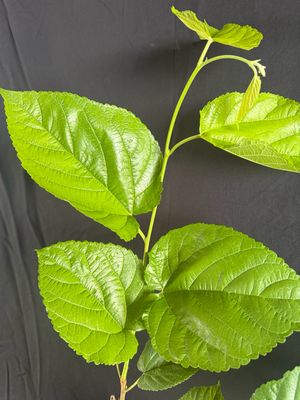
Actual height, branching, foliage density, and appearance will change throughout the year. During active growth, plants can be lush and heavily leafed. During winter dormancy, the exact same healthy plant may be partially or completely bare.
🔎 About the Name: Florida Giant, Estero Giant & Old Florida Mulberries
Mulberry naming in Florida can get a little… wild.
Unlike modern patented fruit cultivars with carefully documented pedigrees, many older Florida mulberries were passed from property to property through cuttings, backyard growers, small farms, and informal nursery networks.
That history gave us some fantastic trees—but not always a clean paper trail.
Florida Giant and Estero Giant are sometimes treated as the same selection or as closely related selections. Estero Giant has also occasionally been compared with the old Florida cultivar Tice.
At this time, widely available genetic testing and historical documentation do not conclusively establish that all of these names represent the exact same clone.
For that reason, GreenDreams identifies our plant conservatively as:
Morus spp. ‘Florida Giant / Estero Giant’
Our stock comes from the cultivar we have grown and observed in Florida for many years.
Instead of inventing certainty where the nursery trade does not have it, we prefer to tell growers what matters most:
- 🍇 Long, juicy dark fruit
- 🌿 Extremely vigorous growth
- 🌳 A broad edible shade canopy
- ✂️ Excellent response to size management
- 🌞 Strong performance in warm climates
- 🧺 Substantial seasonal fruiting potential
Grower observations also demonstrate that Estero Giant can have a distinct dormancy cycle compared with other Florida mulberries, reinforcing why cultivar-by-cultivar behavior matters.
🍇 Giant Mulberry Fruit Profile — What Does It Taste Like?
This is the section that makes people start finding room in the yard.
| Fruit Trait | What to Expect |
|---|---|
| Shape | Long and narrow rather than round |
| Typical Length | Approximately 1½–2 inches |
| Color Progression | Green → red → purple → deep purple-black |
| Flavor | Sweet, richly berry-like, with balancing tartness |
| Texture | Extremely juicy, soft, and delicate |
| Skin | Thin and tender |
| Seeds | Tiny, soft, and unobtrusive while eating |
| Aroma | Mild floral and classic ripe-berry character |
| Best Eating Stage | Fully colored, soft, and releasing from the stem with almost no resistance |
| Storage Quality | Very short; best eaten or processed soon after harvest |
🍇 The Ripeness Rule
A Giant Mulberry that looks almost ripe can taste very different from one that is actually ripe.
Fruit that is still red-purple may retain noticeable acidity.
For the fullest flavor:
- Wait until the berry has developed its final dark color.
- Look for a soft, swollen appearance.
- Gently touch the fruit.
- If ripe, it should release with almost no effort.
If you have to tug, give it more time.
That extra day or two on the tree is the difference between pretty good and where-have-these-been-all-my-life?
🌸 Fruiting Habit & Production
Mulberries produce fruit with the fresh flush of seasonal growth.
In Central Florida and similar climates, a typical annual rhythm may look like:
- 🍂 Winter leaf drop and dormancy
- 🌱 Bud swelling in late winter
- 🌿 Fresh leaves and shoots emerging
- 🌸 Flowers developing with new growth
- 🍇 Fruit forming along the shoots
- 🧺 Main harvest during spring
- 🌳 Rapid vegetative growth following harvest
- ✂️ Canopy management through the warmer months
- 🍂 Growth slowing again as winter approaches
UF/IFAS specifically notes that mulberry fruit is borne on current-season growth, which is one reason thoughtful pruning can be so useful for both productivity and harvest access.
How Soon Can a 1-Gallon Giant Mulberry Fruit?
Because this plant is propagated vegetatively rather than grown as an unknown seedling, it may reach reproductive maturity much sooner than a seed-grown mulberry.
A young plant can occasionally flower or fruit while still small.
However:
Fruit on a newly purchased 1-gallon tree is a bonus—not a guarantee.
Its first job is to establish roots, develop structure, and adapt to its new growing environment.
🍇 What Improves Fruit Set, Berry Size & Flavor?
For stronger production:
- 🌞 Grow in full sun
- 💧 Maintain even root-zone moisture while fruit develops
- 🪣 Maintain excellent drainage
- 🌾 Build soil biology with finished compost
- 🪵 Maintain a broad hardwood mulch layer
- ✂️ Encourage healthy current-season growth through appropriate pruning
- 🌿 Keep the canopy open enough for good light penetration
- ⚖️ Avoid excessive nitrogen
- ❄️ Protect tender early growth from late freezes
- 🧺 Harvest frequently once fruit begins ripening
Heavy nitrogen feeding can create an impressive wall of green growth without necessarily improving fruit quality.
With Giant Mulberry, more fertilizer is not automatically more fruit.
🗓️ Approximate Giant Mulberry Harvest Season
Weather matters, so these are useful planning ranges rather than exact calendar promises.
| Region | Typical Main Harvest Window |
|---|---|
| South Florida | Approximately February–March |
| Central Florida | Approximately March–April |
| North Florida | Approximately March–May |
| Gulf Coast / Lower Southeast | Approximately April–May |
| Warmer Zone 7–8 Areas | Approximately late spring |
| Protected Container Trees | Depends heavily on winter dormancy and spring budbreak |
A warm winter can trigger earlier growth.
Then comes the catch: if tender flowers and shoots emerge early and a late freeze arrives, the tree itself may survive perfectly well while that season’s early fruit is damaged.
That is one of the most important distinctions to understand with mulberry cold tolerance.
🧺 How to Harvest Giant Mulberries
Mulberries should be treated more like raspberries than apples.
Hand Harvesting
- Harvest during the cooler morning hours when possible
- Choose fruit that releases effortlessly
- Use shallow harvest containers
- Avoid piling berries deeply
- Refrigerate promptly
- Wash shortly before eating rather than before storage
Shake-and-Catch Harvesting
Once the tree becomes larger:
- Spread a clean tarp or harvest cloth beneath a fruiting section.
- Gently shake individual branches.
- Fully ripe fruit will fall naturally.
- Sort fruit immediately.
- Refrigerate, freeze, cook, or process promptly.
Avoid aggressive shaking, particularly with young trees or poorly structured branches.
🫐 Why Grow Mulberries When You Can Buy Berries?
Because this is one fruit the supermarket cannot really deliver.
Mulberries have thin skin, very soft flesh, and an exceptionally short post-harvest life. UF/IFAS notes that ripe fruit is tender, flavorful, sweet, and juicy, while fresh mulberries are commonly eaten raw or processed into juice, dried fruit, and jam.
Growing your own gives you:
- 🍇 True tree-ripened fruit
- 🧺 Fruit that rarely reaches conventional produce aisles
- ❄️ Plenty for freezing when harvests become heavy
- 🍯 Homegrown preserves and syrups
- 🌳 Rapid seasonal shade
- 🐦 Wildlife forage
- 🌿 A productive food-forest canopy species
- ✂️ A tree that responds beautifully to active management
This is one of those crops where homegrown does not merely mean fresher—it unlocks an entirely different product.
🍴 How to Use Giant Mulberries
Think blackberry, raspberry, blueberry, or dark cherry—but softer and juicier.
Fresh From the Tree
Try Giant Mulberries:
- Straight from the branch
- Over yogurt
- With oatmeal or granola
- In smoothies
- Over vanilla ice cream
- In fruit salads
- With soft cheeses
- Folded into pancakes or waffles
- Frozen as a backyard snack
- Crushed into sparkling water or lemonade
Cooked & Preserved
A large harvest can become:
- 🍯 Mulberry jam
- 🥧 Cobbler
- 🥧 Pie or galette
- 🫙 Compote
- 🍹 Syrup
- 🌿 Chutney
- 🧺 Fruit leather
- 🍷 Mulberry wine
- 🫙 Drinking vinegar
- 🍶 Homemade fruit vinegar
- 🔥 Barbecue glaze
- ❄️ Frozen fruit purée
- 🌞 Dehydrated berries
Savory Pairings
Dark mulberries pair particularly well with:
- Goat cheese
- Balsamic vinegar
- Citrus zest
- Black pepper
- Basil
- Rosemary
- Hot peppers
- Pork
- Duck
- Roasted vegetables
🍯 Simple Small-Batch Mulberry Jam
Ingredients
- 4 cups fully ripe mulberries
- 1½–2 cups sugar
- 2 tablespoons lemon juice
- 1 teaspoon lemon zest, optional
Directions
- Remove leaves and debris.
- Gently rinse and drain the fruit.
- Add berries, sugar, and lemon juice to a heavy saucepan.
- Lightly crush the fruit.
- Simmer over medium-low heat.
- Stir frequently as the fruit releases juice.
- Continue cooking until the mixture reaches the desired consistency.
- Transfer to a clean container and refrigerate.
For shelf-stable preservation, use a tested USDA or university Extension canning recipe rather than improvising processing times or acidity levels.
A Tree With a Surprisingly Deep Human History
Mulberry trees have historically provided far more than berries.
Across different cultures and species, mulberries have been used for:
- Fresh and dried fruit
- Jams and preserves
- Fermented drinks
- Vinegars
- Animal forage
- Dyes
- Wood products
- Traditional remedies
- Silkworm production
White mulberry became globally important in sericulture, since its leaves have long been used as feed for silkworms.
In North America, UF/IFAS documents historical use of native red mulberry fruit by Indigenous peoples, including dried fruit and fruit incorporated into sauces and corn-based foods. Mulberry branches, berries, leaves, and wood also had traditional practical uses.
🌳 Ornamental Appeal — Yes, This Fruit Tree Can Look Good Too
Giant Mulberry does not need to be hidden in the back forty.
The tree produces:
- 🌿 Large green leaves
- 💚 Heart-shaped to variably lobed foliage
- 🌳 A rapidly expanding shade canopy
- 🪵 Gray-brown bark developing with age
- 🍇 Draping fruiting branches
- 🍂 Seasonal fall and winter leaf drop
- 🌱 Bright fresh spring growth
Excellent Landscape Roles
Use Giant Mulberry as a:
- Food-forest canopy tree
- Backyard orchard tree
- Homestead production tree
- Poultry forage tree
- Wildlife tree
- Seasonal privacy screen
- Managed edible hedge
- Fast-growing shade tree
- Background edible specimen
Think Twice Before Planting It:
- Directly over a driveway
- Beside white paving
- Over a patio dining space
- Next to a pool
- Above parked vehicles
- Against a foundation
- Close to a septic drainfield
- Beneath power lines
- In a narrow ornamental bed
Dark ripe mulberries stain.
Plant them somewhere the harvest can be celebrated instead of constantly scrubbed off the concrete.
🍇 GreenDreams Mulberry Comparison Guide
| Cultivar | Fruit & Flavor | Growth Habit | Climate Notes | Best For |
|---|---|---|---|---|
| Thai Dwarf | Small–medium; sweet, soft, juicy | Compact, bushy, highly prune-responsive | Strong choice for Zones 8–10 | Containers, patios, smaller yards |
| Everbearing | Small–medium; classic sweet-tart mulberry flavor | Bushy to medium-sized | Hardiness varies by clone | Backyard orchards and repeat crops |
| Tice | Medium–large; rich sweet-tart flavor, very juicy | Large and spreading | Excellent Florida performer | Food forests, shade, larger properties |
| Florida Giant / Estero Giant | Large–very large; elongated, juicy, richly sweet-tart | Very vigorous and broad | Best in warm Southern climates | Oversized fruit, fast shade, major production |
| World’s Best | Large; sweet and very juicy | Vigorous but highly manageable with pruning | Best in warm-temperate/subtropical areas | Productive home orchards |
| Pakistan | Exceptionally long; sweet, mild acidity, somewhat firmer | Vigorous and upright | Loves heat; more cold-sensitive than many common mulberries | Specialty fruit collectors |
| Shangri-La | Medium–large; rich, dark berry flavor | Fast, broad, tropical-looking | Excellent Florida performer | Food forests and dramatic edible landscapes |
| White-Fruited Types | Honey-sweet, mild, usually low acid | Varies | Hardiness varies | Lower-staining harvests |
| Unryu / Corkscrew | Fruit is secondary to ornamental value | Twisted, architectural branching | Deciduous and comparatively cold tolerant | Ornamental edible gardens |
Planting more than one cultivar is not generally required for pollination, but it is a fantastic way to diversify fruit shape, flavor, texture, tree habit, and harvest timing.
🌱 Giant Mulberry Planting & Care Guide
🍂 Yes—Giant Mulberry Is Deciduous
This is one of the most important facts for first-time mulberry growers.
Deciduous means the tree naturally sheds most or all of its leaves during its winter resting period.
A perfectly healthy Giant Mulberry may look dramatically different in January than it does in May.
A dormant plant may arrive:
- Completely leafless
- Partially defoliated
- With yellow leaves
- With spotted aging foliage
- With tiny dormant buds
- With no visible active growth for several weeks
That is not automatically a sign that the tree is dying.
UF/IFAS identifies mulberries as deciduous trees, and Florida Extension notes that cold winters may trigger partial or complete leaf drop.
🗓️ Giant Mulberry Seasonal Care — Florida & Similar Zones
| Season | What the Tree May Do | What the Grower Should Do |
|---|---|---|
| Winter — Dec.–Feb. | Yellowing, spotting, dormancy, partial or complete leaf loss | Reduce irrigation, avoid routine fertilizer, protect young plants during hard freezes |
| Late Winter | Buds swell; early new growth may appear | Watch forecasts closely because new growth is less cold hardy than dormant wood |
| Spring — Mar.–May | Leaves, flowers, fruit, and rapid new growth | Maintain even moisture and harvest fruit frequently |
| After Main Harvest | Vigorous vegetative flush | Begin controlled size-management pruning |
| Summer | Rapid canopy expansion | Manage height, thin crowded growth, maintain irrigation during drought |
| Late Summer | Continued vigorous shoots | Make moderate size-control cuts if needed |
| Fall | Growth gradually slows and wood hardens | Avoid heavy nitrogen and severe pruning that could trigger tender late growth |
💡 Florida Grower Tip
Warm spells in January or February can convince a mulberry that spring has arrived.
Unfortunately, Florida weather may disagree a week later.
A fully dormant branch can handle substantially more cold than a brand-new leaf, flower, or developing fruit.
Protect the new growth, not just the trunk.
❄️ Cold & Frost Care for a 1-Gallon Giant Mulberry
The 1-gallon size deserves more protection than a mature landscape tree.
During Hard Freeze Conditions
Container-grown plants can be:
- Moved into a garage
- Moved into a greenhouse
- Placed on a protected porch
- Positioned beside a warm south- or east-facing wall
For in-ground young plants:
- Water dry soil earlier in the day
- Cover the canopy to the ground with frost cloth
- Anchor the covering
- Avoid allowing plastic to rest directly on foliage
- Remove or vent protection when temperatures rise
After Freeze Damage
Do not immediately cut every brown-looking branch.
Wait.
Living buds may emerge farther down the stem once temperatures stabilize.
Premature pruning can remove tissue that would have recovered.
🌞 Where to Plant Giant Mulberry
Choose a permanent location with:
- 6–8+ hours of direct sun
- Well-drained soil
- Room for the eventual root system
- Good air movement
- Access for future pruning
- Space to harvest underneath
- Protection from the strongest cold north winds where possible
Suggested Spacing
Managed trees: approximately 10–15 ft apart
Natural trees: approximately 20–30 ft apart
Keep Giant Mulberry Away From
- Foundations
- Septic drainfields
- Wells
- Major underground utilities
- Sidewalks
- Driveways
- Pools
- Rooflines
- Narrow side yards
- Neighboring property lines where fruit drop may become an issue
UF/IFAS specifically advises providing enough space around large mulberries and keeping them away from wells, drainage fields, and foundations.
🌬️ Wind & Coastal Conditions
Mulberries have some wind tolerance once established, but there is an important catch:
Fast-growing trees can create long branches faster than they create ideal structure.
UF/IFAS describes mulberries as moderately wind resistant while also encouraging early structural pruning.
Build a Stronger Giant Mulberry
While the tree is young:
- Select several well-spaced scaffold branches
- Remove crossing limbs early
- Avoid crowded competing leaders
- Discourage narrow branch unions
- Shorten excessive upright growth
- Keep the canopy lower and broader
- Remove damaged wood before storm season
Salt Exposure
Mulberries have some tolerance to coastal conditions, but Giant Mulberry should not be treated like a frontline beach plant.
Best performance will generally occur:
- Inland from direct ocean exposure
- Behind structures or vegetation that reduce salt spray
- With non-saline irrigation
- Where storm surge or brackish flooding is unlikely
🚚 Arrival & Acclimation — Do This Before Planting
A live plant just spent several days:
- Inside a dark box
- Experiencing temperature changes
- Moving through warehouses and vehicles
- Being handled repeatedly
- Receiving no normal sunlight
Do not reward it by immediately ripping apart the root ball and planting it in full afternoon sun.
GreenDreams 30-Day Recovery Approach
We recommend keeping your 1-gallon Giant Mulberry in its original container for approximately 30 days—or until healthy new growth confirms recovery.
After arrival:
- Open the box promptly.
- Carefully remove all packaging.
- Check the root-ball moisture.
- Water at soil level if dry.
- Place in bright, protected shade.
- Introduce gentle morning sun.
- Increase sunlight gradually.
- Protect from intense wind.
- Avoid immediate fertilization.
- Wait for clear recovery before transplanting.
Temporary leaf spotting, yellowing, curling, wilting, or partial defoliation can occur after shipping.
New healthy growth is the sign we care about most.
🌱 How to Plant Giant Mulberry — GreenDreams High & Tight Method
Step 1 — Check Drainage First
Never begin by digging the hole.
Begin by asking:
Where will the water go?
Avoid a site that remains saturated after rain.
If necessary:
- Build a broad mound
- Improve surrounding drainage
- Redirect runoff
- Choose higher ground
Step 2 — Dig Wide, Not Deep
Dig the hole:
- Only slightly wider than the root ball
- Approximately the same depth as the container
- With roughened sides rather than polished walls
The tree should not sink into a bowl.
Step 3 — Inspect the Roots
Once the plant has recovered from shipping and is ready for transplant:
- Slide the root ball carefully from the pot
- Keep healthy soil and roots largely intact
- Loosen tightly circling exterior roots
- Correct severe girdling roots with clean tools
- Avoid shredding a healthy young root system
Step 4 — Plant High & Tight
Position the root ball so:
- The root flare remains visible
- The top of the root ball sits at or slightly above surrounding grade
- The trunk remains upright
- No additional soil is piled over the original root-ball surface
Step 5 — Backfill
Use primarily the native soil removed from the hole.
A modest amount of finished compost may be incorporated where appropriate, but avoid creating a dramatically different pocket of soil that traps excessive moisture around the roots.
Firm the surrounding soil enough to remove major air pockets without compacting it into concrete.
Step 6 — Feed the Soil From Above
GreenDreams favors building biology from the soil surface.
Depending on site conditions, top-dressing may include:
- Finished compost
- Charged biochar
- Worm castings
- Trace mineral amendments such as azomite
- A modest organic nutrient source when appropriate
Keep concentrated fertilizer away from direct trunk contact.
Step 7 — Mulch Broadly
Apply approximately 2–4 inches of hardwood mulch.
Keep mulch:
- Several inches away from the trunk
- Spread broadly over the developing root zone
- Free from herbicide contamination
- Replenished as it decomposes
Never create a mulch volcano around the trunk.
🎥 GreenDreams High & Tight Fruit Tree Planting Method
urlWatch the GreenDreams High & Tight planting video
💧 Giant Mulberry Watering Guide
🚫 No Overhead Watering
For GreenDreams plants, we recommend watering at the soil level.
Preferred methods:
- Drip irrigation
- Slow-running hose
- Properly positioned micro-irrigation
- Watering wand directed at the soil
- Tree watering ring
Morning watering is best.
Avoid routine overhead irrigation, particularly during hot afternoons.
Wet foliage combined with heat, humidity, and splash from the soil can increase stress and leaf-spot pressure.
🪴 Watering a 1-Gallon Giant Mulberry in Its Nursery Pot
A 1-gallon mulberry can dry considerably faster than a larger 2- or 3-gallon tree.
Check the plant daily.
Water when:
- The upper potting mix is drying
- The container feels noticeably lighter
- New foliage begins losing firmness
- Moisture is no longer present deeper in the root ball
When watering:
- Apply water slowly at the soil surface.
- Wet the entire root ball.
- Continue until excess water drains from the bottom.
- Allow normal drainage.
Do not leave the plant sitting in standing water.
During a hot Florida summer, daily watering may be necessary.
During cool, rainy, or dormant periods, watering frequency may decrease substantially.
Use the plant and soil—not a rigid calendar—as your guide.
🌳 Suggested In-Ground Watering Schedule
Adjust for rainfall, soil type, temperature, plant response, and season.
| Establishment Stage | Suggested Watering |
|---|---|
| Days 1–14 | Water daily during hot or dry conditions |
| Weeks 3–6 | Deep watering approximately 2–3 times per week |
| Months 2–6 | Approximately 1–2 deep waterings weekly during dry periods |
| After Establishment | Irrigate during prolonged drought and fruit development |
| Florida Rainy Season | Reduce supplemental irrigation when rainfall is adequate |
Florida sand may require a different frequency than heavy clay.
The goal is not permanently wet soil.
The goal is:
Deep moisture → drainage → oxygen → root growth.
🌾 Soil Preferences
Giant Mulberry is adaptable, but fastest healthy growth occurs in soil that is:
- Well drained
- Moderately fertile
- Biologically active
- Moist without staying saturated
- Rich in decomposing organic matter
- Slightly acidic to near neutral
Mulberries are famously forgiving of Florida’s sandy soils.
That does not mean poor soil is ideal.
Compost, mulch, healthy soil biology, and reliable establishment irrigation can dramatically improve performance.
🌿 Fertilizing Giant Mulberry — Less Can Be More
Mulberries can grow extraordinarily fast without heavy fertilization.
UF/IFAS notes that established mulberries frequently need little or no fertilizer.
Excess feeding—especially high nitrogen—can create:
- Long weak shoots
- Dense foliage
- Poor airflow
- Greater storm leverage
- Late tender growth
- Fertilizer burn
- Lots of canopy without a proportional increase in fruit
GreenDreams Organic Approach
Consider:
- Finished compost
- Worm castings
- Charged biochar
- Hardwood mulch
- Light organic fruit-tree nutrition only when needed
- Soil testing when chronic problems occur
Florida Timing
Early spring: Compost and modest nutrition if needed
After harvest: Optional light feeding to support regrowth
Summer: Feed only if plant growth indicates a need
Late summer/fall: Avoid heavy nitrogen
Winter dormancy: Routine feeding generally unnecessary
✂️ How to Prune Giant Mulberry for Fruit + Manageable Height
Giant Mulberry is naturally vigorous.
If you never prune it, it will eventually make its own decisions about tree size—and they probably will not involve a convenient eight-foot harvest ladder.
Main Pruning Goals
- Keep fruit within reach
- Maintain approximately 8–12 ft where practical
- Encourage productive new shoots
- Improve light penetration
- Develop stronger branch structure
- Reduce storm leverage
- Control width
- Remove crossing, broken, or diseased wood
Young Tree Training
During the first several years:
- Encourage several well-spaced scaffold branches.
- Remove competing narrow leaders when appropriate.
- Correct crossing branches while cuts are still small.
- Shorten excessively long shoots.
- Avoid creating a dense interior.
- Remove unwanted basal suckers.
After-Harvest Pruning
For a managed Florida fruit tree, the period following the main spring harvest is particularly useful for size control.
The warm growing season gives the tree time to recover and develop new wood.
Summer Pruning
Moderate summer pruning can:
- Reduce rapidly increasing height
- Shorten upright water sprouts
- Maintain pathways
- Open dense areas
- Keep fruiting growth accessible
Avoid Giant Cuts When Possible
UF/IFAS advises using young-tree pruning to establish good structure and being conservative with major cuts on mature mulberries because larger wounds are slower to close.
That makes early management far better than waiting until a 35-foot tree needs emergency surgery.
Avoid Heavy Late-Fall Pruning
Major pruning can stimulate new growth.
New growth immediately before winter is exactly what we do not want heading into a freeze.
🪴 Can Giant Mulberry Grow in a Container?
Yes—but this is not naturally a dwarf cultivar.
Container growing works best for:
- Growers waiting to plant in the ground
- Renters
- Cold-climate growers needing winter mobility
- Patio growers willing to prune frequently
- Bonsai-style training
- Growers intentionally restricting tree size
Recommended Container Progression
| Stage | Suggested Container |
|---|---|
| Starter | 4-inch pot |
| Current Listing | 1 gallon |
| Next Step | 3 gallon |
| Developing Tree | 7 gallon |
| Patio Tree | 10–15 gallon |
| Productive Container Tree | 20–30 gallon |
| Long-Term Specimen | 30–45+ gallon |
Recommended Progression
4-inch → 1 gallon → 3 gallon → 7 gallon → 15 gallon → 25–30+ gallon
Do not automatically move a young 1-gallon tree directly into a massive container.
Unused potting mix stays wet longer, which can reduce oxygen around a still-small root system.
🪴 How Do I Know When It Is Time to Up-Pot?
Look for:
- Roots growing through drainage holes
- Dense circling roots
- The root ball holding together firmly
- Soil drying unusually quickly
- Water bypassing the root ball
- Slower growth despite good conditions
- The tree becoming top-heavy
- A container that cannot keep up with summer moisture demand
The best transplant signal is usually the root system, not a calendar date.
🌱 How to Transplant Giant Mulberry Into a Larger Container
- Choose a pot with multiple drainage holes.
- Increase container size gradually.
- Add enough mix to maintain the same planting depth.
- Carefully remove the tree.
- Inspect the root ball.
- Loosen only tightly circling exterior roots.
- Position the trunk upright.
- Backfill without burying the trunk flare.
- Firm the potting mix gently.
- Water thoroughly at soil level.
- Keep the tree protected from severe wind and extreme heat during initial recovery.
Containers and potting materials can often be sourced through:
- Independent garden centers
- Nursery suppliers
- Landscape supply stores
- Hydroponic retailers
- Farm-supply stores
- Online horticultural suppliers
Search by container volume, drainage style, and professional nursery potting mix rather than simply buying the cheapest “garden soil.”
🪴 Suggested Potting Mix for Giant Mulberry
The goal is moisture retention without waterlogging.
A practical starting blend:
| Ingredient | Approximate Proportion |
|---|---|
| Quality peat- or coir-based potting mix | 40–45% |
| Aged pine bark fines | 20–25% |
| Finished compost / worm-casting blend | 15–20% |
| Perlite, pumice, or similar drainage material | 10–15% |
| Charged biochar | Up to approximately 5% |
Avoid:
- Straight Florida sand in a container
- Heavy native garden soil
- Pure compost
- Poorly drained decorative pots
- Containers with no drainage holes
- Fresh uncomposted manure
🏠 Can Giant Mulberry Grow Indoors?
Not successfully as a permanent houseplant.
It wants:
- Strong outdoor sun
- Seasonal temperature changes
- Winter dormancy
- Outdoor airflow
- A substantial root system
- Regular pruning
- Space for fruit drop
A container tree can temporarily move indoors to a garage, greenhouse, or protected porch during freezes.
Think:
winter protection—not living-room fruit tree.
🌿 Companion Plants & Food-Forest Guild Ideas
Mulberries are primarily wind-pollinated, so companion flowers are not necessary to pollinate the tree itself.
But biodiversity still matters.
Companions can:
- Produce biomass
- Cover soil
- Support beneficial insects
- Add nitrogen-rich chop-and-drop
- Improve visual layers
- Produce additional food
- Reduce empty ecological niches
🌱 Nitrogen-Supporting Plants
Consider:
- Pigeon pea
- Sunn hemp
- Perennial peanut in appropriate open areas
- Other regionally suitable legumes
🌿 Biomass & Chop-and-Drop Plants
GreenDreams favorites include:
- Mexican sunflower
- Fakahatchee grass
- Lemongrass
- Other non-running clumping grasses
🐝 Beneficial-Insect Plants
Consider:
- African blue basil
- Coreopsis
- Native asters
- Goldenrod
- Mountain mint
- Native sunflowers
- Flowering culinary herbs
🥬 Productive Edible Companions
Depending on sunlight:
- Cranberry hibiscus
- Roselle
- Chaya
- Okinawa spinach
- Longevity spinach
- Ginger
- Turmeric
- Managed sweet potato
One Important Rule
Do not build a jungle against the trunk of a young tree.
Maintain a broad mulched root zone while the Giant Mulberry is getting established.
⚠️ Giant Mulberry Cautions
🍇 Ripe Fruit Stains
Fully ripe dark berries can stain:
- Concrete
- Pavers
- Vehicles
- Clothing
- Patio furniture
- Pool decks
- Light-colored surfaces
Plant over:
- Mulch
- Lawn
- Pasture
- Orchard floor
- Groundcover
Your future self will appreciate the planning.
🐦 Wildlife Will Find the Fruit
Birds do not require a Google search to discover a ripe mulberry tree.
Neither do:
- Squirrels
- Raccoons
- Opossums
- Other fruit-eating wildlife
UF/IFAS documents mulberry fruit as valuable wildlife food.
Strategies for keeping more of the harvest include:
- Picking daily
- Keeping the tree low
- Harvesting immediately when ripe
- Using wildlife-safe netting where practical
- Growing enough to share
Avoid loose netting that can entangle wildlife.
🧤 Milky Sap
Mulberry stems and leaves release a milky sap when cut.
UF/IFAS notes that this sap can irritate the skin of sensitive individuals.
When pruning:
- Wear gloves
- Avoid touching your eyes
- Wash exposed skin
- Clean tools after use
Consume the fully ripe fruit, not milky unripe fruit or freshly cut plant tissue.
🌱 Responsible Landscape Management
Because the exact genetics of many old Florida mulberry cultivars are not formally resolved, Giant Mulberry should not be represented as a native red mulberry simply because it grows well in Florida.
White mulberry (Morus alba) has naturalized widely in North America and can hybridize with native red mulberry (Morus rubra). The U.S. Forest Service identifies white mulberry as nonnative and invasive in North America and documents hybridization concerns.
Responsible growers should:
- Remove unwanted volunteer seedlings
- Avoid allowing seedlings to spread into natural areas
- Never label seed-grown offspring as the named cultivar
- Check local invasive-species regulations
- Choose native red mulberry for restoration projects specifically requiring native genetics
🔍 Giant Mulberry Troubleshooting Guide
Icons represent common issues and organic recovery strategies—look for 🌿 for the next step.
| ⚠️ Issue | 🧠 Likely Cause | 🌿 Recommended Response |
|---|---|---|
| 🍂 Bare tree in winter | Normal dormancy | Check for firm buds and living wood; reduce watering and wait for spring |
| 🍂 Yellow/spotted fall leaves | Normal seasonal senescence | No treatment required if timing matches dormancy |
| 🌱 No growth shortly after shipping | Transit/acclimation stress | Maintain proper moisture, bright shade, and patience |
| 💧 Wilting + dry soil | Underwatering | Water deeply at soil level and monitor the 1-gallon root ball daily |
| 💦 Wilting + wet soil | Low root-zone oxygen | Reduce irrigation frequency and improve drainage |
| 🍃 Summer yellowing | Root stress, poor drainage, nutrition imbalance, or heat | Inspect soil moisture and roots before fertilizing |
| ☀️ Brown edges after delivery | Sunburn / transit stress | Reduce exposure temporarily and acclimate gradually |
| 🍄 Leaf spotting in humid weather | Fungal leaf spot favored by moisture | Improve airflow; eliminate unnecessary overhead watering |
| 🍿 Enlarged green “popcorn” fruit | Popcorn disease | Remove affected fruit from tree and ground; sanitation is the primary home-garden response |
| 🐛 Chewed leaves | Caterpillars or beetles | Identify the pest before treating; tolerate light damage where practical |
| 🪲 Sticky leaves / sooty coating | Sap-sucking pests such as aphids or scale | Inspect undersides, manage ants, and use appropriately labeled organic controls if needed |
| 🕷️ Fine stippling/webbing | Spider mites | Improve hydration, reduce stress, inspect closely, and use a labeled treatment if necessary |
| 🍃 Fruit dropping early | Freeze injury, moisture swings, heat, wind, or crop stress | Maintain even moisture and reduce environmental stress |
| 🌿 Huge growth but poor fruiting | Excess nitrogen, immaturity, shade, or pruning imbalance | Increase light and reduce unnecessary fertilizer |
| ✂️ Excess upright shoots | Heavy heading cuts or high nitrogen | Thin selectively rather than repeatedly topping everything |
| 🌬️ Broken branches | Rapid growth + poor branch structure | Train young trees early and reduce leverage before storm season |
| ❄️ Brown new spring growth | Late frost | Wait for healthy regrowth before deciding what is dead |
| 🐦 Fruit disappears just before harvest | Congratulations, the birds found it | Harvest earlier in the morning and more frequently |
| 🌾 Weak growth in Florida sand | Drought, poor root establishment, low organic matter, or root problems | Improve irrigation consistency, compost, mulch, and inspect roots |
Popcorn disease is caused by Ciboria carunculoides. White mulberry types and hybrids can be more susceptible, and Extension recommendations emphasize removing diseased fruit and fallen debris.
♻️ GreenDreams Organic Pest-Management Approach
Do not begin with a spray bottle.
Begin with identification.
- Check soil moisture.
- Check drainage.
- Consider seasonal dormancy.
- Look at both sides of the leaves.
- Inspect new growth.
- Remove heavily diseased fruit or fallen debris.
- Encourage beneficial predators.
- Control ants when they are protecting aphids or scale.
- Use the least disruptive treatment that addresses the actual problem.
- Follow edible-crop label instructions exactly.
Neem oil, horticultural oil, insecticidal soap, Bt, copper, and sulfur are not interchangeable products.
The right organic treatment depends on the problem.
🌟 Is Giant Mulberry Right for You?
✅ Ideal For
- Florida fruit growers
- Gulf Coast gardeners
- Backyard orchard owners
- Food-forest growers
- Permaculture enthusiasts
- Homesteaders
- Families who love unusual fruit
- Wildlife-friendly landscapes
- Growers wanting fast edible shade
- Gardeners comfortable with pruning
- Cooks interested in jams, cobblers, syrups, wine, and preserves
- Larger properties that can accommodate vigorous growth
❌ Probably Not Ideal For
- Tiny spaces without pruning access
- Areas directly beside white pavement
- Poolside planting
- Planting over parked vehicles
- Growers wanting a naturally dwarf tree
- Permanently saturated soil
- Long-term indoor growing
- Gardeners unwilling to prune
- Sites where falling fruit cannot be tolerated
- Ecological restoration projects requiring documented native Morus rubra genetics
❓ Giant Mulberry FAQ
Are Florida Giant and Estero Giant the same mulberry?
The names are frequently associated with one another in Florida horticulture, but there is not enough widely available historical or genetic evidence to state definitively that every plant sold under these names is the exact same clone.
GreenDreams therefore lists ours conservatively as Morus spp. ‘Florida Giant / Estero Giant’.
How big does Giant Mulberry get?
Without pruning, expect a genuinely large tree—commonly 25–40+ ft depending on genetics, climate, soil, and management.
With regular training, growers can keep the canopy much closer to 8–12 ft for easier harvesting.
How fast does Giant Mulberry grow?
Very fast.
Florida Extension describes mulberry as one of the state’s faster-growing fruit trees, with extremely rapid growth possible under favorable conditions.
That vigor is part of the appeal—but also why pruning matters.
When does Giant Mulberry fruit in Florida?
The primary crop usually develops from late winter into spring, with Central Florida harvest commonly centered around March and April depending on the winter.
Weather, pruning, irrigation, and late cold fronts can shift the season.
Does Giant Mulberry fruit on new growth?
Yes. Mulberry fruit is borne on current-season growth.
Does Giant Mulberry need another tree for pollination?
A second cultivar is not normally necessary for this selected fruiting clone.
You can still grow multiple varieties to expand flavor and harvest diversity.
Do bees pollinate mulberry trees?
Mulberries are primarily wind-pollinated.
Flowering companion plants are still useful because they support beneficial insects and the surrounding food-forest ecosystem.
Can Giant Mulberry be maintained under 10 ft?
Yes, but you have to start young and stay consistent.
Trying to turn a mature 35-foot mulberry into a 9-foot tree is much harder than simply keeping an 8-foot tree from becoming a 35-foot one.
Can I grow Giant Mulberry in a container?
Yes.
However, this is a naturally vigorous tree and will need:
- Progressive up-potting
- Full sun
- Consistent irrigation
- Excellent drainage
- Canopy pruning
- Eventually a large container
Can Giant Mulberry grow indoors?
Not as a permanent indoor fruit tree.
It needs strong sunlight, airflow, seasonal changes, dormancy, and substantial root space.
Containers can be moved into protected structures temporarily during hard freezes.
Is Giant Mulberry evergreen?
No.
It is deciduous and may become partially or completely leafless during winter.
Why did my shipped Giant Mulberry lose leaves?
Transit darkness, moisture changes, heat, cold, wind, and seasonal dormancy can all trigger leaf loss.
Leaf loss does not automatically equal plant loss.
Focus on proper moisture, acclimation, healthy buds, and eventual new growth.
When should I transplant my 1-gallon Giant Mulberry?
After shipping, we recommend waiting approximately 30 days or until healthy new growth confirms recovery.
For container progression, up-pot when roots clearly begin outgrowing the existing pot.
Why shouldn’t I transplant it immediately after delivery?
Shipping already stresses a plant.
Transplanting adds another major environmental change.
Giving it time to recover first allows you to separate shipping stress from transplant stress and generally makes troubleshooting much easier.
Does Giant Mulberry grow in Florida sand?
Yes.
Mulberries are quite adaptable, but Florida sand performs much better when growers add biological support from above using:
- Compost
- Hardwood mulch
- Organic matter
- Reliable establishment irrigation
Is Giant Mulberry drought tolerant?
An established mulberry is considerably more drought tolerant than a newly planted one.
Do not confuse mature-tree drought tolerance with permission to let a new 1-gallon root ball dry to dust.
Are mulberries messy?
They can be.
Dark ripe fruit stains, and birds help distribute it.
Choose the planting location accordingly.
What if my Giant Mulberry arrives with no leaves?
If ordered during dormancy, that may be completely normal.
Look for:
- Firm dormant buds
- Flexible young wood
- Living tissue
- An intact root system
Then allow the season to do its job.
🚚 Shipping Your 1-Gallon Giant Mulberry
This listing ships in a 1-gallon nursery container from Florida via UPS Ground.
The 1-gallon size has more root mass and soil volume than a 4-inch starter, but it is still a relatively small live plant and deserves extra consideration during long-distance ground transit.
🌴 Best Shipping Regions
We consider this size most ideal for shipping to:
- Florida
- The Southeastern United States
- Gulf Coast states
- Texas
These destinations generally benefit from shorter transit periods from our Florida nursery and climates that more closely resemble our growing environment.
🗺️ Northern & Western U.S. Buyer Advisory
We can ship live plants throughout the continental United States.
However, buyers in northern and western states should carefully consider:
- Longer UPS Ground transit
- Extreme temperature differences
- Dry western conditions
- Freezing weather
- Summer heat inside carrier vehicles
- Extended darkness
- Additional handling
- Potential carrier delays
A 1-gallon plant may require a longer recovery period and additional TLC after extended transport.
Buyer discretion is strongly recommended when ordering small live plants outside our primary regional shipping area.
When larger sizes are available for shipping, they generally carry more soil and moisture reserves and may be the better choice for difficult long-distance routes.
🌡️ Extreme Heat & Cold Disclaimer
We ship living plants—not plastic products.
Weather during transportation matters.
Buyer discretion is especially important during:
- Peak summer heat
- Freezing winter conditions
- Severe storms
- Holiday shipping congestion
- Major carrier disruptions
GreenDreams cannot control temperature exposure, UPS handling, delays, or weather conditions once a shipment enters the carrier network.
The buyer assumes the added risk associated with ordering live plants during extreme weather or through unusually long UPS Ground routes.
📦 California Shipping Note
California agricultural inspection can occasionally hold plant shipments for additional review.
That may add a day or more to normal ground transit.
During extreme heat or cold, even one additional day can increase plant stress.
California growers should order with seasonal conditions in mind.
🗓️ GreenDreams Live-Plant Shipping Schedule
- 🚚 Ships from Florida
- 📦 UPS Ground only
- 🌿 Live plants normally ship on Mondays
- 🌡️ Shipping may be postponed around dangerous temperatures
- 🌪️ Major weather events may affect scheduling
- 🎁 Holiday carrier congestion may also require adjustments
🍂 Dormant-Season Shipping
Because Giant Mulberry is deciduous, fall and winter orders may arrive:
- Leafless
- Partially defoliated
- With yellow foliage
- With spotted aging leaves
- With dormant buds
- Without visible new growth
This is normal seasonal biology.
A dormant tree should not be evaluated the same way you would evaluate an evergreen tropical tree in July.
🌱 After Your Giant Mulberry Arrives
- Open the box immediately.
- Remove packaging carefully.
- Photograph any true shipping damage.
- Check root-ball moisture.
- Water at soil level only if needed.
- Begin in bright protected shade.
- Gradually restore direct sunlight.
- Protect from extreme wind.
- Do not immediately fertilize.
- Keep the plant in its original 1-gallon container.
- Allow approximately 30 days—or wait until healthy new growth appears—before transplanting.
A stressed mulberry may drop old leaves and still push vigorous healthy growth soon afterward.
Give the roots time to tell you how the plant is doing.
🌾 Shop Giant Mulberries With Us in Person
Want a larger tree? Want to compare cultivars? Want to see what is already fruiting?
Come wander the nursery.
We carry larger fruit trees, edible plants, native species, medicinal plants, food-forest support species, and unusual subtropical plants that are not always available for online shipping.
GreenDreams Nursery & Farm — Retail Nursery Open to the Public
🌾 18709 US Hwy. 41, Spring Hill, FL 34610
🕘 Tuesday–Friday: 9 AM–5 PM
🌞 Saturday: 8 AM–3 PM
🌿 Stop by our regenerative nursery to see what is blooming, fruiting, and ready to plant this week.
Online availability, sizes, and pricing may differ from what is available through our physical retail nursery.
🌿 Beyond the Plant: GreenDreams Services
At GreenDreams, we do more than sell plants—we design, build, and restore productive ecosystems across Florida.
Our services include:
- 🌳 Onsite consultations
- 🌿 Edible landscape and food-forest design
- 🚜 Installation and project management
- 🚚 Bulk delivery of compost, mulch, biochar, and soil materials
- 🌾 Large-scale regenerative landscape solutions
- 🍇 Fruit-tree and orchard planning
Whether you are planting one mulberry or transforming an entire property, our goal is the same:
build a landscape that produces more food, supports more life, and gets better over time.
🌿 IMPORTANT INFORMATION BEFORE PURCHASING LIVE PLANTS
Please note: Plants purchased through our online store are not available for pickup at our retail nursery in Spring Hill, Florida.
Online inventory is housed at a separate facility and is priced, prepared, and handled exclusively for shipping.
🌱 Looking for larger plants or more selection?
Our retail nursery location offers far more availability, including larger sizes, specialty plants, and many selections not suitable for nationwide shipping.
Local pickup is available for retail nursery purchases only.
Visit our Spring Hill, FL retail nursery page to explore in-person shopping options.
🚚 LIVE PLANT SHIPPING & TRANSIT EXPECTATIONS
Live plants naturally experience stress during shipping. Temporary leaf drop, mild wilting, or cosmetic stress is normal after transit. Most plants recover quickly with proper watering, gradual light exposure, and basic aftercare. Some plants may require additional attention during the first few weeks.
Despite careful packing, minor cosmetic damage may occur during transit. Small issues such as broken leaves or stems typically resolve with time and proper care.
If your shipping box arrives with significant external damage, please contact UPS within 30 days to initiate a carrier claim.
⏱️ SHIPPING METHOD, TIMING & TRANSIT WINDOWS
All online orders ship via UPS Ground from our Central Florida nursery.
📦 Shipping Schedule: Orders ship once weekly on Mondays to reduce the risk of packages sitting in transit over weekends. A countdown clock on our website displays the next shipping date.
🚚 Typical Transit Times:
-
Florida: 1–2 days
-
Southern U.S.: approximately 2 days
-
Midwest, West & Northern U.S.: 3–5 business days
Long-distance shipments, particularly to the western U.S., may experience additional transit time due to agricultural inspections in states such as Arizona, California, and Texas.
Extended transit times can be more challenging for small or tender plants and may require additional recovery care after arrival.
🌡️ EXTREME WEATHER & SEASONAL RISK
Live plants are sensitive to temperature extremes.
We cannot guarantee plant condition during periods of extreme summer heat or winter cold and freezing temperatures. Weather-related delays, carrier interruptions, or exposure during delivery are beyond our control.
Customers are responsible for:
-
Monitoring tracking information sent via email
-
Retrieving packages promptly upon delivery
-
Preventing plants from being left outdoors in extreme conditions
During unsafe weather, holiday shipping volume, or extended transit risk, orders may be held and shipped the following week to protect plant health.
⚠️ CUSTOMER RESPONSIBILITY & REFUND POLICY
By purchasing live plants, customers acknowledge and accept the risks associated with shipping, weather exposure, transit delays, and regional suitability.
Refunds or replacements are considered only under exceptional circumstances and in accordance with our return and refund policy. We are not responsible for:
-
Weather-related damage
-
Carrier delays
-
Poor plant selection for a given climate or region
-
Improper care after delivery
Upon purchase, customers assume full responsibility for the ongoing care and success of their plants.
✅ CONSENT & AGREEMENT
By completing a purchase, you confirm that you have read, understand, and agree to all shipping policies, responsibilities, and conditions outlined above.
Our goal is transparency, plant health, and long-term growing success — and we appreciate your understanding and care when ordering live plants.


