


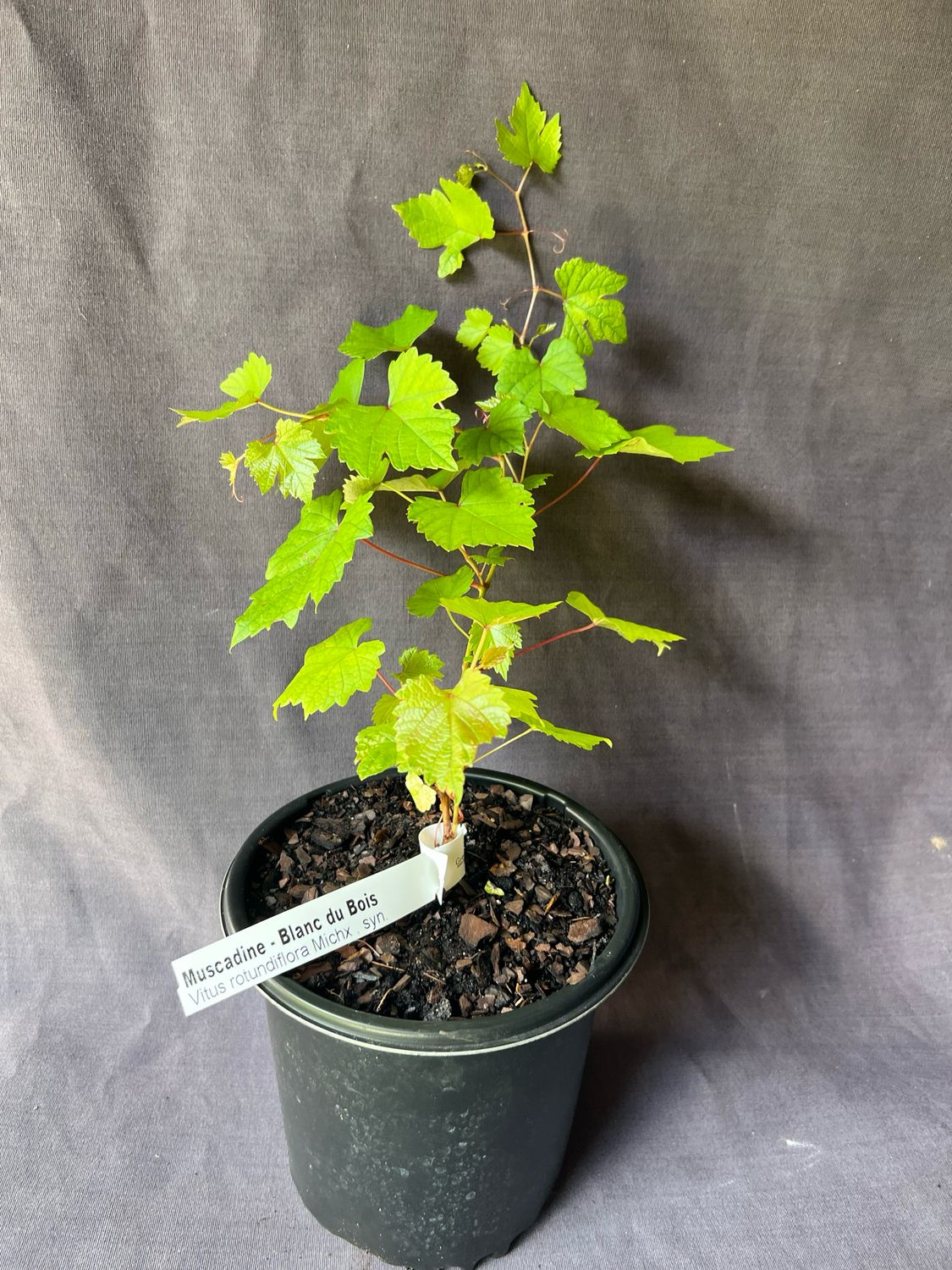
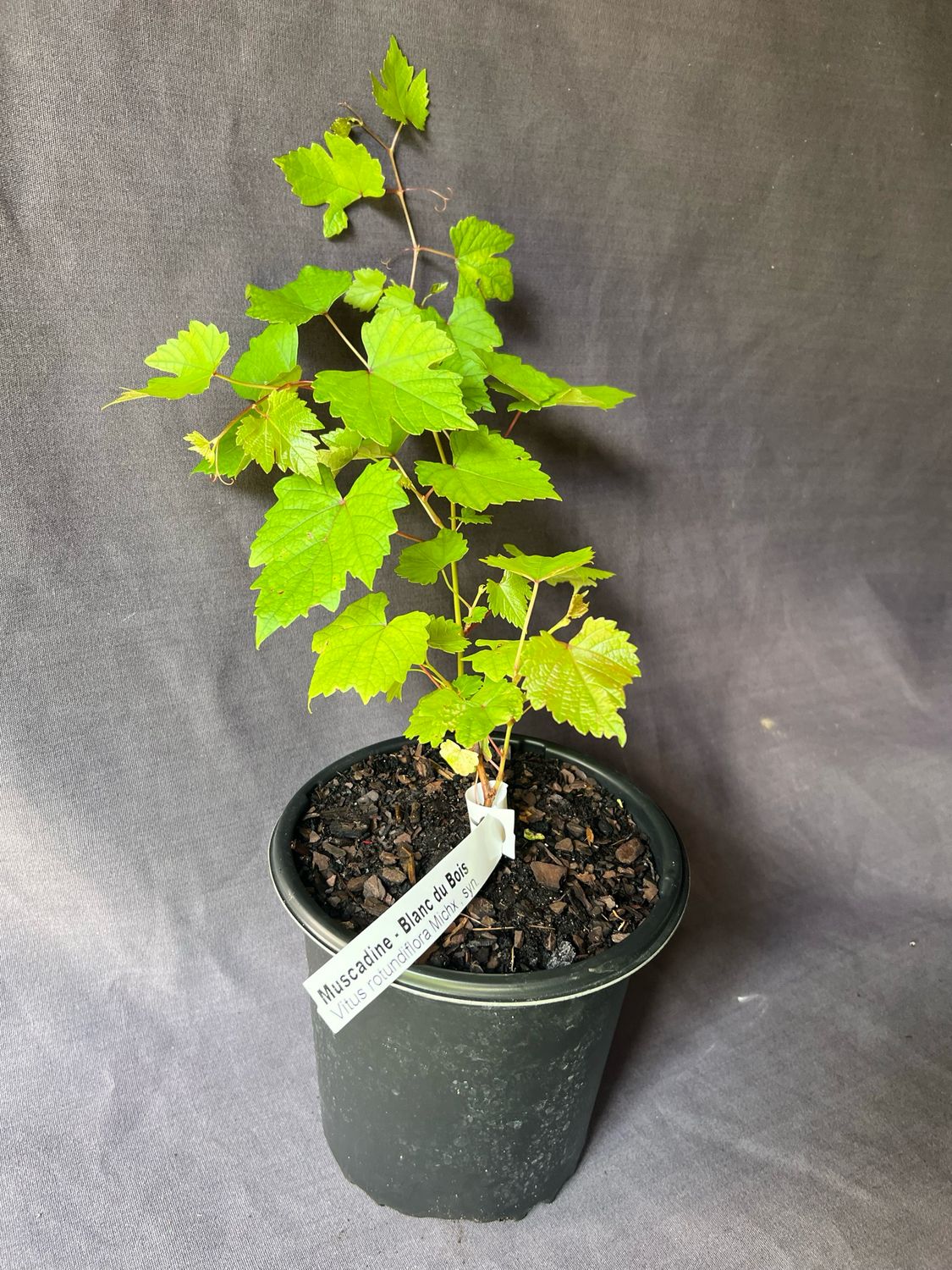
🍇 Blanc du Bois Grape – Florida-Bred White Wine & Table Grape | 1 Gallon
A Florida grape with European ambitions. 🍇🌿
Ships in a 1-gallon container.
If you love the look and flavor of traditional bunch grapes but garden where Florida heat, humidity, summer rain, and Pierce’s disease make ordinary European grapes a struggle, ‘Blanc du Bois’ deserves a spot on your trellis.
This vigorous Florida-bred grapevine produces clusters of beautiful light-green grapes with a juicy, aromatic, Muscat-like flavor and is especially famous for producing fruity, floral, spicy white wines with citrus and tropical-fruit character.
And this isn’t simply another grape that happens to tolerate the South.
Blanc du Bois was literally bred here for it.
Developed through the University of Florida grape-breeding program, this award-winning cultivar has become one of the signature white wine grapes of Florida, Texas, Louisiana, Georgia, and other warm regions where Pierce’s disease severely limits conventional wine grapes.
Whether your plans involve a backyard arbor, fresh grapes straight from the vine, homemade juice and jelly, or your own small-batch white wine, Blanc du Bois brings a very different grape-growing experience to warm-climate gardens.
🌿 Blanc du Bois Quick Facts
| Quick Fact | Blanc du Bois |
|---|---|
| Botanical Name | Vitis spp. ‘Blanc du Bois’ |
| Plant Type | Deciduous perennial interspecific hybrid bunch grapevine |
| Sale Size | 1-gallon container |
| Estimated Nursery Age | Generally around one growing season; exact age and vine length vary by propagation and production cycle |
| Origin | University of Florida, Leesburg, Florida, USA |
| Parentage | Florida D6-148 × ‘Cardinal’ |
| Original Selection | Florida H18-37 |
| Cross Made | 1968 |
| Official Release | 1987 |
| Fruit Color | Light green to green-gold when mature |
| Berry Size | Medium bunch grape; historically averages about 2.9 grams per berry |
| Cluster Size | Historically about 133 grams with roughly 45–55 berries |
| Seeds | Seeded; original UF observations averaged about 3 seeds per berry |
| Flavor | Juicy, aromatic, Muscat-like; fruity and spicy |
| Primary Uses | White wine, fresh eating, juice, jelly, culinary processing |
| Pollination | Self-fruitful — one vine can produce fruit |
| Growth Habit | Very vigorous climbing vine requiring a trellis, arbor, or wire system |
| Managed Height | Commonly trained to approximately 5–7 ft high |
| Mature Spread | Approximately 7–12+ ft per vine depending on trellis and pruning |
| Unpruned Size | Can ramble far beyond its allotted space; grapevines do not have a fixed mature size |
| Recommended Spacing | Approximately 7–8 ft between vines; commercial rows commonly spaced about 10 ft apart |
| Sun | Full sun — ideally 6–8+ hours daily |
| Soil | Well-drained sandy loam or similar aerated soil |
| Preferred Soil pH | Around 6.0; slightly acidic conditions are ideal |
| Water | Moderate; consistent during establishment and fruit development without waterlogging |
| Florida Harvest | Generally late June through July, varying by location and season |
| Georgia / Upper Southeast Harvest | Commonly mid- to late July; sometimes extending into August farther north |
| USDA Growing Range | Best documented in Zones 8–10; warmer Zone 11 sites may also support growth where dormancy requirements are met |
| Cold Consideration | Winter hardiness is not as thoroughly defined as many northern grapes; early budbreak increases late-frost risk |
| Pierce’s Disease | Strongly tolerant/resistant — a major reason the cultivar was developed |
| Salt Tolerance | Not a beachfront salt-spray plant; protect from concentrated salt spray and saline irrigation |
| Wind Tolerance | Established vines tolerate ordinary wind well when securely trellised; tender shoots and loaded vines can be damaged during storms |
| Container Growing | Yes, with a large final container and substantial support |
| Indoor Growing | Not recommended long-term |
Grower note: Blanc du Bois is not a muscadine. It produces true bunches of grapes and offers a distinctly different eating, growing, and winemaking experience.
🍇 What Does Blanc du Bois Taste Like?
This is where Blanc du Bois earns its following.
The original University of Florida cultivar description characterized the berries as:
- Round
- Light green
- Juicy
- Slip-skin
- Muscat-flavored
- Seeded
Fresh from the vine, expect an aromatic grape rather than the neutral sweetness of a supermarket seedless grape.
There can be notes of:
- 🌸 Floral aromatics
- 🍋 Citrus
- 🍐 Tree fruit
- 🌴 Tropical fruit
- 🌿 Herbal or grassy nuances
- ✨ Light spice
The flavor becomes even more interesting when the grapes are fermented. Blanc du Bois wines are frequently described as floral, citrusy, fruity, spicy, and European-inspired, sometimes inviting comparisons with aromatic white grapes such as Riesling and Muscat.
Skin & Texture
Blanc du Bois is a slip-skin grape, meaning the pulp separates relatively easily from the skin when squeezed.
That makes the eating experience different from a crisp seedless table grape but familiar to anyone who enjoys traditional American bunch grapes.
The berries are:
- Juicy rather than crunchy
- Medium sized
- Thin-to-moderate skinned
- Seeded
- Aromatic
Can You Eat Blanc du Bois Fresh?
Absolutely.
Although modern commercial recommendations emphasize Blanc du Bois primarily as a wine grape, its original breeding program was actually seeking an early-ripening, disease-resistant grape suitable for eating as well.
For the backyard grower, there is no rule saying these grapes need to make it as far as the winepress.
🍷 The Grape That Helped Put Florida Wine on the Map
Blanc du Bois has a particularly good origin story because this grape is deeply connected to Florida viticulture.
University of Florida grape breeder John Mortensen made the original cross in 1968 at the Central Florida Research and Education Center in Leesburg.
The seedling was:
- Planted into the vineyard in 1970
- First fruited in 1973
- Selected for additional evaluation in 1974
- Tested as Florida H18-37
- Officially released as ‘Blanc du Bois’ in 1987
Its parents were Florida D6-148 × ‘Cardinal’.
The resulting grape combined genetics from European and American grape species, giving breeders something extremely difficult to accomplish in Florida:
good fruit quality + warm-climate adaptability + Pierce’s disease tolerance.
🌿 So Who Was DuBois?
The cultivar was named in honor of Emile DuBois, a French immigrant who arrived in Florida in the late 1800s and became an important early Florida grape grower and winemaker.
DuBois spent years working to advance viticulture in the Tallahassee area during an era when successfully growing European-style grapes in Florida was no small accomplishment.
Naming this Florida-bred white grape after him connected a modern breeding breakthrough with one of the state’s earlier wine pioneers.
The name translates roughly to White of DuBois — a fitting tribute for a grape that would later become one of Florida’s best-known white wine cultivars.
🍾 From Backyard Vine to Award-Winning Wine
Blanc du Bois eventually gained recognition far beyond experimental vineyards.
Florida-made Blanc du Bois wines received major competition awards, including multiple double-gold medals, helping establish the cultivar as more than simply a disease-resistant alternative.
It proved that growers in hot, humid regions could produce a premium-style white wine without forcing traditional European Vitis vinifera cultivars into a climate where Pierce’s disease makes them exceptionally difficult to maintain.
Historically, Blanc du Bois fruit from Florida trials averaged approximately:
- 17–18° Brix
- pH around 3.2–3.5
- Strong sugar-to-acid balance for white wine production
Modern growers may harvest anywhere around 16–22° Brix, depending on growing region and desired wine style.
🍇 What Can You Make With Blanc du Bois?
Most famous use: white wine.
But home growers have plenty of options:
- Dry white wine
- Off-dry or semi-sweet wine
- Sparkling wine
- Dessert-style wine
- Fresh grape juice
- Grape jelly
- Grape syrup
- Reduction sauces
- Sorbet or granita
- Fresh fruit
- Mixed grape preserves
- Fermented culinary products
🍯 Easy Kitchen Idea: Fresh Grape Juice Base
- Remove ripe grapes from the stems.
- Gently crush and simmer with a small amount of water.
- Strain the juice from skins and seeds.
- Chill for fresh juice or use as the base for jelly, syrup, sorbet, or other recipes.
The aromatic character makes Blanc du Bois especially interesting anywhere you want more flavor than a neutral grocery-store grape provides.
🌱 Why Grow Blanc du Bois?
1. It was bred for warm, humid conditions.
Growers in Florida and the Gulf Coast face challenges that simply do not exist in California or traditional European wine regions.
Blanc du Bois was selected with those conditions in mind.
2. Strong Pierce’s disease tolerance.
Pierce’s disease, caused by Xylella fastidiosa, is one of the biggest reasons conventional European wine grapes struggle in Florida.
Blanc du Bois is one of the cultivars that changed that equation.
3. It produces a familiar bunch-grape experience.
If muscadines are not quite your thing, Blanc du Bois offers:
clusters + juicy light-green fruit + aromatic wine-grape character.
4. One vine can fruit.
Blanc du Bois has self-fertile flowers and does not require a separate pollenizer cultivar.
5. It is beautiful on a trellis or arbor.
During the growing season, vigorous foliage can quickly cover:
- Arbors
- Pergolas
- Vineyard wire
- Decorative trellises
- Fence-line systems
6. Commercial-quality genetics for backyard growers.
You are growing the same cultivar that has been used by professional vineyards across Florida, Texas, Louisiana, Georgia, and other southeastern wine regions.
Pretty cool for the backyard.
🍇 Blanc du Bois vs. Other Grapes in the GreenDreams Collection
Availability changes seasonally, but Blanc du Bois occupies a very different niche from our Florida-adapted muscadine selections.
| Cultivar | Grape Type | Fruit | Best Known For | Pollination | Best Fit |
|---|---|---|---|---|---|
| Blanc du Bois | Interspecific bunch grape | Light green, medium, clustered | Premium white wine + fresh eating | Self-fruitful | Growers wanting traditional bunch grapes in warm climates |
| Alachua | Muscadine | Black/purple, medium | Wine, juice & jelly | Self-fruitful | Productive Florida muscadine plantings |
| Carlos | Muscadine | Bronze, medium | Heavy production, juice & muscadine wine | Self-fruitful | High-yield processing |
| Delicious | Muscadine | Black/purple, larger fruit | Fresh eating, thinner skin & early season | Self-fruitful | Backyard fresh-fruit growers |
| Southern Home | Muscadine hybrid | Dark fruit | Fresh eating + highly ornamental foliage | Self-fruitful | Edible landscapes and decorative arbors |
| Welder | Muscadine | Bronze, smaller fruit | Juice & wine | Self-fruitful | Processing and traditional muscadine production |
The Simple Version
Choose Blanc du Bois if:
You want a true bunch grape with white-wine potential.
Choose Delicious or Southern Home if:
Fresh muscadine eating and ornamental value are higher priorities.
Choose Carlos, Alachua, or Welder if:
Your main goal is juice, jelly, or traditional muscadine wine production.
🌞 Where to Plant Blanc du Bois
If you remember one rule, make it this:
Sun + airflow + drainage.
Those three ingredients matter enormously when growing Blanc du Bois in Florida.
Choose a site with:
- 6–8+ hours of direct sunlight
- Excellent air movement
- Well-drained soil
- Space for a permanent trellis
- Easy access for pruning and harvesting
- Irrigation available during establishment
- Room to keep foliage away from structures and neighboring trees
Best Florida Locations
An open sunny garden, orchard edge, vineyard row, or sunny fence line generally works far better than a protected, heavily shaded corner.
Whenever possible, commercial-style rows are oriented roughly north to south, helping expose both sides of the canopy to sunlight.
Avoid Planting:
- Beneath large shade trees
- Against dense hedges with poor airflow
- In standing water
- In low drainage basins
- Beside frequently irrigated lawns
- Where sprinkler systems regularly soak the foliage
- Immediately against the Gulf or Atlantic where direct salt spray is constant
- Where mature vines cannot be reached for pruning
- Where there is nothing substantial to support the vine
🌿 Trellis First — Vine Second
Do not underestimate Blanc du Bois.
This is a vigorous grapevine, and a decorative tomato cage will not cut it once the plant matures.
A permanent grape trellis is ideal.
UF/IFAS describes systems using approximately 6-ft-high wire supported by substantial posts.
For backyard growing, suitable options include:
- Single-wire grape trellis
- High-wire cordon
- Horizontally divided trellis
- Strong pergola
- Heavy-duty arbor
- Substantial fence-wire system
Because Blanc du Bois can be vigorous and somewhat spreading or semi-drooping, horizontally divided systems can be particularly useful where growing conditions create excessive vigor.
💡 GreenDreams Tip
Build the trellis before or immediately after planting.
Trying to untangle a 12-ft grapevine six months later and convince it that the new trellis was the plan all along is significantly less fun.
🌱 How to Plant a Blanc du Bois Grape
FIRST: Let Your Shipped Plant Recover
After UPS transit, do not immediately transplant your new Blanc du Bois grapevine.
Keep it in its original GreenDreams container while it adjusts.
We generally recommend waiting:
approximately 30 days OR until healthy new growth shows that the plant has recovered from shipping.
During that period:
- Place it in appropriate light gradually.
- Keep the container evenly watered.
- Do not allow the small root ball to dry completely.
- Avoid immediately fertilizing a stressed plant.
- Watch for healthy new growth.
If your grapevine arrives during its natural dormant period, visible new growth may not occur immediately. In that situation, dormancy and root condition should be considered along with your local planting season rather than waiting indefinitely for leaves.
🌿 GreenDreams High & Tight Planting Method
Blanc du Bois needs excellent drainage, so planting too deep is one of the easiest mistakes to avoid.
- Dig a hole only slightly wider than the container.
- Keep the original root ball intact whenever possible.
- Position the original soil line at surrounding grade or very slightly above it.
- Do not bury the trunk or crown beneath several inches of new soil.
- Backfill firmly with native soil and/or modest compost incorporation.
- Water deeply to settle the root zone.
- Top-dress around — not against — the vine with organic material.
- Apply hardwood mulch while leaving open space directly around the stem.
- Connect the young vine to its training stake or trellis.
🎥 Watch Our GreenDreams High & Tight Planting Method
https://youtu.be/RRQFY30qdA8?si=rRIcsbLlVAVYotfI
💧 Watering Blanc du Bois Correctly
NO OVERHEAD WATERING
This matters more with grapes than with many edible landscape plants.
Water the soil — not the leaves.
Warm, humid conditions already create substantial fungal disease pressure. Repeatedly wetting grape leaves and fruit only extends the amount of time disease organisms have favorable conditions.
Best Practice
- Water in the morning
- Water at soil level
- Use drip irrigation whenever possible
- Avoid overhead misters
- Avoid lawn sprinklers hitting the vine
- Avoid routine afternoon/evening foliage watering
🪴 Watering While Still in the 1-Gallon Container
A 1-gallon grapevine can dry much faster than a mature in-ground vine.
Check the container daily during warm weather.
Water thoroughly whenever the upper potting mix begins drying.
During Florida summer heat, this may mean daily watering.
The goal is:
even moisture + good oxygen — never permanent saturation.
🌱 Newly Planted in the Ground
Young grapes planted into Florida sand can require water every 2–3 days during dry weather until establishment.
Adjust according to:
- Temperature
- Rainfall
- Soil texture
- Wind
- Plant size
- Mulch
- Root development
Never water simply because the calendar says so.
Check the soil.
🌿 Established Vines
During active spring growth, approximately 1–1½ inches of water per week from rainfall and irrigation is a useful production benchmark.
Mature established vines can handle periods of moderate dryness, but drought stress during flowering and fruit development can reduce crop quality.
Conversely, continuously saturated soil encourages weak roots and disease.
Drip irrigation wins this category.
🌾 Soil & Fertility
Blanc du Bois adapts to many southeastern soils but performs best when roots have:
- Oxygen
- Drainage
- Organic matter
- Balanced nutrition
- Slightly acidic soil
A soil pH around 6.0 is a good target.
Before Fertilizing
Whenever possible, start with a soil test.
More fertilizer does not automatically equal more grapes.
Blanc du Bois is already vigorous. Excess nitrogen can create an enormous leafy canopy that:
- Shades fruit
- Reduces airflow
- Holds humidity
- Encourages disease
- Increases pruning work
- Delays balanced fruit production
🌿 GreenDreams Organic Approach
Instead of chasing rapid growth, build soil biology gradually with:
- Finished compost
- Worm castings
- Biochar incorporated or charged appropriately
- Trace mineral amendments according to soil needs
- Balanced organic fruit/vine fertilizer
- Hardwood mulch
Keep concentrated fertilizer away from the vine trunk.
Feeding Schedule
For young plants, use small, split applications once active growth begins instead of one huge dose.
For established Florida vines, the main nutrient windows are generally:
- Late winter / beginning of spring growth
- Late spring during vigorous growth
- A modest post-harvest application when soil testing and vine condition justify it
Avoid pushing excessive soft growth with heavy nitrogen late in the season.
🧪 Read the Vine
If a mature Blanc du Bois is producing massive shoots and dark-green foliage but little fruit, the answer probably is not more nitrogen.
🪵 Mulching Blanc du Bois
Mulching is very useful, especially in Florida sand.
Use approximately 2–4 inches of coarse organic mulch, extending outward through the root zone.
Benefits include:
- Reduced soil-temperature swings
- Greater moisture retention
- Weed suppression
- Organic-matter development
- Better soil biology
Keep the Stem Clear
Do not pile mulch against the trunk or crown.
Think:
mulch doughnut — not mulch volcano.
✂️ Pruning Blanc du Bois — This Is Not Optional
Grapevines fruit best when regularly trained and pruned.
Leaving Blanc du Bois completely unpruned may produce more clusters initially, but UF/IFAS notes that unpruned vines develop smaller clusters and berries and become increasingly difficult to manage.
Pruning also improves:
- Air movement
- Sun penetration
- Spray coverage when treatments are needed
- Fruit quality
- Harvest access
- Disease prevention
- Long-term structure
Florida Dormant Pruning Windows
UF/IFAS recommends bunch-grape pruning during dormancy approximately:
| Region | Typical Pruning Period |
|---|---|
| South Florida | January |
| Central Florida | January through approximately February 15 |
| North Florida | January through approximately March 10 |
Weather changes every year, so watch your vine rather than pruning solely by date.
Young Vine Training
During year one:
- Choose one vigorous shoot as the main trunk.
- Train it vertically toward the trellis wire.
- Remove competing basal shoots.
- Once the trunk reaches the wire, begin developing lateral arms.
- Do not prioritize fruit production over building structure.
A strong permanent framework pays dividends later.
Mature Cane Pruning
Traditional Florida bunch-grape management retains productive new wood and renewal spurs.
Fruit develops from shoots arising from buds on one-year-old wood.
That means annual pruning is how you continuously replace exhausted fruiting wood with fresh productive growth.
Do Not Fear Grapevine Bleeding
Sap may drip from fresh pruning cuts as the vine wakes in spring.
That phenomenon is commonly called bleeding and is generally normal.
🍂 Yes — Blanc du Bois Is Deciduous
This is important for Florida growers accustomed to evergreen tropical fruit plants.
Blanc du Bois naturally enters a dormant period.
Leaf drop does not mean the plant died.
🌱 Spring — Wake Up & Move
Expect:
- Bud swelling
- New shoots
- Fast vine growth
- Small flower clusters
- Increasing water demand
Blanc du Bois tends to break bud relatively early.
That helps produce an early crop but also makes emerging shoots vulnerable to late freezes farther north.
Spring priorities:
- Tie and train new shoots
- Remove unwanted suckers
- Begin disease scouting immediately
- Maintain airflow
- Keep soil moisture consistent
- Protect tender growth if a late freeze is predicted
🌞 Summer — Fruit Mode
In Central Florida, fruit development moves quickly.
Expect:
- Rapid canopy growth
- Full-sized clusters
- Increasing fruit sweetness
- Heavy fungal disease pressure during rainy weather
- Bird interest increasing dramatically
Florida harvest can begin around late June and extend through July, depending on weather and location.
Summer priorities:
- Maintain open canopy
- Inspect after heavy rain
- Keep irrigation off foliage
- Net fruit before birds discover it
- Remove diseased berries quickly
- Harvest promptly at desired ripeness
🍂 Fall — Recharge the Vine
After harvest, healthy foliage remains important because the plant is replenishing carbohydrate reserves for next year’s growth.
Do not immediately strip healthy leaves.
As days shorten and temperatures cool:
- Growth slows
- Leaves may yellow
- Older leaves may spot
- Foliage eventually drops
- Canes mature from green to woody brown
Some spotting during late-season senescence may be cosmetic, but severe premature defoliation can indicate fungal disease.
🧘 Winter — Dormancy Is Normal
A dormant Blanc du Bois may look like little more than bare woody sticks attached to a trellis.
That is exactly what a deciduous grapevine is supposed to look like.
Winter is the season for:
- Structural evaluation
- Dormant pruning
- Trellis repair
- Removing mummified fruit
- Removing diseased canes
- Cleaning debris from beneath vines
- Dormant disease management where appropriate
Do not throw away a dormant grapevine because it has no leaves.
🪴 Growing Blanc du Bois in a Container
Yes — but think bigger than the 1-gallon nursery pot.
The 1-gallon container is a shipping and establishment size, not a permanent home.
Suggested Progression
4-inch starter → 1 gallon → 3 gallon → 7 gallon → 15–25+ gallon final container
You do not need to move through every size mechanically.
Up-pot when you see:
- Roots circling heavily
- Roots emerging from drainage holes
- Container drying unusually fast
- Slowed growth despite good care
- The plant becoming physically unstable
Do Not Jump Straight Into an Oversized, Wet Pot
A tiny root system sitting in a giant mass of water-retentive media can stay wet too long.
Move up gradually.
Recommended Container Mix
Blanc du Bois needs a mix that holds moisture without staying soggy.
A useful grape-container blend is approximately:
- 2 parts high-quality pine-bark-based potting mix
- 1 part coco coir or peat-based material
- 1 part coarse perlite, pumice, or similar drainage material
The exact ingredients can vary.
The goal is a:
coarse + aerated + fast-draining + moderately moisture-retentive mix.
Avoid using dense garden soil by itself inside a pot.
You can find larger nursery containers and bark-based potting materials through independent garden centers, hydroponic suppliers, landscape suppliers, farm stores, and online nursery-supply retailers.
Final Container Size
For long-term fruit production, aim for at least 15–25 gallons, with larger containers offering more root volume and moisture stability.
The container must have substantial drainage holes.
And remember:
the pot may contain the roots — it will not contain the vine.
You still need a serious trellis.
🏠 Can Blanc du Bois Be Grown Indoors?
Not successfully as a normal long-term houseplant.
Blanc du Bois needs:
- Full outdoor sunlight
- Significant air movement
- Large root volume
- A major support structure
- Seasonal temperature changes
- Winter dormancy
- Annual pruning
A greenhouse or specialized controlled growing system is another story, but a bright living-room window is not enough for reliable grape production.
Container plants can certainly be moved temporarily for protection from unusual cold, storms, or shipping recovery.
For permanent culture, though:
Blanc du Bois belongs outside.
🌬️ Wind & Coastal Growing
Wind
Blanc du Bois can perform well in breezy sites, and good airflow actually helps reduce leaf-wetness duration.
The limiting factor is the support system.
Tropical storms can:
- Snap tender shoots
- Tear foliage
- Break overloaded arms
- Drop fruit
- Collapse weak trellises
Use durable posts, wire, and anchors.
Salt
Grapevines as a group have some tolerance of moderate soil salinity, but Blanc du Bois should not be treated like a highly salt-tolerant coastal landscape plant.
For beachfront or barrier-island properties:
- Shield vines from direct ocean spray.
- Avoid saline irrigation water.
- Locate vines behind buildings or salt-tolerant windbreaks.
- Monitor leaf margins for salt burn.
- Flush container media periodically if salts accumulate.
A few miles inland is very different from directly behind the dune line.
⚠️ Important Reality Check: Pierce’s Disease Resistant Does NOT Mean Disease-Proof
This distinction is critical.
Blanc du Bois became famous because of its ability to tolerate Pierce’s disease, but southeastern growers still need to manage fungal disease.
In fact, current southeastern research identifies anthracnose as one of Blanc du Bois’ most significant weaknesses.
Other diseases that may appear include:
- Downy mildew
- Black rot
- Bitter rot
- Ripe rot
- Sour rot
- Phomopsis/cane disease
- Other fruit rots
🍄 Anthracnose
Blanc du Bois can be highly susceptible.
Typical symptoms include:
- Dark lesions on shoots
- Black spots on leaves
- Shot-hole appearance as damaged leaf tissue falls out
- Purple-to-dark lesions on fruit
- Sunken berry spots sometimes called bird’s-eye rot
Warm, wet conditions favor disease development.
🍃 Downy Mildew
Do not rely on older descriptions claiming complete resistance.
Current southeastern observations confirm that downy mildew can significantly affect Blanc du Bois, particularly during prolonged wet weather.
Look for:
- Yellow or oily spots on upper leaves
- White downy fungal growth underneath
- Premature defoliation
- Young fruit infection
Why Leaf Health Matters
A grapevine that loses its foliage prematurely cannot manufacture and store carbohydrates effectively.
That can affect:
- Fruit quality
- Next year’s crop
- Winter resilience
- Overall vine longevity
♻️ Organic Disease Management: Prevention Wins
Growing grapes organically in Florida requires attention.
Blanc du Bois makes the job more realistic than highly Pierce’s-disease-susceptible European grapes — but humid-climate grape growing still rewards proactive management.
Your Best Tools Are Cultural
- Full sun
- Open canopy
- Correct spacing
- Dormant pruning
- Immediate removal of diseased fruit
- Removal of mummified grapes
- Removal of infected pruning debris
- Drip irrigation
- No overhead watering
- Good drainage
- Moderate rather than excessive nitrogen
Dormant Anthracnose Management
Where anthracnose has been a recurring problem, extension recommendations commonly include a delayed-dormant lime-sulfur treatment shortly before budbreak.
Organic growers should verify that the specific material:
- Is labeled for grapes
- Is labeled for the disease being treated
- Is permitted under their intended organic program
- Is appropriate for local conditions
Copper & Other Organic-Compatible Materials
Certain copper products may be useful against diseases such as downy mildew.
However:
copper and sulfur products can injure grape foliage under certain conditions.
Always:
- Read the complete label
- Confirm grapevine use
- Follow temperatures and timing restrictions
- Avoid combining incompatible materials
- Contact your local Extension office when uncertain
The label is the law.
🔍 Blanc du Bois Troubleshooting Guide
Icons represent common issues and organic solutions — look for 🌿 for recovery tips!
| ⚠️ Issue | 🧠 Likely Cause | 🌿 What to Do |
|---|---|---|
| 🍂 Leaves yellowing in late fall | Normal dormancy | ✅ Allow natural leaf drop; prepare for dormant pruning |
| 🍂 Leaves falling in midsummer | Disease, saturated roots, severe drought or nutrient stress | 🔍 Inspect leaves and soil before fertilizing |
| 🍄 Black/purple spots with holes in leaves | Possible anthracnose | ✂️ Remove infected tissue; increase airflow; plan dormant sanitation |
| 🍄 Yellow oily leaf spots + white growth underneath | Downy mildew | 🌿 Improve airflow, keep foliage dry and consult local disease-control guidance |
| 🍇 Berries develop dark sunken lesions | Anthracnose or fruit rot | ✂️ Remove affected fruit immediately; sanitation is critical |
| 🍇 Grapes shrivel or rot before harvest | Fruit rot + prolonged wet conditions | 🌞 Thin canopy, improve airflow, remove infected clusters and harvest promptly |
| 💧 Vine wilts despite wet soil | Root oxygen problems / poor drainage | 🪣 Reduce saturation and correct drainage |
| 💧 Young vine wilts in dry Florida sand | Underwatering | ✅ Deeply water root zone and check moisture every 1–3 days during establishment |
| 🌱 Huge leafy vine but little fruit | Excess nitrogen or improper pruning | ✂️ Reduce nitrogen and improve annual dormant pruning |
| 🍇 Tiny clusters / small berries | Overcropping, inadequate pruning, stress | ✂️ Restore balanced pruning and vine health |
| ☁️ Weak growth + little fruit | Too much shade | 🌞 Increase sunlight or relocate before vine becomes mature |
| 🌬️ Broken shoots | Wind or inadequate support | 🪵 Install stronger trellis and secure young canes |
| ❄️ New spring growth turns brown | Late frost | ✂️ Wait before removing damaged tissue; allow secondary growth to emerge |
| 🐛 Leaves skeletonized or chewed | Beetles/caterpillars | 🔍 Identify pest before treatment; encourage predators and use targeted controls |
| 🐦 Fruit disappears as it ripens | Birds | ✅ Install vineyard netting before fruit becomes attractive |
| 🌳 Whole vine weakens over time | Root/crown issue, borer damage, disease or drainage problem | 🔍 Inspect crown and roots rather than simply adding fertilizer |
🐦 Birds Will Find Your Grapes
Sometimes before you do.
Birds can damage developing clusters by:
- Eating berries
- Pecking fruit
- Opening wounds that encourage rot
Netting is usually the most reliable physical protection for a backyard grape crop.
Install it before peak ripening, not after the neighborhood birds send out the group text.
🐕 Pet Caution
Grapes are food for humans — not dogs.
Grapes and raisins have been associated with serious kidney injury in dogs.
If your landscape includes dogs that regularly eat fallen fruit, consider:
- Harvesting frequently
- Removing dropped grapes
- Restricting access during harvest
Do not intentionally feed Blanc du Bois grapes or raisins to pets.
🌟 Is Blanc du Bois Right for You?
✅ IDEAL FOR:
- Florida gardeners wanting bunch grapes
- Southeastern growers
- Texas Gulf Coast growers
- Backyard vineyard enthusiasts
- Home winemakers
- Edible landscape growers
- Growers who find conventional wine grapes difficult
- People interested in Florida agricultural history
- Gardeners with full sun
- Properties with space for a permanent trellis
- Growers willing to prune annually
- Anyone wanting something genuinely different from a muscadine
❌ NOT IDEAL FOR:
- Deep shade
- Poorly drained or frequently flooded sites
- Gardeners unwilling to prune
- Locations where overhead irrigation constantly wets foliage
- Tiny spaces without a support structure
- Highly exposed beachfront salt-spray sites
- People expecting a completely disease-free grape
- Long-term indoor growing
- Growers expecting seedless supermarket-style grapes
- Very cold northern regions without careful site selection and winter planning
Blanc du Bois is easier to grow in the Deep South than many traditional wine grapes — not maintenance-free.
That distinction sets realistic expectations and produces happier growers.
❓ Blanc du Bois Grape FAQ
Is Blanc du Bois a muscadine?
No.
Blanc du Bois is an interspecific hybrid bunch grape. Its berries form true grape clusters rather than the looser clusters typical of muscadines.
Can Blanc du Bois grapes grow in Florida?
Yes — Florida is where Blanc du Bois was developed.
It was bred through the University of Florida grape program and selected specifically for conditions where Pierce’s disease makes ordinary European wine grapes difficult to grow.
Is Blanc du Bois resistant to Pierce’s disease?
Blanc du Bois has strong Pierce’s disease tolerance/resistance and was selected largely for that reason.
However, it is not resistant to every grape disease.
Anthracnose, downy mildew, and fruit rots still require careful management in humid climates.
Does Blanc du Bois need another grape for pollination?
No.
The flowers are self-fertile, so a single healthy vine is capable of setting fruit.
Additional grape cultivars are optional, not required for pollination.
When does Blanc du Bois ripen in Florida?
Usually late June through July, depending on location and season.
Historical UF trials harvested fruit as early as late June in Central Florida and during early July farther north.
When does Blanc du Bois ripen in Georgia and the upper Southeast?
Typically around mid- to late July, with harvest moving somewhat later in cooler areas.
How long before a Blanc du Bois grape produces fruit?
Do not expect a full crop immediately.
Well-established grapevines often begin producing meaningful crops around their second or third growing season, depending on starting size, pruning, climate and establishment.
Build the trunk and trellis structure first.
Fruit comes later.
Can you eat Blanc du Bois grapes fresh?
Yes.
The berries are juicy, aromatic, seeded, and Muscat-like.
The cultivar is best known for wine, but fresh eating is absolutely possible.
Is Blanc du Bois seedless?
No.
It is a seeded grape.
The original cultivar evaluation averaged a little over three seeds per berry.
What does Blanc du Bois wine taste like?
Depending on vineyard conditions and winemaking style, Blanc du Bois is associated with:
- Floral aromas
- Citrus
- Tropical fruit
- Tree fruit
- Spice
- Light herbal/grassy character
It can produce dry, off-dry, sparkling and sweet wine styles.
Does Blanc du Bois need a trellis?
Absolutely.
This is a vigorous climbing grapevine and needs permanent support.
A commercial-style wire trellis, sturdy arbor, or substantial pergola is much more appropriate than a lightweight garden trellis.
Can Blanc du Bois grow in a pot?
Yes.
Start with the 1-gallon nursery container and progressively up-pot as roots develop.
For permanent container culture, a 15–25+ gallon container with excellent drainage and a substantial trellis is preferred.
Can I grow Blanc du Bois indoors?
Not realistically as a productive long-term houseplant.
It needs strong outdoor sun, airflow, a large support system, annual pruning and seasonal dormancy.
Should Blanc du Bois be pruned every year?
Yes.
Annual dormant pruning is one of the most important steps for maintaining productive grapevines.
Why is my Blanc du Bois grape losing its leaves in winter?
Because it is deciduous.
Winter leaf loss and dormancy are normal.
The vine should return from healthy buds as temperatures warm.
Why is my Blanc du Bois not producing grapes?
Common reasons include:
- Vine is still too young
- Too much shade
- Excess nitrogen
- Improper pruning
- Severe disease
- Freeze damage
- Drought during critical growth periods
- Overall weak root establishment
📦 SHIPPING YOUR 1-GALLON BLANC DU BOIS GRAPE
Best Shipping Region
Our 1-gallon live plants are most ideally shipped to Florida, the Southeastern United States, and Texas, where transit from our Florida nursery is generally shorter.
We can ship live plants throughout the continental United States where agricultural regulations permit, but growers farther north or west should carefully consider transit time and seasonal weather.
🚚 UPS Ground Shipping
GreenDreams currently ships live plants using UPS Ground.
Our regular live-plant shipping day is Monday.
Shipping early in the week helps reduce the chance of plants spending an unnecessary weekend sitting inside a carrier facility.
🌡️ Peak Heat & Cold Disclaimer
Live-plant shipping always carries some risk.
Buyer discretion is especially important during:
- Summer heat waves
- Extreme cold
- Freezing weather
- Major storms
- Extended shipping delays
GreenDreams cannot guarantee that a live plant traveling through extreme temperatures will arrive in the same cosmetic condition it left our Florida nursery.
Northern & Western Growers
Extended UPS Ground transit may place more stress on smaller nursery plants.
Potential symptoms after shipping include:
- Leaf yellowing
- Wilt
- Cosmetic leaf damage
- Leaf drop
- Temporary stalled growth
These symptoms do not automatically mean the plant will fail.
Many plants recover once roots are hydrated and new growth begins.
However, the additional transit risk is assumed by the buyer when ordering smaller live plants outside our regional shipping zone.
California Orders
California packages may occasionally experience additional agricultural inspection time.
An additional day in transit can further increase stress during extreme weather.
After Delivery
Do not immediately transplant.
Keep Blanc du Bois in its original container for approximately 30 days or until healthy new growth confirms recovery from transit.
When it is actively growing and the root system begins filling the container, you can decide whether to:
- Up-pot
- Install into a permanent trellis site
- Continue container growing
We recommend larger plant sizes whenever available for customers facing especially long ground transit.
🏡 Shop With Us in Person
📍 Available at GreenDreams Nursery & Farm!
Want to see your grapevine before it comes home with you?
Come shop our retail nursery in Spring Hill, Florida.
We carry hundreds of edible, medicinal, native, tropical, subtropical and ecological plant selections, including many larger plants and seasonal items that never make it into the online store.
GreenDreams Nursery & Farm — Open to the Public
🌾 18709 US Hwy. 41, Spring Hill, FL 34610
🕘 Tuesday–Friday: 9AM–5PM
🌞 Saturday: 8AM–3PM
🌿 Stop by and see what is fruiting, flowering, growing and ready for a new home this week.
Online availability, sizes and pricing may differ from our retail nursery inventory.
🌿 Beyond the Plant: GreenDreams Services
At GreenDreams, we do more than grow plants — we design, build and restore ecosystems across Florida.
- 🌳 Onsite consultations & edible landscape design
- 🚜 Installation & project management
- 🚚 Bulk delivery of compost, mulch, biochar and soil materials
- 🌾 Wholesale & large-scale regenerative solutions
Whether you need one new grapevine or help turning an entire property into a productive edible ecosystem, our goal is to help you put the pieces together correctly from the beginning.
Let our team help you create your own thriving edible paradise — starting with Blanc du Bois. 🍇🌿
🌿 IMPORTANT INFORMATION BEFORE PURCHASING LIVE PLANTS
Please note: Plants purchased through our online store are not available for pickup at our retail nursery in Spring Hill, Florida.
Online inventory is housed at a separate facility and is priced, prepared, and handled exclusively for shipping.
🌱 Looking for larger plants or more selection?
Our retail nursery location offers far more availability, including larger sizes, specialty plants, and many selections not suitable for nationwide shipping.
Local pickup is available for retail nursery purchases only.
Visit our Spring Hill, FL retail nursery page to explore in-person shopping options.
🚚 LIVE PLANT SHIPPING & TRANSIT EXPECTATIONS
Live plants naturally experience stress during shipping. Temporary leaf drop, mild wilting, or cosmetic stress is normal after transit. Most plants recover quickly with proper watering, gradual light exposure, and basic aftercare. Some plants may require additional attention during the first few weeks.
Despite careful packing, minor cosmetic damage may occur during transit. Small issues such as broken leaves or stems typically resolve with time and proper care.
If your shipping box arrives with significant external damage, please contact UPS within 30 days to initiate a carrier claim.
⏱️ SHIPPING METHOD, TIMING & TRANSIT WINDOWS
All online orders ship via UPS Ground from our Central Florida nursery.
📦 Shipping Schedule: Orders ship once weekly on Mondays to reduce the risk of packages sitting in transit over weekends. A countdown clock on our website displays the next shipping date.
🚚 Typical Transit Times:
-
Florida: 1–2 days
-
Southern U.S.: approximately 2 days
-
Midwest, West & Northern U.S.: 3–5 business days
Long-distance shipments, particularly to the western U.S., may experience additional transit time due to agricultural inspections in states such as Arizona, California, and Texas.
Extended transit times can be more challenging for small or tender plants and may require additional recovery care after arrival.
🌡️ EXTREME WEATHER & SEASONAL RISK
Live plants are sensitive to temperature extremes.
We cannot guarantee plant condition during periods of extreme summer heat or winter cold and freezing temperatures. Weather-related delays, carrier interruptions, or exposure during delivery are beyond our control.
Customers are responsible for:
-
Monitoring tracking information sent via email
-
Retrieving packages promptly upon delivery
-
Preventing plants from being left outdoors in extreme conditions
During unsafe weather, holiday shipping volume, or extended transit risk, orders may be held and shipped the following week to protect plant health.
⚠️ CUSTOMER RESPONSIBILITY & REFUND POLICY
By purchasing live plants, customers acknowledge and accept the risks associated with shipping, weather exposure, transit delays, and regional suitability.
Refunds or replacements are considered only under exceptional circumstances and in accordance with our return and refund policy. We are not responsible for:
-
Weather-related damage
-
Carrier delays
-
Poor plant selection for a given climate or region
-
Improper care after delivery
Upon purchase, customers assume full responsibility for the ongoing care and success of their plants.
✅ CONSENT & AGREEMENT
By completing a purchase, you confirm that you have read, understand, and agree to all shipping policies, responsibilities, and conditions outlined above.
Our goal is transparency, plant health, and long-term growing success — and we appreciate your understanding and care when ordering live plants.


