


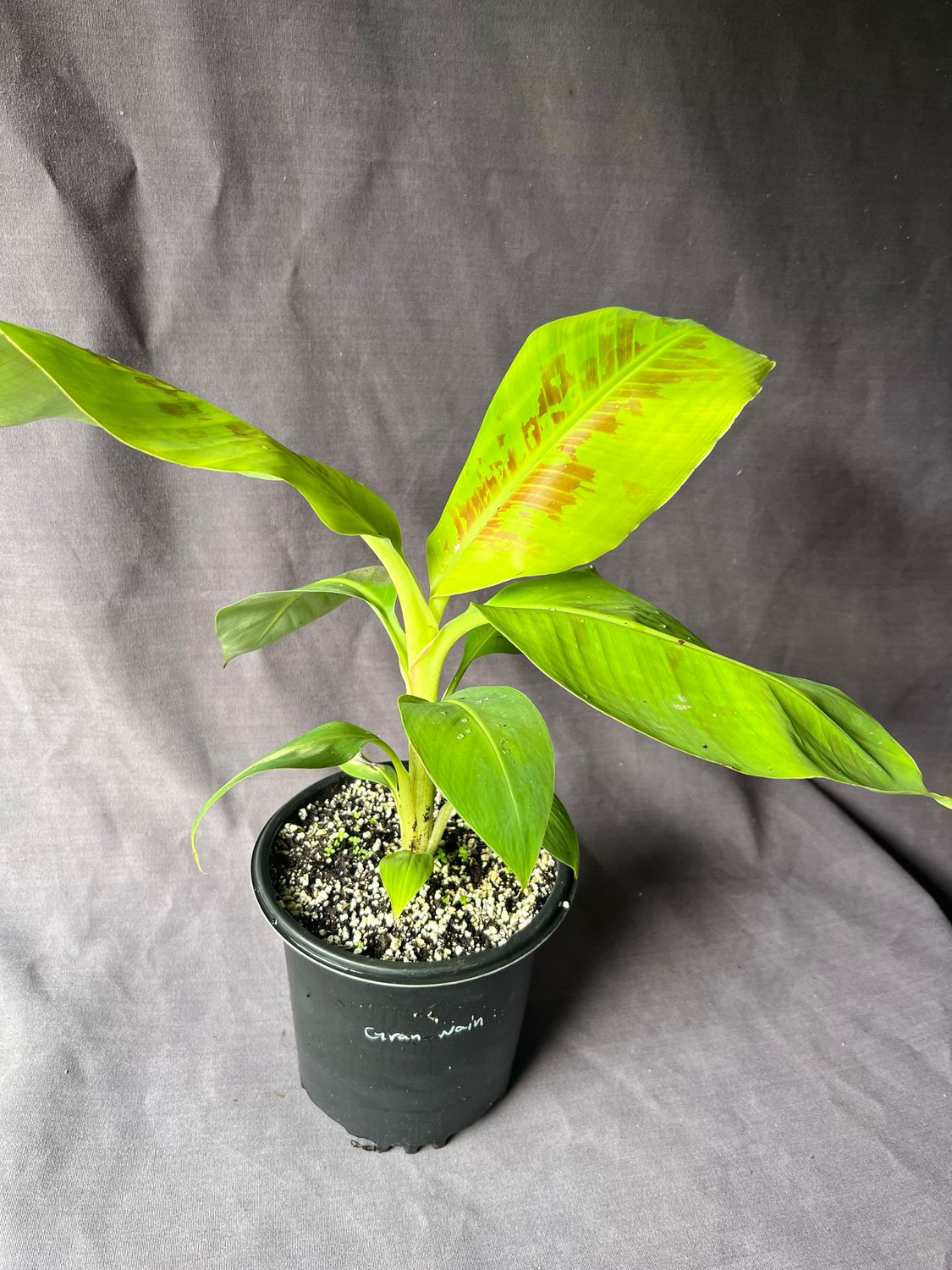
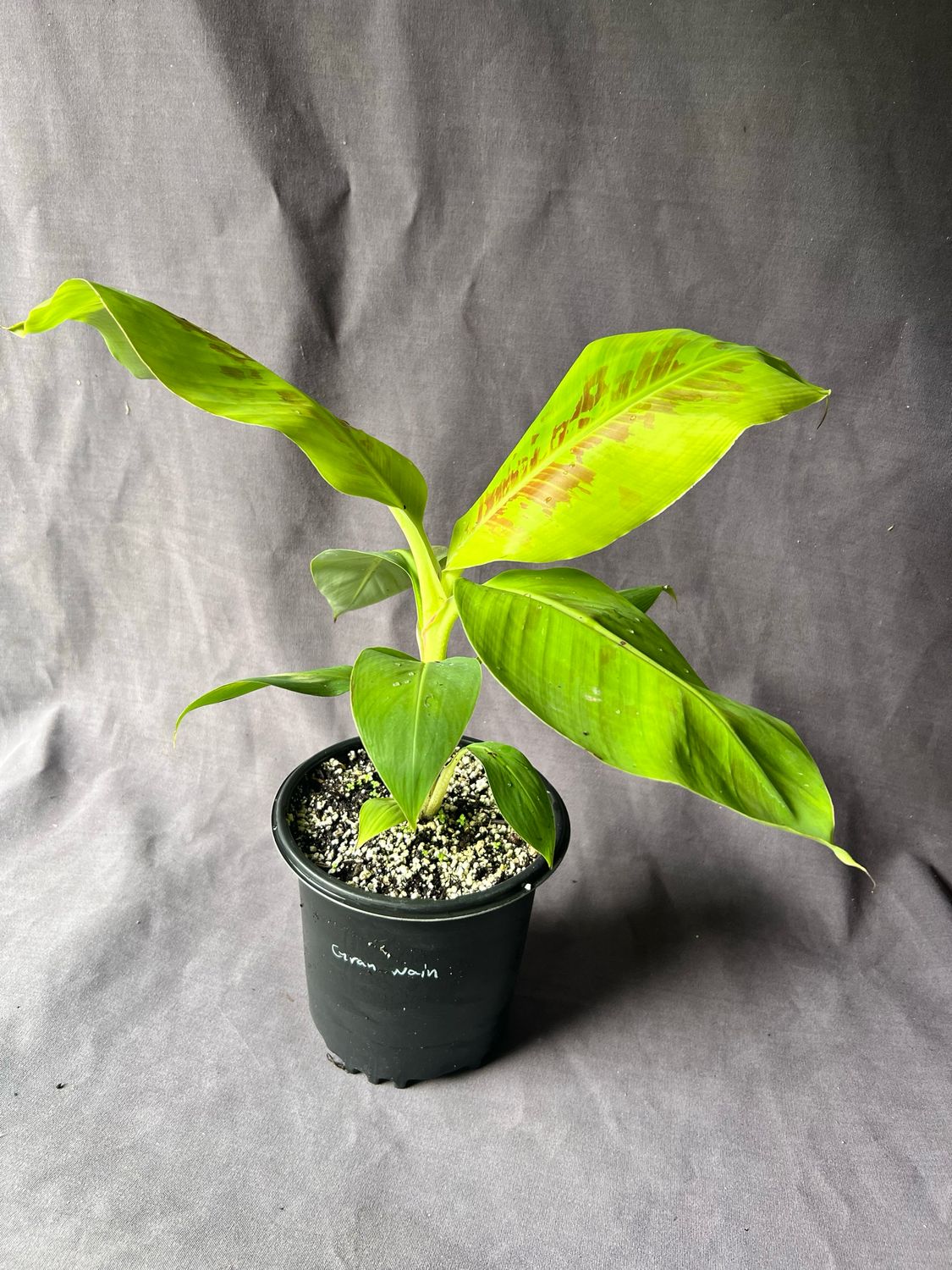
🍌 Grand Nain Banana Plant — Grow the Classic AAA Banana at Home | 1-Gallon
Grow the banana the world already knows—only fresher, locally grown, and harvested from your own backyard. Grand Nain combines manageable height, fast tropical growth, lush ornamental foliage, and generous bunches of smooth, sweet bananas.
This is the classic Cavendish-style banana growers recognize from grocery stores, but fruit allowed to mature properly at home can develop a fuller aroma, creamier texture, and richer sweetness than fruit harvested early for long-distance shipping.
🌿 Grand Nain Banana Quick Facts
| Category | Details |
|---|---|
| Botanical Name | Musa acuminata (AAA Group) ‘Grand Nain’ |
| Accepted Spellings | Grand Nain, Grande Naine, Gran Nain |
| Cultivar Group | Cavendish subgroup, AAA dessert banana |
| Plant Type | Fast-growing, fruiting herbaceous perennial |
| Is It Actually a Tree? | No. The “trunk” is a pseudostem formed from tightly layered leaf sheaths |
| Sale Size | Ships in a 1-gallon nursery container, approximately 3.8 liters |
| Estimated Nursery Age | Commonly approximately 4–8 months, depending on propagation method, season, and nursery conditions |
| Mature Pseudostem Height | Commonly about 6–8 ft |
| Height to Top of Leaves | Frequently 8–12 ft in warm, fertile conditions |
| Mature Width | Approximately 6–10 ft per managed mat |
| Maintained Size | Thin suckers to maintain one fruiting stalk, one follower, and one young sword sucker |
| USDA Zones | Best outdoors in Zones 9b–11; possible in Zones 8–9a with winter protection, container culture, or acceptance of freeze-back |
| Florida Performance | Best fruiting reliability in South Florida and protected Central Florida microclimates |
| Sun Requirements | Full sun preferred; approximately 6–8+ hours daily |
| Light-Shade Tolerance | Tolerates light shade, but shade delays growth and can reduce fruit size and quality |
| Cold Hardiness | Fair cold tolerance for a Cavendish banana, but foliage and fruit are damaged by frost |
| Growth Slowdown | Growth slows below approximately 60°F and nearly stops around 50°F |
| Freeze Response | Temperatures near or below 32°F can severely damage foliage and pseudostems; temperatures below approximately 28°F may kill growth to the ground |
| Soil Preference | Fertile, organic-rich, well-draining soil with a preferred pH around 5.5–7.0 |
| Water Requirements | High moisture demand, but extremely poor tolerance of standing water |
| Spacing | Allow approximately 8–12 ft between managed mats in a home landscape |
| Growth Habit | Upright, clumping, sucker-producing banana mat |
| Wind Tolerance | Better leverage than very tall bananas, but not windproof; leaves shred and fruiting stalks may topple |
| Salt Tolerance | Poor; avoid saline soil, brackish irrigation, and direct coastal salt spray |
| Pollination Needed? | No. Fruit develops without pollination |
| Expected Time to Fruit | Commonly 9–20 months from a small plant under favorable warmth and care; cool weather can extend the cycle |
| Fruit Type | Sweet, seedless dessert banana |
| Typical Fruit Length | Approximately 6–8 inches |
| Potential Bunch Weight | Often 25–50+ lb with excellent culture; actual home-garden yield varies widely |
| Container Growing | Yes, although large containers and intensive care are needed for fruit |
| Indoor Growing | Suitable as a foliage plant; reliable indoor fruiting requires greenhouse-level light, warmth, and space |
| Deciduous? | No. It is an evergreen tropical perennial, but cold or drought can cause major leaf loss |
Banana growth is strongest under uniformly warm conditions. UF/IFAS reports that flowering commonly begins 10–15 months after planting, fruit can take approximately 80–180 days to mature after the flower emerges, and total time from a small plant to harvest may range from 9–20 months.
🍌 Why Grow Grand Nain?
Grand Nain is a powerful choice for growers who want more than tropical decoration.
Top reasons to add it to your edible landscape
- Grow a familiar, family-friendly banana with classic sweet Cavendish flavor.
- Harvest at home instead of relying exclusively on fruit picked early for commercial shipping.
- Enjoy manageable height compared with taller banana cultivars.
- Create fast tropical screening around patios, food forests, pools, and outdoor living spaces.
- Produce abundant organic matter through spent stalks and leaves.
- Build a renewable banana mat that replaces harvested stalks with new suckers.
- Grow in the ground or a large container depending on climate and available space.
- Use the fruit fresh, frozen, baked, blended, dried, or cooked while green.
- Experience one of the most commercially important banana types as a living plant rather than simply a supermarket product.
🌍 The Story Behind Grand Nain: The “Large Dwarf” That Went Global
The name Grand Nain is commonly translated from French as “large dwarf.” That description makes sense when the plant is compared with its Cavendish relatives: Grand Nain is typically taller than Dwarf Cavendish but shorter than Giant Cavendish, Robusta, and Lacatan.
The exact place where the cultivar first appeared is not clearly established. Its ancestry traces through Musa acuminata bananas domesticated in Southeast Asia, while Grand Nain itself developed as one of the closely related vegetative selections within the Cavendish subgroup.
The broader Cavendish name dates to a banana specimen described in 1837 and named in honor of the Cavendish family, the Dukes of Devonshire. During the late 1950s and 1960s, Cavendish cultivars became dominant in international banana trade after Fusarium wilt Race 1 devastated commercial Gros Michel plantations.
Grand Nain eventually became one of the industry standards because it combines:
- Medium, harvest-friendly stature
- Strong commercial yields
- Long, gently curved dessert fruit
- Familiar flavor and ripening characteristics
- Better resistance to Fusarium wilt Race 1 than Gros Michel
Cavendish cultivars now define much of what consumers expect a dessert banana to look and taste like. Grand Nain represents that worldwide story in a plant compact enough for many subtropical home landscapes.
🌿 Plant Appearance: A Living Tropical Canopy
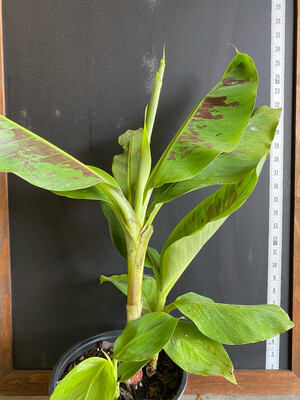
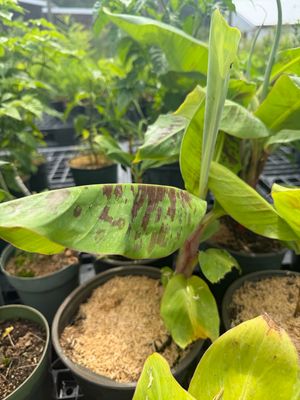
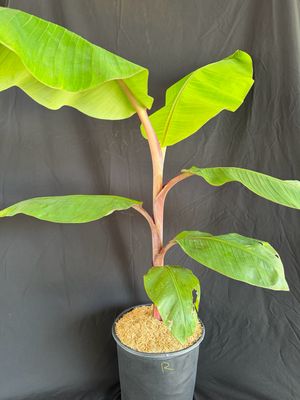
Grand Nain creates an immediate tropical atmosphere with broad, paddle-shaped leaves held above a thick green pseudostem.
Defining characteristics
- Leaves: Long, broad, vibrant green blades that may reach several feet in length
- New growth: Emerging leaves unfurl from the center of the pseudostem
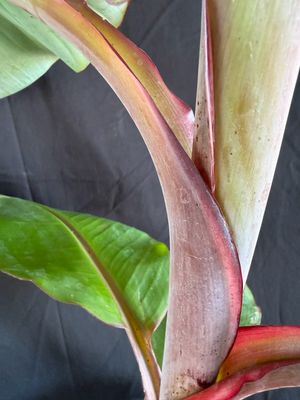
- Pseudostem: Formed from overlapping leaf bases rather than woody trunk tissue
- Root system: Fibrous roots arise from an underground rhizome or corm
- Growth pattern: New suckers emerge around the original plant, gradually forming a banana mat
- Flower: A large, dramatic inflorescence with burgundy-purple bracts
- Fruit display: Cylindrical bunches containing multiple hands of gently curved green fruit
Some wind-related leaf splitting is normal. Banana leaves are designed to tear along their veins, which reduces resistance during wind. Severe shredding, drying, crown distortion, or leaning indicates that the site is too exposed.
Ornamental landscape uses
Grand Nain can be used as:
- A tropical backdrop behind shorter edible plants
- A living privacy screen
- A soft visual barrier around patios or pools
- A fast-growing seasonal focal point
- A canopy component in a subtropical food forest
- A dramatic container specimen
- A shade-producing companion near heat-sensitive understory crops
Keep it away from windows, power lines, narrow walkways, and structures that could be damaged if a mature fruiting pseudostem falls during severe weather.
🍌 Grand Nain Fruit and Flavor Profile
Grand Nain produces the style of banana most people associate with the classic commercial Cavendish.
| Fruit Characteristic | What to Expect |
|---|---|
| Flavor | Sweet, mellow, creamy, and familiar |
| Aroma | Mild when commercially harvested; often fuller and more fragrant when properly matured at home |
| Texture | Smooth, soft, and creamy when ripe |
| Flesh Color | Pale cream to light ivory |
| Skin Color | Deep green while developing, turning yellow as it ripens |
| Fruit Shape | Long and gently curved with a moderately tapered end |
| Typical Length | Approximately 6–8 inches |
| Seeds | Seedless under normal cultivation |
| Best Eating Stage | Fully yellow for a firmer bite; yellow with brown speckles for maximum sweetness |
| Green-Fruit Use | Can be cooked as a starch, although it is primarily grown as a dessert banana |
A Grand Nain grown with consistent moisture, nutrition, warmth, and sunlight can produce a substantial bunch. UF/IFAS reports that home-grown banana bunches commonly weigh approximately 25–40 pounds, with significantly larger bunches possible under exceptional conditions. A Grand Nain cultivar study recorded bunches averaging approximately 48 pounds under the evaluated production system. Yield should never be treated as guaranteed because temperature, irrigation, soil fertility, disease pressure, and the number of competing suckers all affect production.
🌸 Fruiting Habits and How to Encourage a Larger Bunch
Each individual Grand Nain pseudostem flowers and fruits only once. After harvest, that stalk is removed and one of the younger suckers becomes the next fruiting plant.
A productive banana mat should contain
- One mature fruiting or flowering pseudostem
- One follower approximately one-half to two-thirds its size
- One healthy sword sucker developing behind it
Allowing every sucker to remain creates an impressive jungle, but it also increases competition and often produces smaller bunches.
What improves Grand Nain fruit production?
- Full or nearly full sun
- Consistent warmth
- Deep, fertile soil
- Reliable soil-level irrigation
- High organic-matter content
- Adequate potassium and magnesium
- Protection from strong wind
- Regular sucker management
- Removal of dead leaves and leaves rubbing against the bunch
- A sturdy support beneath heavy developing fruit
- Disease-free planting material
- Enough healthy leaves to fill and mature the bunch
Does Grand Nain need another banana for pollination?
No. Cultivated dessert bananas develop fruit parthenocarpically, meaning fruit forms without pollination. A second cultivar is not required for fruit set. Adding another banana variety can extend harvest diversity, but it is not a pollination requirement.
Should the banana flower be removed?
After the final hand of fruit has formed, the remaining male bud hangs beneath the bunch. UF/IFAS notes that removing this non-fruiting male bud after fruit set can help speed fruit development. Use sanitized tools and avoid damaging the fruiting stalk.
🧺 When Will Grand Nain Bananas Be Ready to Harvest?
Bananas do not follow one fixed annual harvest date. Their harvest schedule is determined by when the pseudostem reaches maturity and produces its flower.
General production timeline
| Growth Stage | Approximate Timing |
|---|---|
| Establishment and leaf production | First several months |
| Potential flowering from a small plant | Approximately 10–15 months in favorable conditions |
| Flower to mature bunch | Approximately 80–180 days |
| Small plant to harvest | Approximately 9–20 months, sometimes longer in cool climates |
| Ratoon or follower crop | Often faster once the mat and root system are established |
Florida harvest expectations
South Florida: Fruiting may occur during much of the year when warmth, water, and nutrition remain consistent.
Central Florida: Flowers emerging during spring or early summer generally have a better opportunity to mature before winter. Bunches emerging late in the year may develop slowly or experience chilling damage.
North Florida and the Southeastern United States: Plants may grow vigorously during summer but require protection, greenhouse culture, or an unusually long warm season to mature fruit consistently.
Cooler climates: Container plants can be overwintered, but moving an 8–12-foot fruiting banana becomes difficult. A heated greenhouse is more practical for reliable fruit than a typical indoor room.
Signs the bunch is nearing harvest
- Individual fingers look plump and full
- Sharp fruit angles begin to round
- The fruit reaches normal cultivar size
- The light-green color begins to soften
- One or two fingers may begin showing a pale-yellow cast
For home use, the bunch can be cut while mature-green and hung in a shaded, protected place. UF/IFAS recommends harvesting approximately 7–14 days before expected on-plant ripening and avoiding refrigeration before the fruit has ripened.
🥣 Culinary Uses: One Bunch, Plenty of Possibilities
Grand Nain is a true multipurpose kitchen banana.
Fresh and simple
- Slice over cereal, oatmeal, yogurt, or chia pudding
- Add to fruit salads
- Pair with peanut, almond, or sunflower-seed butter
- Mash into overnight oats
- Freeze peeled fruit for later use
Smoothies and frozen treats
- Banana smoothies
- Protein shakes
- Smoothie bowls
- Frozen banana “nice cream”
- Chocolate-dipped frozen banana pieces
- Tropical blends with mango, pineapple, papaya, or coconut
Baking
- Banana bread
- Muffins
- Pancakes
- Waffles
- Cakes
- Cookies
- Breakfast bars
- Banana pudding
- Custards and cream pies
Preserving the harvest
- Freeze peeled bananas
- Dehydrate into chewy banana slices
- Make fruit leather
- Blend into freezer pops
- Prepare banana jam or butter
- Mash and freeze in measured baking portions
Using green Grand Nain bananas
Although Grand Nain is best known as a dessert banana, mature green fruit can be:
- Boiled
- Steamed
- Fried
- Mashed
- Added to soups or stews
- Used similarly to a mild cooking banana
Green fruit contains more starch and considerably less sweetness than fully ripe fruit. The texture and flavor change as the starch converts to sugar during ripening.
Using overripe fruit
Do not waste heavily spotted bananas. Their concentrated sweetness makes them especially useful for:
- Banana bread
- Smoothies
- Baking without as much added sugar
- Homemade frozen desserts
- Fermented fruit preparations
- Compost or worm-bin feed when no longer usable
🍌 Nutritional Profile
Bananas provide carbohydrates, dietary fiber, potassium, magnesium, vitamin B6, and vitamin C. A typical medium raw banana contains approximately 105 calories and around 3 grams of dietary fiber, although nutrient content varies with fruit size and ripeness.
Grand Nain should be marketed as a nutritious whole fruit—not as a treatment or cure for medical conditions.
🌿 Grand Nain Compared with Other Popular Bananas
Availability of individual cultivars and sizes may vary.
| Cultivar | Approximate Plant Size | Fruit Style | Flavor and Texture | Cold Response | Best Reason to Grow |
|---|---|---|---|---|---|
| Grand Nain | Medium; commonly 6–8 ft pseudostem | Classic Cavendish dessert banana | Sweet, creamy, smooth, familiar | Fair for a Cavendish; frost damages foliage | Commercial-style fruit on a manageable plant |
| Dwarf Cavendish | Shorter than Grand Nain | Medium Cavendish fruit | Sweet and creamy | Often considered better adapted to cool subtropical conditions | Smaller spaces and lower canopy |
| Lacatan | Taller Cavendish-group plant | Golden dessert fruit | Sweet, aromatic, deeper-colored flesh | Fair; benefits from warmth and wind protection | Distinctive Filipino dessert-banana experience |
| Blue Java / Ice Cream | Medium to tall | Blue-green immature skin | Soft, sweet, creamy; flavor descriptions vary by climate and ripeness | Often rated fair to good among Florida bananas | Unusual fruit color and collector appeal |
| Nam Wah Types | Medium | Dessert or dual-purpose fruit | Sweet, dense, aromatic | Often more resilient in subtropical gardens | Productive food-forest banana |
| Plantain Types | Varies | Starchy cooking fruit | Firm and savory when green | Cultivar dependent | Frying, boiling, roasting, and traditional cooking |
Grand Nain, Dwarf Cavendish, and Lacatan belong to the Cavendish subgroup, which contains cultivars that are closely related and often difficult to distinguish until mature. Their relative pseudostem height is one of the most useful identifying characteristics.
🌾 Home Garden or Larger Production?
Grand Nain has legitimate commercial-production history and can be grown beyond the single backyard specimen.
Home landscape spacing
Allow approximately 8–12 ft between managed mats. Wider spacing improves:
- Airflow
- Light penetration
- Access for harvesting
- Sucker management
- Disease inspection
- Irrigation coverage
- Bunch support
Small farm or market-garden strategy
Commercial spacing depends on climate, machinery, fertility, wind, and whether ratoon crops will be maintained. A practical starting range is approximately:
- 6–8 ft between plants
- 10–15 ft between rows
Higher-density plantings can increase early yield per acre but require disciplined mat thinning, disease sanitation, nutrient management, and periodic replanting.
Grand Nain has produced strong yields in cultivar trials and is recognized by UF/IFAS as suitable for both home and commercial consideration in South Florida.
SEASONAL CARE, PLANTING, WATERING, CONTAINERS & PRODUCTION
🌱 Begin with Recovery After Shipping or Transport
Do not immediately transplant your Grand Nain Banana after delivery.
Even a healthy plant may experience temporary stress from:
- Darkness inside the shipping box
- Heat or cold fluctuations
- Reduced airflow
- Soil movement
- Leaf bending
- Moisture changes
- Transition into stronger sunlight
GreenDreams acclimation recommendation
- Carefully remove all packing material.
- Inspect the soil moisture before adding water.
- Place the plant in bright shade or gentle morning sun.
- Water only at soil level.
- Protect it from strong wind and intense afternoon sun during the first several days.
- Gradually increase sunlight over 7–14 days.
- Keep it in its original container for at least 30 days or until healthy new growth is visible.
- Transplant when the plant is actively growing and roots are beginning to fill the container.
Minor leaf tears, bent leaves, yellowing of one older leaf, or cosmetic shipping damage do not necessarily indicate a failing plant. The condition of the central emerging leaf and the production of new roots and foliage are more useful recovery indicators.
🌞 Where to Plant Grand Nain Banana
Best location
Choose a location with:
- 6–8 or more hours of sunlight
- Fertile, organic-rich soil
- Excellent drainage
- Protection from strong north and northwest winds
- Access to dependable irrigation
- Enough room for a 6–10-foot-wide managed mat
- Space away from buildings, windows, power lines, and narrow pathways
Full or nearly full sun is recommended for the strongest Florida production. Grand Nain tolerates light shade, but heavily shaded plants grow more slowly and generally produce smaller or lower-quality fruit.
Avoid planting in
- Low areas that hold stormwater
- Frequently flooded soil
- Dense, compacted clay without drainage improvement
- Locations receiving direct salt spray
- Soil irrigated with salty or brackish water
- Narrow beds beside a structure
- Areas exposed to constant strong wind
- Lawns where weed trimmers may strike the pseudostem
- Sites treated regularly with lawn herbicide near the root zone
- Areas where a falling fruiting stalk could cause damage
Bananas are extremely sensitive to stagnant water. In flood-prone areas or landscapes with a high water table, create a broad raised mound before planting.
🌿 How to Plant Grand Nain Banana: GreenDreams Method
Grand Nain should be planted at the same depth it occupied in its nursery container or slightly higher—not buried deeply.
Step-by-step planting instructions
- Water the container several hours before planting.Moist roots are less likely to crumble or tear during removal.
- Dig a broad planting hole.Make the hole only slightly deeper than necessary and approximately two to three times the width of the container when soil conditions allow.
- Do not create a bathtub.In poorly draining soil, avoid filling a deep hole with loose compost that can collect water.
- Remove the plant carefully.Support the soil and root ball rather than pulling on the leaves or pseudostem.
- Set the plant high and tight.Position the top of the nursery soil level with or slightly above the surrounding grade.
- Backfill firmly.Use native soil, finished compost, or an appropriate blend. Pack gently but securely to eliminate large air pockets.
- Top-dress instead of burying amendments deeply.Apply finished compost, biochar, azomite, worm castings, and an organic nutrient source around the root zone.
- Water thoroughly at soil level.Saturate the newly disturbed soil to settle it around the roots.
- Mulch broadly.Apply approximately 2–6 inches of hardwood mulch over the surrounding root zone.
- Keep mulch away from the pseudostem.Leave several inches of open space around the base to reduce rot and pest habitat.
- Stake only when necessary.Use soft, flexible ties that will not cut into the pseudostem.
Although bananas are not woody fruit trees, the same core principle applies: establish the plant slightly high, protect drainage, and never bury the crown or pseudostem base.
💧 Grand Nain Banana Watering Guide
Bananas use significant water but cannot tolerate oxygen-starved, waterlogged roots. The goal is consistent moisture with dependable drainage.
UF/IFAS estimates that bananas need approximately 4–6 inches of water per month for normal growth and production, equivalent to roughly 1–1.5 inches per week when rainfall is insufficient. Drought can delay flowering, reduce fruit size, and reduce the number of fruit in the bunch.
GreenDreams irrigation rule
Do not routinely water over the foliage.
- Water at soil level.
- Water during the morning.
- Use drip irrigation, a soaker hose, or a hose placed at the root zone.
- Avoid afternoon overhead irrigation.
- Avoid keeping the leaves wet overnight.
- Adjust irrigation according to rainfall, temperature, soil drainage, and plant response.
Suggested watering schedule
| Planting Stage | Suggested Approach |
|---|---|
| Plant still in nursery container | Check daily. Water thoroughly when the upper portion of the mix begins to dry |
| First 7–14 days in ground | Water deeply each morning when rainfall is absent and drainage is good |
| Weeks 3–4 | Water every 2–3 days as needed |
| Established plant | Supply approximately 1–1.5 inches weekly through rainfall and irrigation |
| Hot, dry, windy weather | Check daily; sandy Florida soils may require more frequent irrigation |
| Cool winter weather | Reduce frequency because growth and water use slow |
| Flowering and fruit filling | Maintain especially consistent moisture |
| After heavy rain or tropical weather | Stop irrigation and check for standing water |
Signs Grand Nain needs more water
- Leaves fold downward along the midrib
- Foliage becomes pale green
- Older leaves die prematurely
- New growth slows
- Leaf edges become dry
- Developing fruit remains undersized
Signs the roots are staying too wet
- Yellowing throughout the plant
- Weak, slow growth
- Soft or unstable pseudostem
- Sour-smelling soil
- Persistent fungus gnats in containers
- Dark, decaying roots
- Stagnant water around the mat
Do not follow a fixed timer without checking the soil. Lawn sprinkler systems frequently apply water too often or place moisture where the banana does not need it.
🌾 Soil and Potting Mix Requirements
Grand Nain performs best in fertile soil that holds moisture but still drains rapidly.
Preferred in-ground conditions
- pH approximately 5.5–7.0
- High organic-matter content
- Deep, aerated soil
- Strong biological activity
- Good drainage after summer storms
- Broad mulch coverage
Florida sands can grow excellent bananas when compost, mulch, water, and nutrients are replenished consistently. Heavy or compacted soil usually requires mound planting and broad soil improvement.
Recommended container mix
Use a high-quality potting mix blended for both moisture retention and drainage. A practical blend may include:
- Finished potting mix
- Fine pine bark
- Coconut coir
- Perlite or another coarse aeration material
- Finished compost or worm castings
Avoid:
- Unamended native yard soil in containers
- Dense muck
- Potting mixes that remain saturated
- Containers without drainage holes
- Heavy layers of gravel that reduce usable root volume
Fertilizing Grand Nain Banana
Bananas are hungry plants. Strong early growth affects the potential size and weight of the future bunch.
Grand Nain especially benefits from:
- Nitrogen for leaf and pseudostem growth
- Potassium for fruit filling and plant strength
- Magnesium for healthy green foliage
- Manganese, zinc, and iron where soils are deficient
- Carbon-rich organic matter for soil biology
UF/IFAS recommends frequent banana fertilization and notes that potassium demand is particularly high. A nutrient ratio close to 3-1-6 with magnesium is commonly recommended for Florida banana production.
Organic fertility approach
Top-dress with a combination of:
- Finished compost
- Worm castings
- A balanced organic tropical-fruit fertilizer
- Sulfate of potash or another suitable potassium source when indicated
- Azomite or a comparable trace-mineral amendment
- Charged biochar
- Hardwood mulch
- Chopped banana leaves and harvested pseudostems
Suggested feeding rhythm
| Season | Feeding Strategy |
|---|---|
| Spring | Resume regular feeding as active growth accelerates |
| Summer | Feed approximately every 6–8 weeks based on plant size and product directions |
| Early fall | Continue moderate feeding while temperatures remain warm |
| Late fall and winter | Reduce feeding as growth slows |
| Flowering and fruit filling | Maintain adequate potassium, magnesium, water, and healthy foliage |
Do not place concentrated fertilizer against the pseudostem. Spread nutrients broadly over the root zone and water them in at soil level.
Avoid excessive nitrogen
Too much nitrogen can produce:
- Soft, overly lush growth
- Greater wind vulnerability
- Delayed fruiting
- Nutrient imbalance
- Fertilizer burn
- Increased pest pressure
Soil or leaf testing is the most dependable approach for larger plantings.
✂️ Pruning and Managing the Grand Nain Banana Mat
Banana pruning is less about shortening the plant and more about managing the number and age of pseudostems.
Do not top-prune a healthy pseudostem
The newest leaf and future flower emerge through the center. Cutting the top of an actively growing pseudostem can destroy its main growing point and eliminate its ability to fruit normally.
Use the 1-1-1 system
Maintain:
- One fruiting or nearly mature pseudostem
- One half-grown follower
- One young sword sucker
Remove excess suckers at ground level and destroy the internal bud to slow immediate regrowth.
Sword suckers vs. water suckers
Sword suckers
- Narrow, upright young leaves
- Strong attachment to the parent rhizome
- Better future fruiting potential
- Preferred as replacement stalks
Water suckers
- Broad leaves while still small
- Weaker connection to the rhizome
- Often less vigorous
- More likely to produce inferior growth
Leaf pruning
Remove:
- Completely dead leaves
- Broken leaves hanging into pathways
- Diseased tissue
- Leaves rubbing directly against a developing bunch
Retain as much healthy green foliage as possible. Green leaves manufacture the energy needed to fill the fruit.
After harvest
Each pseudostem fruits once. After the bunch is removed:
- Cut the spent stalk near ground level.
- Chop it into manageable pieces.
- Place the pieces around the mat as chop-and-drop mulch.
- Keep thick, wet material from piling directly against living pseudostems.
- Allow the selected follower to become the next crop.
This cycle turns the plant’s own biomass back into soil organic matter.
🌸 Supporting a Developing Banana Bunch
Grand Nain can carry a heavy bunch, and fruit weight increases as the bananas fill.
Support options
- A forked wooden prop
- A padded bamboo support
- A strong post and soft strap
- A purpose-built banana support frame
Do not use thin wire or cord that can cut into the pseudostem.
Protect the bunch from
- Strong wind
- Leaf rubbing
- Rodents
- Raccoons
- Birds
- Sunscald after excessive leaf removal
- Freezing temperatures
- Mechanical damage
Fruit-protection bags may help reduce cosmetic damage, but they must allow ventilation and should not trap excessive heat or moisture.
🌦 Florida and Southeastern Seasonal Care Guide
Grand Nain is not deciduous. It does not enter a true woody dormancy. Instead, growth accelerates during warm weather and slows dramatically during cool weather.
| Season | What to Expect | What to Do |
|---|---|---|
| Spring | New leaves emerge faster as soil and air temperatures rise | Transplant, divide mats, renew mulch, begin regular feeding, and restore irrigation |
| Summer | Fastest vegetative growth; high water and nutrient use | Water consistently, monitor leaf spots, thin suckers, support bunches, and maintain airflow |
| Fall | Continued growth while nights remain warm; late bunches may struggle to finish | Maintain water, reduce late excessive nitrogen, prepare frost protection, and inspect supports |
| Winter | Growth slows below 60°F; foliage may yellow, tear, or burn during cold events | Reduce water and fertilizer, protect the pseudostem and fruit, and avoid unnecessary pruning before freezes |
Central Florida winter strategy
- Plant on the south or southeast side of a windbreak.
- Avoid open frost pockets.
- Maintain a broad root-zone mulch layer.
- Cover the pseudostem and canopy with breathable frost cloth.
- Secure frost cloth to the ground to trap radiant heat.
- Remove plastic or non-breathable coverings during the day.
- Protect developing fruit whenever freezing weather is forecast.
- Do not irrigate the foliage before a freeze.
- Delay major cleanup until the extent of damage is clear.
What cold damage looks like
- Water-soaked foliage
- Limp or collapsed leaves
- Darkened leaf tissue
- Browning within several days
- Damaged fruit peel
- Soft or decaying pseudostem tissue
- Failure of a late flower or bunch to emerge properly
Temperatures below approximately 28°F may kill above-ground growth, but established rhizomes can sometimes send up new shoots when warmth returns. Survival does not guarantee that the original fruiting pseudostem or bunch will recover.
🌬 Wind and Storm Preparation
Grand Nain’s moderate height gives it some advantage over taller bananas, but its broad leaves and heavy bunches remain vulnerable.
Before storm season
- Thin crowded mats.
- Remove dead hanging leaves.
- Install bunch supports.
- Inspect for pseudostem or root damage.
- Maintain even moisture without saturating the soil.
- Avoid pushing soft growth with excessive nitrogen.
- Protect the mat from mower and weed-trimmer damage.
After a storm
- Check whether the corm remains firmly rooted.
- Remove dangerously hanging leaves.
- Re-support leaning fruiting stalks only when roots remain intact.
- Improve drainage if water is standing.
- Do not immediately discard a plant with shredded leaves.
- Watch the central leaf for continued growth.
Constant winds can shred leaves, dry the canopy, and distort the growing crown. Banana plants should not be treated as hurricane-resistant screening.
🌊 Salt and Coastal Exposure
Grand Nain is not a strong choice for direct oceanfront exposure.
Salt stress may cause:
- Yellow or brown leaf margins
- Leaf death
- Thin or deformed fruit
- Stunted growth
- Root damage
- Reduced yield
Use fresh irrigation water and place the plant behind a salt-tolerant windbreak when growing near the coast.
🪴 Growing Grand Nain in Containers
Grand Nain can be grown in a container, but its eventual size and water demand should not be underestimated.
Container progression
A sensible progression is:
4-inch pot → 1-gallon → 3-gallon → 7-gallon → 15-gallon → 25–45+ gallon
Do not jump a tiny root system directly into an oversized, poorly draining container. Excess unused soil can remain wet for too long.
When to move into the next container
Up-pot when:
- Roots circle the pot
- Roots emerge from drainage holes
- The plant dries unusually quickly
- Growth slows despite proper nutrition
- The plant becomes unstable
- The root ball holds together when removed
How to up-pot Grand Nain Banana
- Select a container only one or two stages larger.
- Confirm that it has multiple drainage holes.
- Add enough fresh mix to keep the original root ball at the same level.
- Remove the plant without pulling on the pseudostem.
- Loosen only tightly circling exterior roots.
- Fill around the root ball with fresh potting mix.
- Press the mix firmly enough to remove large air pockets.
- Water thoroughly at soil level.
- Place the plant in bright shade briefly before returning it to full sun.
- Resume fertilizing only after new growth confirms establishment.
Container size for fruiting
- 7–15 gallons: Suitable for temporary growth and smaller plants
- 20–25 gallons: Better for maintaining a larger specimen
- 25–45+ gallons: Preferred when meaningful fruit production is the goal
Larger containers buffer water and temperature changes but become extremely heavy. Place the final container before it becomes difficult to move.
Where to find supplies
Search locally or online through:
- Independent garden centers
- Nursery-supply companies
- Farm and feed stores
- Hydroponic suppliers
- Landscape-material yards
- Food-safe container recyclers
- Local gardening groups
Repurposed containers must be food-safe, clean, and modified with adequate drainage.
🏡 Can Grand Nain Be Grown Indoors?
Grand Nain can survive indoors as a foliage plant, but normal household conditions rarely provide enough light or space for reliable fruit production.
Indoor requirements
- Very bright south-facing exposure
- Supplemental full-spectrum grow lighting
- Warm temperatures
- High ceilings
- Strong airflow
- A large container
- Protection from heating and air-conditioning vents
- Careful watering
- Regular feeding during active growth
Indoor challenges
- Insufficient light
- Spider mites
- Rapid drying near heating vents
- Oversaturated soil in low light
- Large leaves brushing walls and furniture
- Insufficient height for the flower and bunch
- Difficulty moving the plant outdoors
A heated greenhouse, sunroom, or conservatory is considerably better than a standard living room for fruit production.
🌿 Companion Plant and Banana Guild Sidebar
Grand Nain does not need pollinators to set fruit, but a diverse guild can improve soil protection, biomass production, insect habitat, and overall landscape function.
| Companion Role | Suggested Plants | Purpose |
|---|---|---|
| Fast biomass | Mexican sunflower | Chop-and-drop organic matter and rapid seasonal growth |
| Carbon and silica | Clumping grasses | Mulch material, soil coverage, and visual structure |
| Nitrogen support | Pigeon pea or seasonally appropriate legumes | Biomass and nitrogen cycling |
| Living groundcover | Perennial peanut or suitable low groundcovers | Reduces exposed soil and erosion |
| Aromatic edge plants | Lemongrass and culinary herbs | Defined border, fragrance, and harvest diversity |
| Beneficial-insect habitat | Roselle, cranberry hibiscus, basil, salvia, and flowering herbs | Adds nectar, pollen, and biodiversity |
| Understory edibles | Longevity spinach, Okinawa spinach, or shade-tolerant perennial greens | Uses filtered light around a mature banana canopy |
Guild-placement tips
- Keep aggressive companions away from the immediate corm.
- Leave room for harvesting and sucker removal.
- Do not allow vines to climb the pseudostem.
- Prevent groundcovers from hiding rot or borer damage.
- Chop support plants before they compete heavily for light or water.
- Keep mulch and fresh biomass several inches away from living pseudostems.
CAUTIONS, TROUBLESHOOTING, FAQ & SHIPPING
⚠️ Important Grand Nain Banana Cautions
Not reliably frost-proof
Grand Nain has fair cold tolerance within the Cavendish subgroup, but frost can destroy leaves, damage developing fruit, and kill a pseudostem before it produces.
Not tolerant of standing water
Bananas need frequent moisture but can decline rapidly in stagnant or continuously saturated soil.
Not highly salt tolerant
Avoid direct salt spray, salty soil, and brackish irrigation.
Can spread into a large mat
New suckers arise from the underground rhizome. Unmanaged mats can widen considerably and become difficult to access.
Heavy bunches can topple the plant
Support fruiting stalks and avoid planting near windows, cars, walkways, or structures.
The sap can stain
Banana sap can leave dark stains on clothing, tools, patios, and skin. Wear gloves and old clothing when pruning.
Pseudostems are easily damaged
Mower and weed-trimmer injuries weaken the plant and can create entry points for pests and disease.
Disease sanitation matters
Cavendish bananas are susceptible to Sigatoka leaf diseases and certain races of Fusarium wilt. Do not move soil, corms, or suckers from a suspected diseased planting into a clean location. There is no simple cure for Fusarium wilt once a susceptible field becomes infested.
🔍 Grand Nain Banana Troubleshooting Guide
Icons represent common issues and organic recovery strategies—look for 🌿 for the recommended response.
| ⚠️ Issue | 🧠 Likely Cause | 🌿 Organic Response |
|---|---|---|
| 🍂 One lower leaf turns yellow | Normal aging or shipping adjustment | Remove it only after it is mostly brown; monitor new central growth |
| 🍂 Multiple leaves yellow rapidly | Overwatering, root stress, nutrient deficiency, or cold | Check drainage and soil moisture before fertilizing |
| 💧 Leaves fold or droop | Drought, heat, wind, or root loss | Water deeply at soil level during the morning and inspect the root zone |
| 💦 Soil remains wet for days | Poor drainage or oversized container | Reduce watering, clear drainage holes, or replant high and tight |
| 🪣 Plant is stunted in a wet area | Saturated soil and low root oxygen | Move to a raised mound or improve drainage |
| 🌬️ Leaves are shredded | Wind exposure; moderate splitting is normal | Add a windbreak and remove only severely damaged leaves |
| ☀️ Pale or burned patches after delivery | Sudden exposure to intense sunlight | Reacclimate gradually from bright shade to full sun |
| 🔥 Brown leaf tips after feeding | Excess fertilizer or salt accumulation | Flush the soil, pause feeding, and resume at a lower rate |
| 🌊 Yellow and dead leaf margins | Salinity or brackish irrigation | Use fresh water and reduce salt exposure |
| 🍄 Brown or black leaf spotting | Sigatoka or another leaf-spot organism | Improve airflow, remove heavily affected tissue, avoid overhead irrigation, and seek local Extension guidance |
| 🐛 Tunneling or weakness near the base | Banana or sugarcane weevil larvae | Remove decaying stalks, inspect the corm, and use clean planting material |
| 🌱 Many weak suckers | Unmanaged mat or water suckers | Retain one strong sword sucker and remove excess growth |
| 🍌 No flower after a long period | Insufficient warmth, shade, crowding, drought, or low fertility | Increase light, thin the mat, correct watering, and review nutrition |
| 🍈 Small bunch or thin fruit | Water stress, low potassium, too many stalks, shade, or leaf disease | Maintain one productive sequence of stalks and improve care |
| 🍃 Fruit drops or fails to fill | Cold, severe drought, root stress, or damaged foliage | Stabilize water and protect the plant from temperature extremes |
| ❄️ Leaves collapse after a freeze | Cold injury | Wait for the damage to become clear, protect the corm, and remove rotting material |
| 🌬️ Fruiting stalk begins leaning | Bunch weight, wind, or root injury | Add a padded support immediately and inspect the base |
| 🫣 New leaf will not emerge normally | Cold-related choking, drought, or crown injury | Restore warmth and even moisture; do not cut into the growing center |
| 🕷️ Fine stippling or webbing indoors | Spider mites | Isolate the plant, rinse or wipe leaves carefully, and use a labeled horticultural product if needed |
| 🐜 Ant activity on leaves | Ants may be tending aphids or scale | Inspect leaf bases and undersides; address both ants and sap-feeding pests |
When to contact your Extension office
Seek local diagnosis before treatment when you observe:
- Progressive yellowing from old leaves toward the newest leaf
- Dark internal vascular discoloration
- Persistent foul odor
- Severe pseudostem collapse
- Rapid spread through multiple banana mats
- Unidentified leaf spotting during prolonged wet weather
- Significant nematode or borer damage
🌿 Is Grand Nain Banana Right for You?
✅ Grand Nain is ideal for
- Florida and Gulf Coast growers
- Tropical-fruit collectors
- Home gardeners wanting familiar dessert bananas
- Food-forest and permaculture enthusiasts
- Families wanting a recognizable fruit
- Growers with full sun and dependable irrigation
- Gardeners willing to manage banana suckers
- Landscapes needing fast tropical foliage
- Container gardeners with room for a large pot
- Small farms exploring Cavendish-style production
- Gardeners who value chop-and-drop biomass
- Anyone ready to turn “store-bought banana” into “backyard harvest”
❌ Grand Nain may not be ideal for
- Growers expecting reliable outdoor fruit in very cold regions
- Landscapes without irrigation
- Sites with standing water
- Direct oceanfront exposure
- Extremely windy open properties
- Tiny patios or narrow side yards
- Homes without adequate indoor overwintering space
- Gardeners who do not want to manage suckers
- People expecting an ornamental houseplant to fruit in low light
- Growers seeking a distinctly unusual or non-Cavendish flavor
- Anyone needing a tree that can be neglected after planting
❓ Grand Nain Banana FAQ
Is Grand Nain the same kind of banana sold in grocery stores?
Grand Nain belongs to the Cavendish subgroup that dominates international dessert-banana trade. Its fruit has the familiar sweet, creamy flavor most shoppers associate with a standard banana.
How tall does Grand Nain grow?
The pseudostem commonly reaches approximately 6–8 feet, while the full plant may reach roughly 8–12 feet to the top of its leaves. Conditions, mat age, nutrition, and climate affect final size.
Is Grand Nain a dwarf banana?
It is medium-sized within the Cavendish subgroup. The name “Grand Nain” means “large dwarf,” reflecting its position between shorter Dwarf Cavendish plants and taller Cavendish cultivars.
Can Grand Nain grow in Zone 8?
The rhizome may survive and regrow in protected Zone 8 locations, but reliable outdoor fruit production is unlikely without a greenhouse, large movable container, or unusually long frost-free season.
Will it fruit in Central Florida?
Yes, especially in warm, protected microclimates with full sun, irrigation, strong fertility, and cold protection. A bunch that emerges late in the year may be damaged or delayed by winter temperatures.
How long will it take to produce bananas?
Under favorable conditions, a small plant may reach harvest in approximately 9–20 months. Cold weather, shade, drought, and transplant stress can extend that timeline.
Does Grand Nain need a pollinator?
No. The fruit develops without pollination, so one plant can produce a bunch by itself.
How many times does one stalk produce?
Each pseudostem produces one bunch. After harvest, remove the spent stalk and allow the selected follower sucker to produce the next crop.
How much fruit can it produce?
UF/IFAS reports that banana bunches in home landscapes often weigh approximately 25–40 pounds. Grand Nain can exceed that range under excellent production conditions, but yield is never guaranteed.
Can Grand Nain grow in a container?
Yes. Use progressively larger containers, with approximately 25–45 gallons or more preferred for serious fruit production.
Can it fruit indoors?
It is possible only with exceptional light, warmth, height, humidity, and root space. Most household-grown plants remain ornamental.
Why are the leaves tearing?
Moderate splitting is a normal response to wind. Severe shredding, browning, or crown distortion indicates excessive exposure.
Why are the lower leaves turning yellow?
One aging lower leaf is usually normal. Multiple yellowing leaves may indicate excess water, root problems, cold, nutrient deficiency, or salt stress.
Should I remove every banana sucker?
No. Retain a planned sequence consisting of one fruiting stalk, one follower, and one young sword sucker.
When should I harvest the bunch?
Harvest when the fruit is full-sized, plump, and beginning to lose its sharp angles. The bunch can be cut mature-green and ripened in a shaded, protected location.
Can I refrigerate green bananas?
Do not refrigerate them before ripening. Chilling can interfere with normal ripening and reduce fruit quality.
🚚 Shipping and Live-Plant Recovery Information
This Grand Nain Banana ships in a 1-gallon nursery container from GreenDreams in Florida.
Regional shipping recommendation
One-gallon tropical plants are best suited for shipping to:
- Florida
- The Southeastern United States
- Gulf Coast regions
- Texas
- Other destinations with relatively short UPS Ground transit times
We can ship across the continental United States, but buyer discretion is especially important for orders traveling to northern and western states.
Shipping schedule
- Plants ship from Florida.
- We currently use UPS Ground.
- Our regular live-plant shipping day is Monday.
- Shipping schedules may be adjusted around holidays or dangerous weather.
Northern and Western United States advisory
Extended UPS Ground transit may expose smaller plants to:
- Prolonged darkness
- Heat buildup
- Cold temperatures
- Drying
- Soil displacement
- Rough handling
- Delayed delivery
A plant may arrive with cosmetic foliage damage and need a substantial recovery period. Larger plants, when available and eligible for shipping, generally carry greater moisture reserves and may tolerate extended transit better.
California advisory
California agricultural inspection may hold a package for an additional day or longer. This can extend the time a live plant remains boxed.
Extreme-temperature disclaimer
Buyer discretion is required during peak summer heat and winter cold.
GreenDreams cannot control:
- Temperatures inside UPS facilities or vehicles
- Weather delays
- Delivery rescheduling
- Inspection delays
- The amount of time a package remains outdoors after delivery
- Ground-service handling during transit
Risk associated with extreme temperatures, extended ground transit, and destination delays is assumed by the buyer. Plants often recover with appropriate care, but optimal arrival condition cannot be guaranteed outside our regional shipping area.
What to do when your Grand Nain arrives
- Open the box immediately.
- Remove packing materials carefully.
- Check the soil before watering.
- Place the plant in bright shade.
- Water at soil level only when needed.
- Gradually reintroduce direct sunlight.
- Protect it from strong wind.
- Keep it in the original container.
- Wait at least 30 days or until healthy new growth appears before transplanting.
🏡 Shop with Us in Person
🌿 GreenDreams Nursery & Farm — Retail Nursery Open to the Public
We carry countless tropical fruit trees, useful plants, native species, perennial vegetables, and ecological landscape plants in larger sizes—including many selections that are not listed online.
📍 18709 US Hwy. 41, Spring Hill, FL 34610
🕘 Tuesday–Friday: 9AM–5PM
🌞 Saturday: 8AM–3PM
Stop by our regenerative nursery to see what is blooming, fruiting, and available this week.
Local inventory and plant sizes change frequently. Visiting the nursery is the best way to explore larger Grand Nain Banana plants and compare other banana cultivars in person.
🌿 Beyond the Plant: GreenDreams Services
At GreenDreams, we do more than grow plants—we design, build, and restore ecosystems across Florida.
- 🌳 Onsite consultations and edible landscape design
- 🚜 Installation and project management
- 🚚 Bulk delivery of compost, mulch, biochar, and soil materials
- 🌾 Wholesale and large-scale regenerative solutions
Let our team help you create your own thriving edible paradise—starting with a productive Grand Nain Banana mat.
🌿 IMPORTANT INFORMATION BEFORE PURCHASING LIVE PLANTS
Please note: Plants purchased through our online store are not available for pickup at our retail nursery in Spring Hill, Florida.
Online inventory is housed at a separate facility and is priced, prepared, and handled exclusively for shipping.
🌱 Looking for larger plants or more selection?
Our retail nursery location offers far more availability, including larger sizes, specialty plants, and many selections not suitable for nationwide shipping.
Local pickup is available for retail nursery purchases only.
Visit our Spring Hill, FL retail nursery page to explore in-person shopping options.
🚚 LIVE PLANT SHIPPING & TRANSIT EXPECTATIONS
Live plants naturally experience stress during shipping. Temporary leaf drop, mild wilting, or cosmetic stress is normal after transit. Most plants recover quickly with proper watering, gradual light exposure, and basic aftercare. Some plants may require additional attention during the first few weeks.
Despite careful packing, minor cosmetic damage may occur during transit. Small issues such as broken leaves or stems typically resolve with time and proper care.
If your shipping box arrives with significant external damage, please contact UPS within 30 days to initiate a carrier claim.
⏱️ SHIPPING METHOD, TIMING & TRANSIT WINDOWS
All online orders ship via UPS Ground from our Central Florida nursery.
📦 Shipping Schedule: Orders ship once weekly on Mondays to reduce the risk of packages sitting in transit over weekends. A countdown clock on our website displays the next shipping date.
🚚 Typical Transit Times:
-
Florida: 1–2 days
-
Southern U.S.: approximately 2 days
-
Midwest, West & Northern U.S.: 3–5 business days
Long-distance shipments, particularly to the western U.S., may experience additional transit time due to agricultural inspections in states such as Arizona, California, and Texas.
Extended transit times can be more challenging for small or tender plants and may require additional recovery care after arrival.
🌡️ EXTREME WEATHER & SEASONAL RISK
Live plants are sensitive to temperature extremes.
We cannot guarantee plant condition during periods of extreme summer heat or winter cold and freezing temperatures. Weather-related delays, carrier interruptions, or exposure during delivery are beyond our control.
Customers are responsible for:
-
Monitoring tracking information sent via email
-
Retrieving packages promptly upon delivery
-
Preventing plants from being left outdoors in extreme conditions
During unsafe weather, holiday shipping volume, or extended transit risk, orders may be held and shipped the following week to protect plant health.
⚠️ CUSTOMER RESPONSIBILITY & REFUND POLICY
By purchasing live plants, customers acknowledge and accept the risks associated with shipping, weather exposure, transit delays, and regional suitability.
Refunds or replacements are considered only under exceptional circumstances and in accordance with our return and refund policy. We are not responsible for:
-
Weather-related damage
-
Carrier delays
-
Poor plant selection for a given climate or region
-
Improper care after delivery
Upon purchase, customers assume full responsibility for the ongoing care and success of their plants.
✅ CONSENT & AGREEMENT
By completing a purchase, you confirm that you have read, understand, and agree to all shipping policies, responsibilities, and conditions outlined above.
Our goal is transparency, plant health, and long-term growing success — and we appreciate your understanding and care when ordering live plants.


