


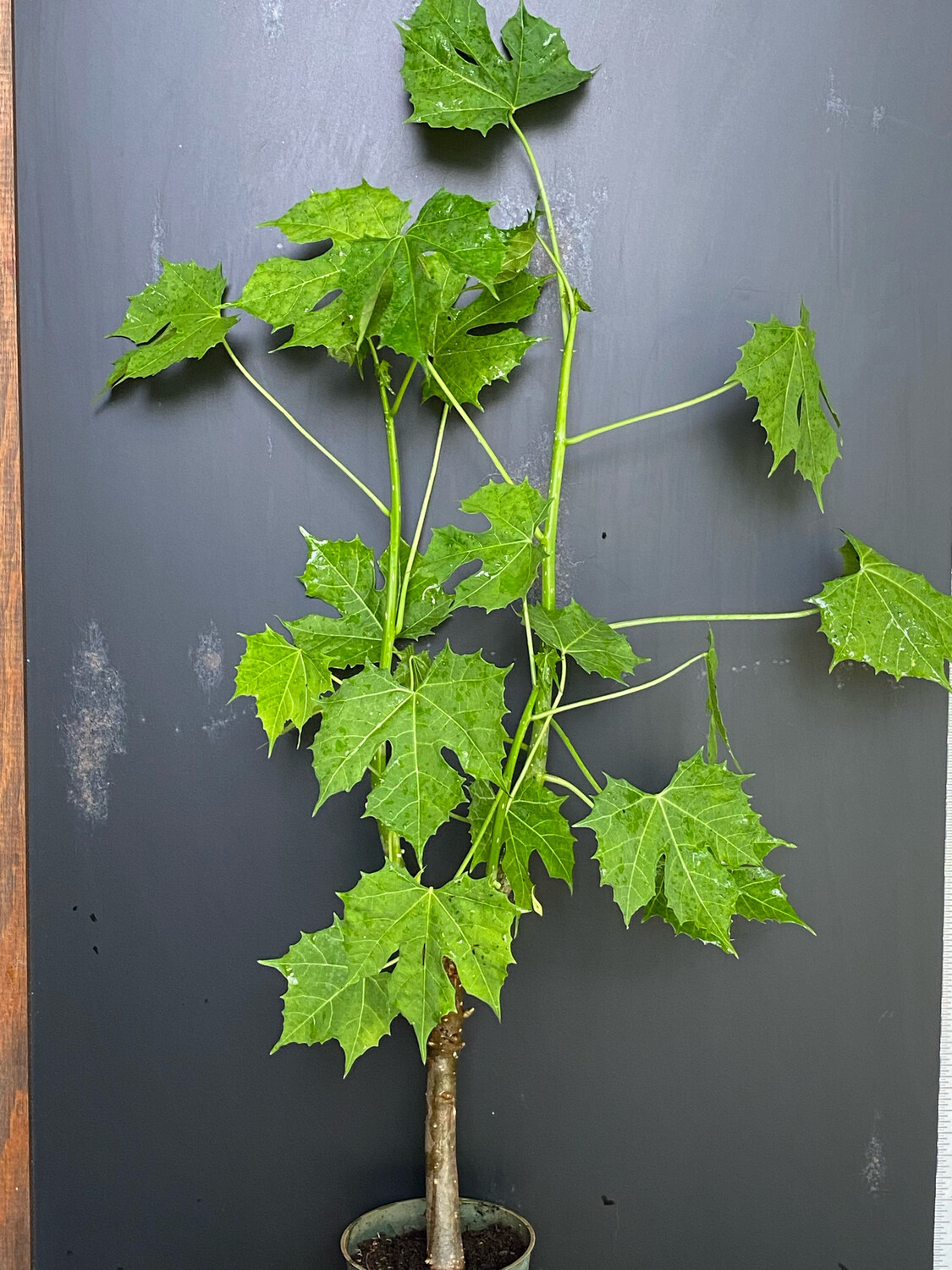
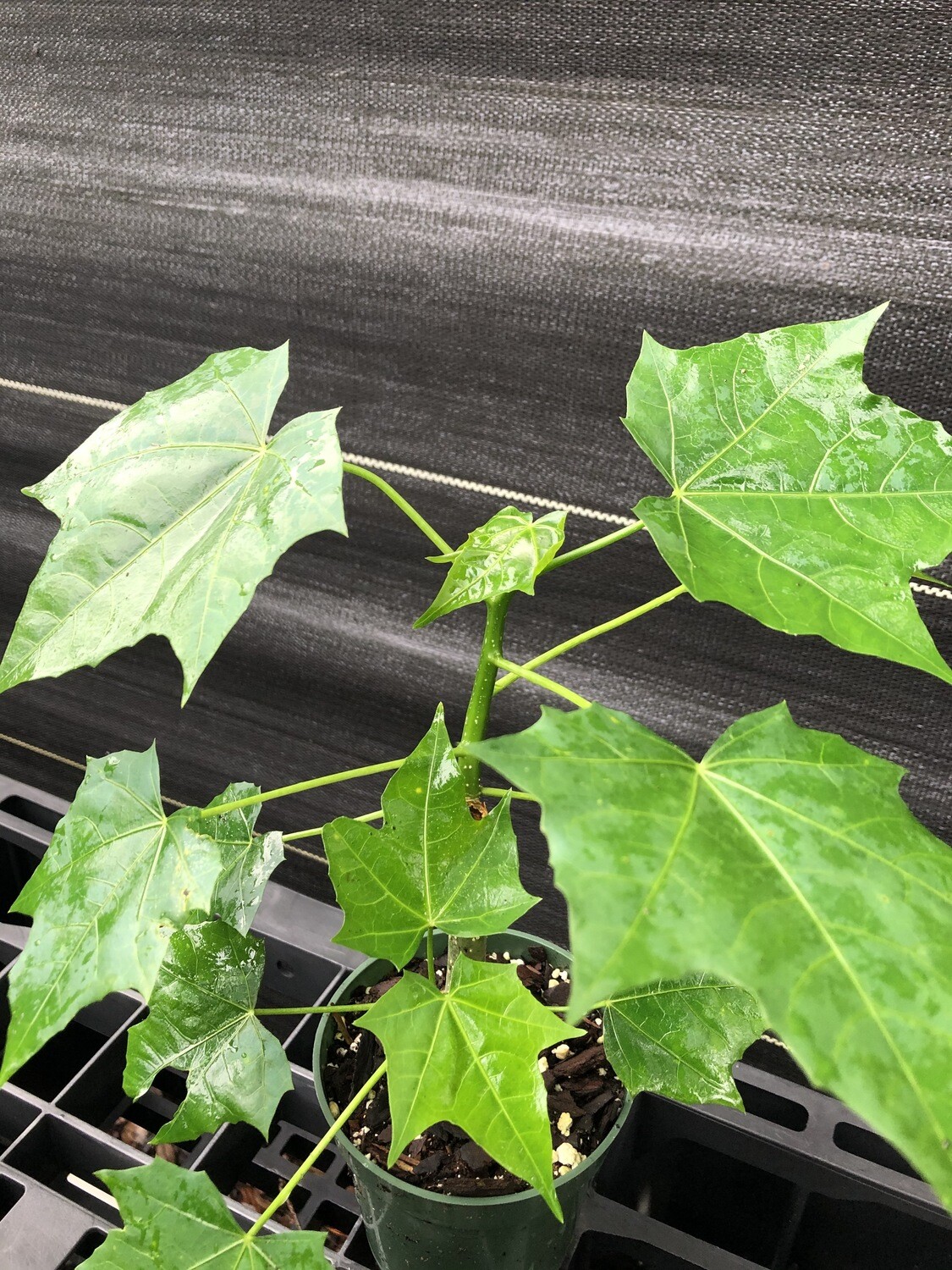
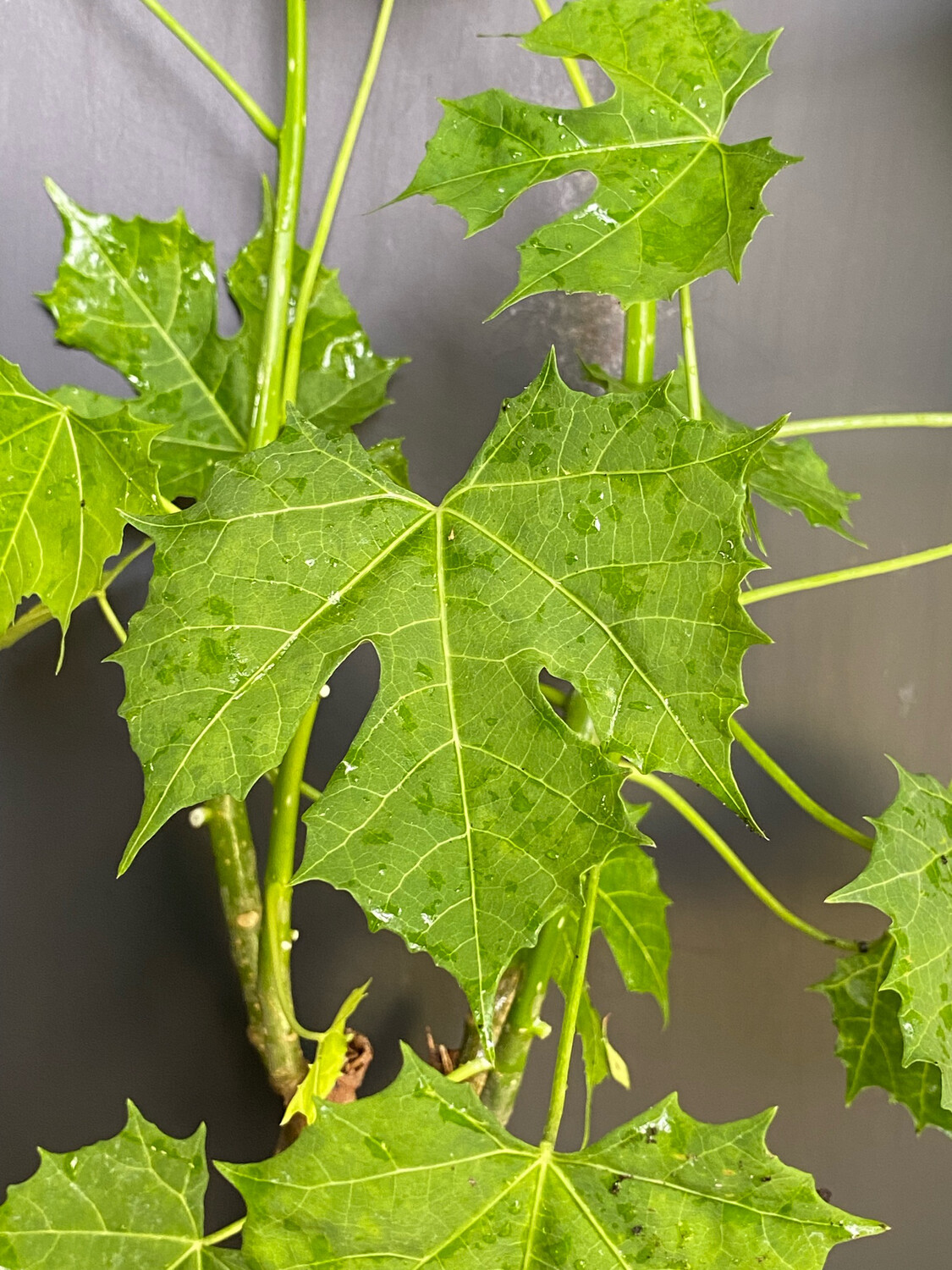
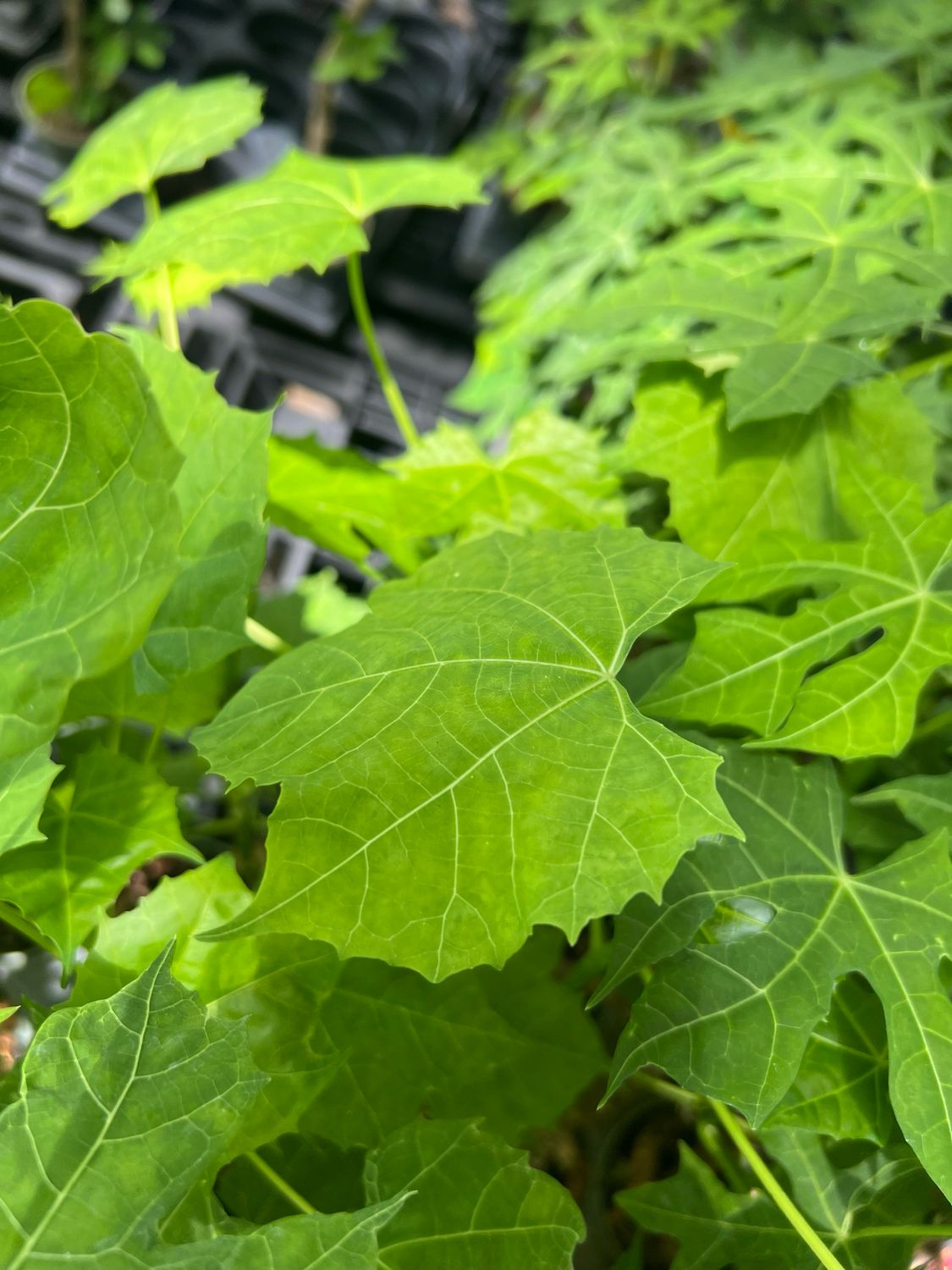
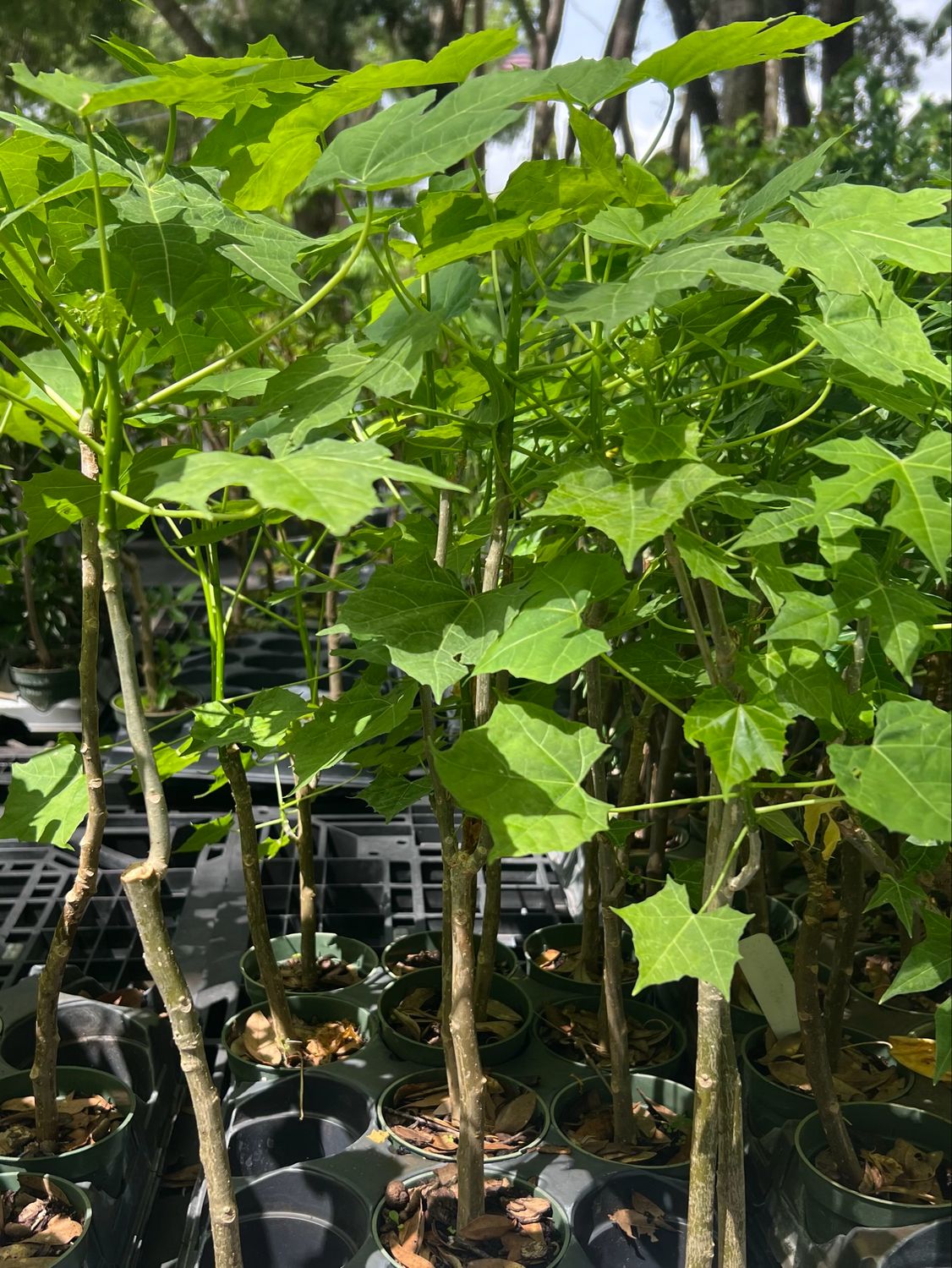
🌿 Marabou Chaya Plant — Florida-Grown Tree Spinach for Edible Landscapes
A Community-Stewarded Chaya with Balanced Form, Flavor & Food-Forest Function
Some plants reach a garden through commercial breeding programs. Others travel from grower to grower—shared as cuttings, tested in real Florida landscapes, and preserved because the people growing them recognize something worth keeping.
Marabou Chaya (Cnidoscolus aconitifolius) belongs to that second tradition.
This distinctive Florida-circulated Chaya selection combines an upright, organized growth habit with productive edible foliage and a balanced tropical appearance. Its leaves are narrower and more divided than Maple Leaf Chaya, yet less dramatically dissected than our Deep Lobed selection.
That middle-ground personality makes Marabou Chaya especially useful in:
- Florida food forests
- Edible hedges
- Productive privacy screens
- Tropical-style landscapes
- Perennial vegetable gardens
- Container collections
- Regenerative planting systems
- Landscapes where food production should still look intentional
It offers enough structure to become a handsome landscape plant, enough branching to respond well to pruning, and dependable leaves for properly cooked dishes.
This is not ordinary spinach—and it is not a plant you should have to replant every season. In warm climates, Marabou Chaya develops into a long-lived perennial shrub or small tree that can produce food, flowers, pruning material, and garden structure for years.
Important: Chaya leaves must always be thoroughly cooked before eating. Never consume Chaya raw.
PHOTO / GRAPHIC HOLDING SPACE — Mature Marabou Chaya in a Florida food forest
🌱 Quick Facts Guide
| Feature | Details |
|---|---|
| Botanical Name | Cnidoscolus aconitifolius |
| Plant Family | Euphorbiaceae — the cassava and poinsettia family |
| Common Names | Marabou Chaya, Chaya, Spinach Tree, Tree Spinach, Mayan Spinach |
| GreenDreams Selection Name | Marabou Chaya |
| Cultivar Status | Informally named, Florida-circulated selection; not a formally registered cultivar |
| Plant Type | Fast-growing perennial edible shrub or small tree |
| Size at Sale | Rooted starter plant in a nominal 4-inch nursery container |
| Container Volume | Varies slightly according to nursery-pot manufacturer |
| Estimated Plant Age | Approximately 3–6 months; age and height vary by growing batch |
| Typical Shipping Height | Varies according to season, propagation timing, and nursery pruning |
| Native Range of the Species | Mexico through Central America |
| USDA Growing Zones | Best as a landscape perennial in Zones 9–11 |
| Zone 8–9a Use | Grow in a protected microclimate or movable container |
| Sun Requirements | Full sun to partial shade |
| Best Florida Exposure | Morning through midday sun; light afternoon shade may improve leaf quality in extremely hot, dry sites |
| Cold Hardiness | Frost-tender; foliage and stems may be damaged near or below 32°F |
| Winter Behavior | Evergreen in frost-free weather; semi-evergreen, drought-deciduous, or dormant after frost |
| Growth Rate | Fast during sustained warm weather |
| Growth Habit | Upright, branching, structured, and vigorous |
| Mature Height Unpruned | Commonly 8–12+ ft; potentially taller in frost-free tropical conditions |
| Mature Width Unpruned | Approximately 5–8 ft |
| Suggested Landscape Height | 6–8 ft |
| Suggested Harvest Height | 4–7 ft for comfortable access |
| Home-Garden Spacing | 4–6 ft apart |
| Food-Forest Spacing | 6–8 ft apart |
| Managed Hedge Spacing | Approximately 3–4 ft apart with regular pruning |
| Soil Preference | Well-drained soil enriched with organic matter |
| Water Needs | Moderate; drought-tolerant after establishment but more productive with regular moisture |
| Salt Tolerance | Low; protect from direct salt spray and saline irrigation |
| Wind Tolerance | Moderate when maintained compactly; tall succulent branches may break in severe storms |
| Edible Portion | Properly cooked leaf blades |
| Primary Uses | Cooked greens, edible landscaping, food forests, hedges, screens, containers, and biomass |
| Cooked Leaf Texture | Tender to medium; generally between Maple Leaf and Deep Lobed Chaya |
| Cooked Flavor | Mild, green, and slightly herbal |
| Flowering | Small pale flowers may develop above the foliage during warm weather |
| Pollinator Value | Flowers may provide nectar for butterflies, bees, and other visiting insects |
| Ornamental Value | High — upright structure with attractive divided foliage |
| Indoor Growing | Not ideal as a permanent houseplant |
| Long-Term Container Growing | Possible in a 15-gallon or larger container with regular pruning |
🌿 The Story Behind Marabou Chaya
According to the story passed through Florida’s food-forest community and maintained with the GreenDreams collection, grower and author Marabou Thomas discovered this distinctive Chaya growing from discarded landscape material.
The plant appeared different from the broad Maple Leaf forms and the most deeply divided Chaya types already circulating among growers.
Recognizing that the plant was worth preserving, he reportedly:
- Collected and propagated it.
- Evaluated its growth in Central Florida.
- Shared cuttings with other growers.
- Helped establish it within Florida’s food-forest community.
As more growers maintained and redistributed the plant, it became informally known as Marabou Chaya.
An Important Note About This History
This story reflects the community history carried with the plant. It has not been documented as a formal cultivar introduction through a university breeding program, botanical registration authority, or peer-reviewed cultivar release.
For that reason:
- Marabou Chaya should not be presented as a patented plant.
- It is not a formally registered cultivar.
- The name does not represent an accepted botanical variety.
- Its exact genetic relationship to historic Chaya varieties has not been established.
- GreenDreams uses the name to acknowledge the grower connected with its stewardship and distribution.
We believe that distinction matters.
Plant history is often preserved through people—not only through institutions. Keeping the Marabou name gives credit to the grower associated with recognizing, propagating, and sharing this selection rather than allowing its community story to disappear.
Marabou Thomas is also associated with HomeGarden Cuisine Toolkit: Ideas for Making Food in the Subtropics, a work known among Florida growers interested in subtropical food production and home-scale culinary resilience.
This Chaya is therefore more than another foliage variation. It represents the way useful plants move through regenerative communities: one cutting, one garden, and one grower at a time.
🌿 What Makes Marabou Chaya Different?
Marabou Chaya occupies the middle ground between our Maple Leaf and Deep Lobed selections.
Its foliage is divided enough to provide texture and tropical character, but it does not have the extremely narrow, architectural lobes associated with Deep Lobed Chaya.
Its growth is generally more upright and structured than Maple Leaf Chaya, making it useful where the landscape needs clean vertical form without becoming visually heavy.
Distinguishing Characteristics
- Narrower leaf lobes than Maple Leaf Chaya
- Less extreme division than Deep Lobed Chaya
- Upright, organized framework
- Balanced edible and ornamental qualities
- Reliable response to pruning
- Good production of new shoots during warm weather
- Tender-to-medium cooked leaf texture
- Mild flavor after proper cooking
- Suitable for hedges and intentional landscape borders
- Easier to integrate into formal edible landscapes
- Strong potential as a food-forest mid-layer plant
Its Main Strength: Balance
Maple Leaf Chaya is usually selected first for maximum culinary tenderness.
Deep Lobed Chaya is usually selected for dramatic foliage, vertical scale, and ornamental impact.
Marabou Chaya fits between them.
It is ideal for growers who want:
- More structure than Maple Leaf
- Less visual drama than Deep Lobed
- Good leaf production
- An upright hedge or screen
- A plant connected to Florida’s food-forest community
- A Chaya that functions equally well in the kitchen and landscape
Selection-Specific Disclosure
The traits described for Marabou Chaya are based on GreenDreams nursery observations, grower experience, and the history carried with this Florida-circulated plant.
No controlled replicated trial has established cultivar-level differences in:
- Nutritional content
- Cyanogenic glycoside concentration
- Cold tolerance
- Drought tolerance
- Salt tolerance
- Pest resistance
- Final mature size
All Chaya selections should therefore receive the same food-safety treatment and general care unless reliable research demonstrates otherwise.
🌿 GreenDreams Chaya Comparison Chart
The following comparison reflects practical observations within the GreenDreams collection. These are useful nursery and landscape distinctions—not formal botanical cultivar descriptions or results from a controlled scientific trial.
| Characteristic | Marabou Chaya | Maple Leaf Chaya | Deep Lobed Chaya |
|---|---|---|---|
| Botanical Species | Cnidoscolus aconitifolius | Cnidoscolus aconitifolius | Cnidoscolus aconitifolius |
| Selection Status | Florida-circulated, informally named selection | GreenDreams descriptive selection name | GreenDreams descriptive selection name |
| Leaf Shape | Moderately divided with relatively narrow lobes | Broad, overlapping, maple-like lobes | Long, narrow, deeply divided lobes |
| Visual Texture | Balanced, structured, and clean | Full, lush, and tropical | Open, dramatic, and architectural |
| Primary Strength | Equal emphasis on food production and landscape structure | Tender cooked greens and frequent kitchen harvesting | Ornamental form, height, ecology, and biomass |
| Cooked Leaf Texture | Tender to medium | Most tender within our collection when young | Firmest of the three |
| Cooked Flavor | Mild and slightly herbal | Mild and closest to spinach or chard | Mild, green, and slightly substantial |
| Growth Habit | Upright, organized, and branching | Bushy, dense, and easy to keep compact | Tall, open, and tree-like |
| Typical Unpruned Height | Approximately 8–12+ ft | Approximately 8–12+ ft | Approximately 10–15+ ft |
| Suggested Managed Height | 6–8 ft; 4–7 ft for frequent harvesting | 4–6 ft | 6–10 ft ornamental; 4–7 ft for harvesting |
| Suggested Spacing | 4–6 ft garden; 6–8 ft food forest | 3–4 ft garden; 4–6 ft food forest | 4–6 ft garden; 6–8 ft food forest |
| Best Landscape Role | Structured edible hedge, tropical border, or food-forest mid-layer | Kitchen garden, container, edible border, or frequent-harvest hedge | Statement plant, tall backdrop, biomass row, or open food-forest layer |
| Best Culinary Role | Egg dishes, soups, beans, stews, rice, and mixed cooked greens | Eggs, fillings, sauces, soups, and tender cooked-green dishes | Soups, beans, rice, and longer-cooked recipes |
| Container Suitability | Good with regular pruning | Best of the three for compact container production | Requires the largest container and strongest height management |
| Pruning Response | Excellent; develops a structured multi-branch framework | Excellent; quickly develops a full harvest shrub | Vigorous; produces strong upright shoots |
| Flower Visibility | Moderately visible above the foliage | May be partly concealed by denser leaves | Often clearly visible above open foliage |
| Pollinator Interest | Good when allowed to flower | Good when allowed to flower | Good when allowed to flower |
| Documented Cold Advantage | None established | None established | None established |
| Documented Nutritional Advantage | None established | None established | None established |
| Best Choice For | Growers wanting a Florida community selection with balanced food and landscape value | Growers prioritizing tenderness and frequent kitchen harvests | Growers prioritizing architectural foliage and landscape scale |
Choose Marabou Chaya When You Want:
- A balanced edible and ornamental Chaya
- An upright plant that still responds well to pruning
- A structured food-forest mid-layer
- A productive tropical hedge
- Leaves with a tender-to-medium cooked texture
- A Florida-grown plant with local community history
- A selection that does not look as dense as Maple Leaf or as dramatic as Deep Lobed
- A plant suitable for intentional edible landscape design
Consider Maple Leaf Chaya Instead When:
- Maximum tenderness is your highest culinary priority
- You want to maintain the plant at approximately 4–6 ft
- Container production is central to your plan
- You expect to harvest small amounts frequently
- You prefer broad, lush foliage
Consider Deep Lobed Chaya Instead When:
- Dramatic ornamental foliage is the main goal
- You need greater vertical presence
- You want abundant warm-season biomass
- You have a larger landscape
- You prefer an open, architectural canopy
GRAPHIC HOLDING SPACE — Three-column GreenDreams Chaya comparison
🌎 Ancient Crop, Modern Florida Selection
The Marabou name belongs to its Florida story, but the species itself has a much older history.
Chaya is an ancient Mesoamerican crop associated especially with Maya communities. Its common name derives from the Yucatec Maya word chay. Historical and ethnobotanical records describe Chaya as a cultivated leafy vegetable, living fence, ornamental shrub, and home-garden staple.
The plant was widely used by the time of European contact and continued to appear in Maya food traditions and historical documents. Young leaves and shoots were—and remain—prepared in soups, stews, corn-based dishes, egg recipes, and other cooked foods.
Traditional cultivated forms include:
- Chayamansa
- Estrella
- Picuda
- Redonda
Those varieties were described primarily through leaf shape, reproductive traits, hairs, and regional distribution.
Marabou Chaya is not claimed as a fifth formally recognized historic variety. It is better understood as a Florida-circulated selection within a much older Chaya tradition.
That makes its story especially appropriate for a food forest.
Chaya has always been a plant kept alive through propagation, household cultivation, and person-to-person sharing. Marabou Chaya continues that tradition in a modern subtropical growing community.
Ancient food crop. Florida selection. Living plant history.
FOOD SAFETY, CULINARY USE, HARVESTING & ECOLOGICAL VALUE
🔥 Chaya Food Safety: Marabou Chaya Must Never Be Eaten Raw
Marabou Chaya contains naturally occurring cyanogenic glycosides.
When raw leaf tissue is chewed, chopped, crushed, or blended, plant enzymes can interact with these compounds and release hydrogen cyanide.
The Marabou selection must receive the same food-safety precautions as every other Chaya.
That means:
- Never eat raw Marabou Chaya.
- Never sample a leaf directly from the plant.
- Never use raw Chaya as a salad green.
- Never add raw leaves to smoothies.
- Never assume a tender young leaf is safe without cooking.
- Never rely on citrus juice, fermentation, drying, or blending as a substitute for heat.
- Never allow children, pets, or livestock to browse the plant.
- Never serve Chaya without explaining how it was prepared.
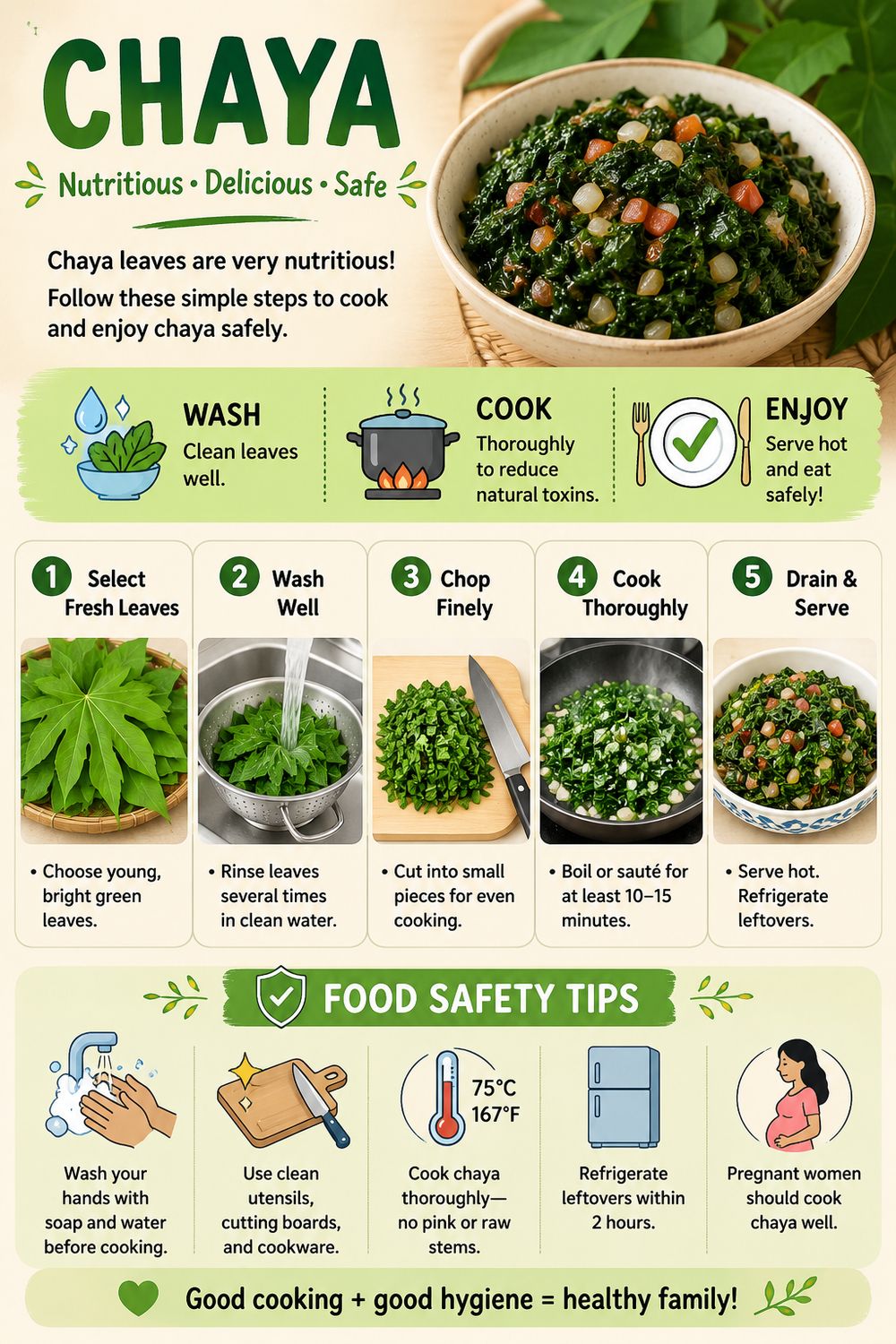
Traditional cooking times generally range from approximately 10–20 minutes. GreenDreams uses a conservative 15–20-minute boiling standard for clear, repeatable home preparation.
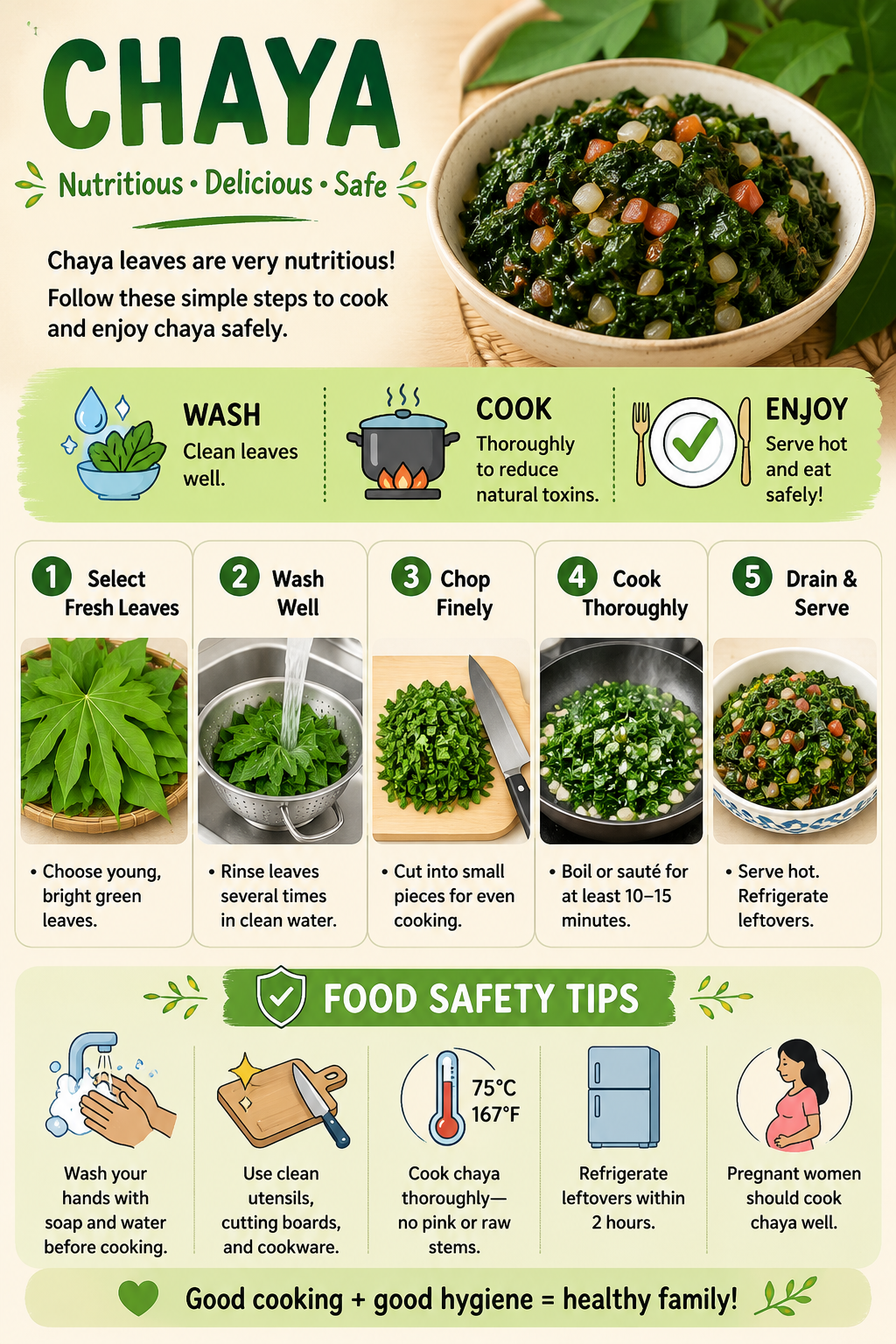
GreenDreams Conservative Cooking Standard
- Select healthy young leaves.
- Remove the petioles and thick stem material.
- Wash the leaf blades thoroughly.
- Chop or tear the leaves into manageable pieces.
- Place them in a stainless-steel or other non-aluminum pot.
- Cover with plenty of boiling water.
- Boil uncovered for 15–20 minutes.
- Drain the cooked leaves.
- Use them in the final recipe.
After boiling, the cooked leaves may be:
- Sautéed
- Mixed with eggs
- Added to beans
- Folded into rice
- Added to soups and stews
- Used in savory fillings
- Blended into cooked sauces
- Combined with other prepared greens
Why We Recommend Boiling First
Research findings can vary according to:
- Chaya variety
- Leaf age
- Which plant portion is tested
- Sample size
- Chopping method
- Cooking temperature
- Water volume
- Processing time
A quick sauté may not expose every piece of raw leaf to enough heat for long enough.
For the safest and easiest home method:
Boil first, drain, and then sauté or add to another cooked dish.
What About Petioles and Tender Shoots?
Traditional Chaya dishes may include petioles or young shoot tips, but thicker green tissues can be:
- More fibrous
- More difficult to heat evenly
- Higher in total raw plant mass
- More likely to require extended cooking
New growers should begin with the leaf blades only.
Kitchen Safety Reminders
- Cook in a well-ventilated area.
- Use stainless-steel, enamel, or other non-aluminum cookware.
- Keep raw leaves separate from foods served uncooked.
- Wash knives and cutting boards after preparation.
- Wash hands after handling raw plant material.
- Do not taste until cooking is complete.
- Store cooked leftovers promptly.
- Do not use Chaya as a substitute for prescribed medical care.
GRAPHIC HOLDING SPACE — Chaya food-safety cooking card
🥬 Flavor, Texture & Culinary Personality
Properly cooked Marabou Chaya has a mild green flavor with a slightly herbal quality.
Within our collection, its texture generally falls between the tender Maple Leaf selection and the firmer Deep Lobed form.
Cooked Flavor Profile
- Mild
- Green and vegetal
- Slightly herbal
- Low in bitterness when young leaves are used
- Compatible with both delicate and strongly seasoned dishes
- Similar in use to spinach, Swiss chard, collards, or callaloo
Cooked Texture
Young Marabou Chaya leaves become:
- Tender to moderately substantial
- Easy to chop
- Suitable for eggs
- Firm enough to remain visible in soups
- Softer than mature Deep Lobed leaves
- Slightly more structured than young Maple Leaf leaves
Older leaves may remain usable after correct cooking but often benefit from:
- Longer boiling
- Finer chopping
- Additional simmering
- Use in beans, soups, or stews
- Blending with softer greens
Why Young Leaves Are Best
Young, fully expanded leaves generally offer:
- Better texture
- Faster preparation
- Less fibrous tissue
- More even cooking
- A cleaner appearance
- A milder flavor
Avoid harvesting only the softest unfolding tips. The best balance is usually found in young leaves that have opened fully but have not yet become leathery.
Flavor Pairings
Marabou Chaya works particularly well with:
- Eggs
- Onion
- Garlic
- Tomato
- Sweet pepper
- Hot pepper
- Beans
- Rice
- Corn
- Squash
- Pumpkin seeds
- Coconut milk
- Broth
- Cheese
- Butter
- Olive oil
- Smoked seasonings
- Citrus added after cooking
- Sofrito-style seasoning blends
PHOTO HOLDING SPACE — Bowl of properly cooked Marabou Chaya
🍳 Ways to Use Properly Cooked Marabou Chaya
Breakfast & Brunch
- Chaya and egg scramble
- Chaya omelet
- Tropical vegetable frittata
- Breakfast tacos
- Chaya and cheese quiche
- Savory breakfast bowls
- Chaya folded into grits
- Cooked greens with eggs and roasted sweet potato
Soups & Stews
- Black bean and Chaya soup
- Red bean stew
- Chicken and vegetable soup
- Coconut vegetable stew
- Lentil soup
- Tomato and pepper soup
- Long-simmered garden stew
- Caldo-style dishes
Rice, Beans & Grains
- Chaya folded into seasoned black beans
- Rice with cooked greens
- Rice-and-bean bowls
- Millet with vegetables
- Quinoa with Chaya and roasted squash
- Stuffed peppers
- Savory grain patties
- Chaya added to dirty-rice-style preparations
Fillings & Savory Dishes
- Tamale filling
- Quesadilla filling
- Enchilada filling
- Savory hand pies
- Chaya and cheese stuffing
- Vegetable patties
- Cooked-green sauces
- Pasta or ravioli fillings
- Flatbread toppings
- Croquettes
Mixed Perennial Greens
Once the Marabou Chaya has been boiled separately, it may be combined with properly prepared:
- Okinawan Spinach
- Longevity Spinach
- Katuk
- Surinam Spinach
- Moringa
- Cranberry Hibiscus
- Tongan Spinach
- Edible Hibiscus
- Roselle foliage
Each plant has its own food-safety and preparation requirements.
Chaya must always complete its required cooking process before being mixed with other ingredients.
🍳 Simple Marabou Chaya & Egg Scramble
Ingredients
- 8–10 young Marabou Chaya leaves
- 3 eggs
- ¼ cup diced onion
- ¼ cup diced sweet pepper
- 1 small clove garlic
- Butter or cooking oil
- Salt and seasoning to taste
- Optional cheese, tomato, or hot pepper
Preparation
- Remove the petioles from the Chaya leaves.
- Wash the leaf blades thoroughly.
- Boil uncovered for 15–20 minutes in a non-aluminum pot.
- Drain the cooked leaves.
- Chop them into small pieces.
- Sauté the onion, pepper, and garlic.
- Add the cooked Chaya.
- Stir briefly to combine.
- Add the beaten eggs.
- Cook until the eggs are fully set.
- Season and serve warm.
The mild flavor allows the herbs, vegetables, and seasonings to lead while the Chaya adds substance and garden-grown nutrition.
🌿 Traditional Chaya Foodways
Chaya’s culinary history reaches far beyond its modern nickname of Tree Spinach.
Ethnobotanical records document the leaves being:
- Boiled in salted water
- Combined with vegetables
- Added to soups and stews
- Cooked with meat
- Served with ground roasted squash seeds
- Paired with tomatoes and peppers
- Wrapped in tortillas
- Incorporated into corn-based foods
- Mixed with eggs
One of the best-known traditional dishes is dzotobilchay, a Yucatecan preparation incorporating chopped Chaya into a corn-based dish.
Traditional dishes vary according to community and household, but the recurring pattern remains clear:
Chaya is a cooked food—not a raw green.
The plant’s long culinary history demonstrates how growers learned to transform a naturally defended tropical plant into a reliable household vegetable through correct preparation.
🌿 Harvesting Marabou Chaya for the Best Quality
Marabou Chaya is a cut-and-regrow perennial vegetable.
Regular, moderate harvesting can help:
- Control height
- Encourage branching
- Renew the canopy
- Increase the number of accessible growing points
- Maintain a structured shrub
- Produce younger leaves
Do Not Harvest a Newly Shipped Starter Plant
A 4-inch starter should first:
- Recover from transit
- Resume active growth
- Establish additional roots
- Develop several healthy branches
- Build enough foliage to support itself
- Adjust to its new light exposure
The first goal is establishment—not immediate yield.
When to Begin Harvesting
Begin only when the plant is:
- Actively producing new growth
- Firmly rooted
- Carrying several healthy branches
- Free from shipping stress
- Free from drought stress
- Large enough to retain substantial foliage after harvesting
For small starter plants, this may require several months of warm-season growth.
Best Leaves to Harvest
Choose leaves that are:
- Young but fully expanded
- Bright to deep green
- Flexible
- Free from major pest damage
- Free from spreading disease spots
- Not wilted
- Not cold-damaged
- Not recently treated with a pesticide or horticultural product
Responsible Harvesting
- Use clean scissors or pruners.
- Wear gloves.
- Harvest from multiple branches.
- Avoid stripping one stem completely.
- Retain at least half of the healthy canopy.
- Delay harvesting during cold, drought, or transplant stress.
- Allow the plant to replace harvested foliage.
- Stop harvesting when new growth becomes smaller or weaker.
Florida Harvest Season
Established plants may provide harvestable foliage through much of the year in frost-free South Florida.
In Central Florida and similar Zone 9 climates, the strongest production generally occurs during:
- Late spring
- Summer
- Early fall
Growth slows during cooler weather.
Frost may stop production until spring recovery.
Southeastern United States
In Zones 8–9, expect the primary harvest period to extend from:
- Late spring
- Through summer
- Into early fall
- Until the first significant cold event
Northern & Western Regions
Container plants may produce during the frost-free outdoor season.
Indoor winter light is rarely sufficient for heavy harvesting. Focus on maintaining the plant until warm weather returns.
PHOTO / GRAPHIC HOLDING SPACE — Young leaves ready for harvest
🌿 Nutritional Value Without Medical Hype
Chaya leaves have attracted agricultural and nutritional interest because they can provide meaningful amounts of:
- Protein
- Calcium
- Iron
- Phosphorus
- Carotenoids associated with vitamin A activity
- Vitamin C
- Fiber
- Phenolic compounds
- Other vitamins and minerals
Actual nutrient levels vary according to:
- Plant genetics
- Leaf age
- Soil fertility
- Climate
- Irrigation
- Harvest timing
- Cooking method
- Cooking duration
- Serving size
Boiling may reduce certain water-soluble nutrients, but correct heat processing remains essential for safety.
No reliable analysis has established that Marabou Chaya is nutritionally superior to Maple Leaf, Deep Lobed, or formally described Chaya varieties.
Responsible Nutritional Language
Marabou Chaya may accurately be described as a:
Nutrient-dense cooked leafy vegetable.
It should not be advertised as a cure for:
- Diabetes
- High blood pressure
- Kidney disease
- Cancer
- Anemia
- Arthritis
- Any other medical condition
Historical folk use and early research do not replace medical diagnosis or treatment.
The plant has more than enough real value without exaggerated health claims:
- It is perennial.
- It thrives in warm weather.
- It regrows after harvesting.
- It offers a useful cooked green.
- It fits into edible landscapes.
- It carries important cultural history.
- It can reduce reliance on repeatedly planted annual vegetables.
🌸 Ornamental & Pollinator Value
Marabou Chaya offers a cleaner, more structured appearance than many productive perennial vegetables.
Foliage Appeal
Its leaves provide:
- Attractive divided silhouettes
- Rich green color
- Tropical character
- Layered texture
- A balance between broad and finely dissected foliage
- Movement in light wind
- Contrast against grasses and broad-leaved tropical plants
Its upright form makes it useful where Maple Leaf Chaya might appear too dense and Deep Lobed Chaya might feel too open or dramatic.
Flowers
Small pale flowers may develop in branching clusters above or among the foliage during warm weather.
Flowering varies according to:
- Plant maturity
- Pruning schedule
- Sunlight
- Water
- Fertility
- Temperature
- Seasonal conditions
When allowed to flower, Chaya may attract:
- Butterflies
- Bees
- Small native pollinating insects
- Other nectar-seeking garden visitors
Chaya should be considered a supplementary nectar plant.
It does not replace native butterfly host plants or a diverse pollinator planting.
Attractive Landscape Partners
Marabou Chaya combines well with:
- Tropical Sage
- Native Porterweed
- Firebush
- Dune Sunflower
- Coreopsis
- Mexican Sunflower
- Cranberry Hibiscus
- Roselle
- Muhly Grass
- Fakahatchee Grass
- Lemongrass
- Pigeon Pea
- Bananas
- Papayas
- Mulberries
- Guavas
- Perennial Peanut
Best Landscape Roles
- Food-forest mid-layer
- Edible hedge
- Structured tropical border
- Productive backdrop
- Warm-season privacy screen
- Perennial vegetable planting
- Pollinator-garden background
- Patio screening plant
- Container specimen
- Companion planting near fruit trees
- Regenerative biomass plant
Placement in Frost-Prone Landscapes
In Central Florida and other Zone 9 areas, Chaya may become bare after frost.
Place it:
- Behind evergreen shrubs
- Within mixed food-forest plantings
- Along productive fence lines
- Among clumping grasses
- Behind lower perennial greens
- Where winter dormancy will not leave the landscape’s only empty space
Marabou Chaya provides excellent warm-season structure but should not be the only screening plant where freezes occur.
🌾 Regenerative & Productive Landscape Uses
Managed Biomass
Healthy, untreated prunings may be used for:
- Chop-and-drop
- Composting
- Surface organic matter
- Temporary soil shading
- Supporting decomposer organisms
- Building food-forest soil
Keep thick, succulent stems away from:
- Tree trunks
- Plant crowns
- Building foundations
- Areas where accidental rooting would be inconvenient
Chaya stems may root under favorable conditions. Allow unwanted stems to dry thoroughly before using them as mulch.
Edible Hedging
Marabou Chaya is well suited to a structured hedge.
A managed hedge can provide:
- Cooked greens
- Warm-season screening
- Pollinator flowers
- Renewable pruning material
- Visual separation
- Additional food-forest structure
Space plants approximately 3–4 ft apart for a regularly pruned hedge.
Wind Filtering
A compact Chaya hedge may filter ordinary wind, but it should not be relied upon as a hurricane-proof windbreak.
Its stems are thick and succulent. Tall or top-heavy branches may split during severe weather.
Use Chaya as one component of a layered wind system that includes:
- Strong trees
- Dense shrubs
- Clumping grasses
- Low groundcovers
Agroforestry Role
Marabou Chaya tolerates partial shade and can grow beneath an open fruit-tree canopy.
Potential canopy partners include:
- Avocado
- Mango
- Jackfruit
- Mulberry
- Loquat
- Guava
- Sapodilla
- Banana
- Moringa
Partial shade may encourage larger, softer foliage.
Deep shade may produce weak, elongated stems.
Always preserve:
- Harvesting access
- Irrigation access
- Airflow
- Room for future canopy growth
ARRIVAL CARE, PLANTING, WATERING, SOIL & COMPANION GUILDS
📦 What to Do After Your Marabou Chaya Arrives
A 4-inch Marabou Chaya is a young rooted starter plant.
A small nursery container has:
- Limited soil volume
- Limited stored moisture
- A young root system
- Less protection from heat and cold
- Fewer stored resources than a 1-gallon plant
The recovery period should never be rushed.
Do Not Transplant Immediately
Keep the plant in its original nursery container for approximately 30 days or until healthy new growth appears, whichever takes longer.
New growth indicates that the plant has:
- Recovered from shipping
- Resumed root activity
- Adjusted to its new environment
- Begun acclimating to local light
- Stabilized enough for another transition
During the Recovery Period
Provide:
- Bright indirect light
- Gentle morning sun
- Protection from intense afternoon sun
- Protection from drying wind
- Warm temperatures
- Good airflow
- Frost protection
- Easy access for daily moisture checks
Do not immediately place the plant:
- In full afternoon sun
- Against a west-facing wall
- On hot concrete
- In an exposed field
- Under a roofline that floods the pot
- In standing water
- Inside a decorative pot without drainage
- In a cold air pocket
- Directly into the landscape
Sun Acclimation
Acclimate over approximately 7–14 days.
- Begin in bright shade or early morning sun.
- Add one or two hours of stronger light every few days.
- Inspect the leaves daily.
- Watch for bleaching, crisp margins, or severe wilting.
- Return to gentler exposure when stress appears.
- Resume acclimation after the plant stabilizes.
Marabou Chaya can grow in full Florida sun, but tender nursery foliage requires a gradual transition.
GRAPHIC HOLDING SPACE — First 30 days after shipping
🌱 Where to Plant Marabou Chaya
Best Location
Choose a site with:
- Full sun to partial shade
- Well-drained soil
- Space for a large shrub
- Easy pruning access
- Easy harvesting access
- Protection from direct salt spray
- No standing water at the crown
- Protection from strong winter north winds in Zone 9
- Room for nearby companion plants
Full Sun
Full sun generally encourages:
- Faster growth
- Shorter internodes
- Strong branching after pruning
- Increased flowering potential
- Higher water use
- Slightly firmer leaves
Partial Shade
Partial shade may produce:
- Larger leaves
- Softer culinary texture
- Reduced afternoon wilt
- Lower irrigation demand
- Slightly more open growth
Morning sun followed by light afternoon shade is an excellent Florida placement where reflected heat is intense.
Avoid Deep Shade
Too little light may cause:
- Stretched stems
- Weak branching
- Sparse foliage
- Leaning
- Reduced harvests
- Increased storm damage
- Poor flowering
Where Not to Plant
Avoid planting directly:
- Against siding
- Beneath low rooflines
- Beside narrow pathways
- Near vehicle doors
- Inside children’s play areas
- Inside pet runs
- Where livestock can browse
- Over septic components
- In poorly drained depressions
- Where salty irrigation is used
- Where winter leaf loss would remove the property’s only screen
Allow Room for Maintenance
The plant should be accessible from multiple sides.
Provide room to:
- Harvest safely
- Prune broken branches
- Inspect pests
- Apply mulch
- Adjust drip irrigation
- Cover young plants during frost
- Remove cold-damaged stems
PHOTO HOLDING SPACE — Proper Marabou Chaya landscape placement
🌬️ Wind & Storm Placement
Treat Marabou Chaya as moderately wind-tolerant when maintained compactly.
Its upright form handles ordinary breezes well, but tall branches can become top-heavy.
For improved storm resilience:
- Maintain the plant around 5–8 ft.
- Encourage several lower branches.
- Tip-prune tall leaders.
- Avoid excess nitrogen.
- Place behind more wind-firm trees or clumping grasses.
- Reduce excessive height before hurricane threats.
- Remove damaged branches with clean cuts.
Do not stake an overgrown plant indefinitely.
Correct the structure through pruning rather than relying permanently on support.
🌊 Salt Exposure
Chaya is not considered salt-tolerant.
Avoid:
- Direct beachfront exposure
- Repeated salt spray
- Saline irrigation
- Seawater flooding
- High-soluble-salt container conditions
In coastal communities, position Marabou Chaya behind a buffer of salt-tolerant vegetation and use low-salinity irrigation water.
🌱 How to Plant Marabou Chaya Using the GreenDreams High & Tight Method
Plant only after:
- Shipping stress has passed.
- Healthy new growth is visible.
- The roots hold the potting mix together.
- Irrigation is ready.
- Frost is not forecast.
- Severe heat or storms are not imminent.
Step-by-Step Planting Instructions
- Water the plant several hours before installation.
- Dig a hole only slightly wider than the nursery container.
- Keep the hole approximately the same depth as the root ball.
- Remove the plant carefully.
- Never pull the plant out by its stem.
- Inspect the roots.
- Loosen only tightly circling exterior roots.
- Position the root ball level with or slightly above the surrounding grade.
- Backfill primarily with the native soil removed from the hole.
- Firm the soil gently around the root ball.
- Eliminate large air pockets.
- Do not bury the stem.
- Do not create a deep basin around the crown.
- Top-dress the surrounding area.
- Apply hardwood mulch.
- Keep mulch several inches away from the stem.
- Water slowly and thoroughly at soil level.
Why High & Tight Matters
Planting too deeply may contribute to:
- Crown rot
- Stem decline
- Root oxygen loss
- Slow establishment
- Root disease
- Weak anchoring
- Storm instability
A slightly elevated root ball is especially useful in:
- Florida’s summer rainy season
- Compacted development soil
- Heavy clay
- Low landscape beds
- Sites with slow drainage
🎥 GreenDreams High & Tight Planting Method
https://youtu.be/RRQFY30qdA8?si=rRIcsbLlVAVYotfI
Improving Difficult Soil
Sandy Florida Soil
Use:
- Finished compost as a surface top-dressing
- Charged biochar blended with compost
- Hardwood mulch
- Organic nutrients in modest amounts
- Drip irrigation
- Living groundcovers
- Repeated organic-matter additions
Do not replace the entire planting hole with potting soil or pure compost.
A sharply different soil pocket may:
- Remain too wet
- Dry differently from the surrounding soil
- Discourage roots from expanding outward
- Create unstable anchoring
Heavy or Compacted Soil
Consider:
- Planting on a broad raised mound
- Loosening a wide surrounding area
- Applying compost at the surface
- Using deep-rooted companion plants
- Preventing vehicle traffic
- Correcting drainage before planting
Seasonally Wet Soil
Chaya tolerates tropical rainfall and temporary wet periods better than many drought-adapted plants, but it should not remain waterlogged.
Create elevation and positive drainage before installation.
Soil pH
Chaya tolerates a relatively broad range but generally performs best in mildly acidic soil.
Avoid trying to correct soil chemistry blindly.
When growth remains poor despite appropriate care, use a soil test before applying large quantities of:
- Lime
- Sulfur
- Phosphorus
- Micronutrients
- Concentrated fertilizer
💧 Watering Marabou Chaya
The GreenDreams Watering Rule
Water at soil level during the morning.
Avoid overhead watering.
Overhead irrigation can:
- Waste water
- Leave the root ball inadequately hydrated
- Splash soil onto foliage
- Encourage leaf spotting
- Increase foliar disease pressure
- Cause heat-related leaf damage during hot afternoons
- Make irrigation volume difficult to measure
Use:
- Drip emitters
- Dripline
- A slow hose
- A watering wand aimed at the soil
- Hand watering directed into the potting mix
Watering a 4-Inch Container
Check a small pot every day.
It may need daily water during:
- Florida summer heat
- Windy weather
- Active growth
- Low humidity
- Rootbound conditions
It may need less during:
- Cool weather
- Cloudy periods
- Rainy conditions
- High humidity
- Winter dormancy
Water thoroughly until excess moisture exits the drainage holes.
Do not leave the pot standing in water.
Suggested In-Ground Establishment Schedule
Use this as a starting point and adjust for rainfall, temperature, soil, plant size, and drainage.
| Establishment Period | Suggested Watering |
|---|---|
| Planting Day | Water deeply at soil level |
| Days 1–14 | Check daily; water when the root ball begins drying |
| Weeks 3–6 | Water approximately every 2–3 days during dry weather |
| Months 2–3 | Water deeply 1–2 times per week when rainfall is insufficient |
| Established Plant | Water during extended dry periods; increase irrigation for greater leaf production |
| Extreme Heat or Drought | Daily drip may be useful in sandy soil when the root zone is actually drying |
Signs of Underwatering
- Drooping leaves
- Folding foliage
- Lightweight container
- Dry potting mix
- Crispy leaf margins
- Premature leaf drop
- Small new leaves
- Slow regrowth
Signs of Excess Water
- Persistently wet soil
- Yellow lower leaves
- Soft tissue near the crown
- Sour-smelling potting mix
- Fungus gnats
- Dark roots
- Stem rot
- Lack of new growth
Chaya is drought-tolerant after establishment, but drought tolerance does not equal maximum edible production.
Regular moisture produces:
- Larger leaves
- More tender growth
- Faster regrowth
- Greater harvest consistency
GRAPHIC HOLDING SPACE — Soil-level watering and drip-irrigation guide
🌾 Organic Fertility & Soil Building
Marabou Chaya can survive in relatively infertile soil, but improved soil health generally produces:
- More foliage
- Larger leaves
- Faster recovery after pruning
- Deeper green color
- Stronger branching
- More consistent harvests
- Greater stress resilience
GreenDreams Organic Top-Dressing Approach
Apply a light blend around the root zone using:
- Finished compost
- Charged biochar
- Azomite or another trace-mineral source
- Worm castings
- A balanced organic nutrient product
- Hardwood mulch
Keep concentrated amendments away from the stem.
Suggested Fertility Timing
Spring
- Wait until frost danger passes.
- Remove confirmed dead wood.
- Apply compost.
- Feed lightly as new growth begins.
- Resume regular irrigation.
Early Summer
- Refresh mulch.
- Feed lightly when growth is pale or slow.
- Avoid excessive nitrogen.
Mid- to Late Summer
- Add compost if the plant is being harvested heavily.
- Maintain moisture.
- Use balanced nutrition rather than forcing excessive height.
Fall
- Reduce nitrogen.
- Avoid stimulating tender growth immediately before frost season.
- Complete major feeding early enough for growth to mature.
Winter
- Do not fertilize a dormant plant.
- Do not fertilize immediately after frost damage.
- Wait for active spring recovery.
Plant Signals & Possible Causes
| Plant Sign | Possible Cause | Suggested Response |
|---|---|---|
| Pale overall color | Low fertility, cold soil, wet roots, or low light | Check the environment before feeding |
| Yellow lower leaves | Natural aging, excess water, or root crowding | Inspect moisture and roots |
| Small new leaves | Drought, root restriction, limited nutrition, or low light | Correct the limiting condition |
| Tall weak stems | Excess nitrogen or inadequate sunlight | Increase light and tip-prune |
| Brown leaf margins | Drought, fertilizer burn, salt, or root damage | Flush soil and reassess care |
| Slow regrowth after harvest | Too much foliage removed, cool weather, drought, or poor roots | Reduce harvesting and support recovery |
| Dark green but weak growth | Excess nitrogen | Reduce feeding and improve sunlight |
| Growth stops despite wet soil | Low oxygen or root decline | Improve drainage before adding nutrients |
Do not automatically fertilize a stressed plant.
First investigate:
- Moisture
- Drainage
- Root condition
- Light
- Temperature
- Shipping stress
- Container size
🌿 Companion Plants & Food-Forest Guild Ideas
A Marabou Chaya guild should support multiple functions:
- Soil cover
- Organic matter
- Pollinator habitat
- Wind filtering
- Nitrogen cycling
- Root diversity
- Additional harvests
- Seasonal beauty
GreenDreams Companion Plant Chart
| Function | Suggested Plants | Why They Work |
|---|---|---|
| Nitrogen & Biomass | Pigeon Pea, Sunn Hemp, suitable native legumes | Produce pruning material and support soil-building systems |
| Fast Chop-and-Drop | Mexican Sunflower | Generates warm-season biomass and abundant flowers |
| Silica & Carbon | Lemongrass, clumping grasses, Vetiver where appropriate | Produce fibrous material and stabilize soil |
| Living Groundcover | Perennial Peanut, Sunshine Mimosa | Shade soil and reduce bare-ground pressure |
| Pollinator Support | Tropical Sage, Native Porterweed, Firebush, Coreopsis | Add nectar, color, and habitat |
| Perennial-Green Layer | Okinawan Spinach, Longevity Spinach, Katuk, Surinam Spinach | Extend the diversity of leafy harvests |
| Tropical Food Production | Banana, Papaya, Moringa | Complement Chaya’s edible and tropical role |
| Fruit-Tree Canopy | Mulberry, Guava, Loquat, Avocado | Create layered food-forest structure |
| Color Contrast | Cranberry Hibiscus, Roselle, Purple Muhly Grass | Contrast with green divided foliage |
| Beneficial-Insect Habitat | Sweet Almond Bush and native flowering perennials | Extend nectar availability and habitat complexity |
Maintain Space Around the Crown
Keep mulch and dense groundcovers from touching the stem.
Preserve:
- Airflow
- A visible crown
- Harvest access
- Irrigation access
- Room for future branches
- Space for seasonal inspection
A Simple Florida Marabou Chaya Guild
Combine:
- One Marabou Chaya as the structured edible centerpiece
- One Pigeon Pea for nitrogen-rich pruning material
- One Mexican Sunflower for rapid biomass
- Three Tropical Sage plants for pollinators
- One clump of Lemongrass for carbon and culinary use
- Perennial Peanut as living groundcover
- One nearby Mulberry or Guava as the developing fruit-tree canopy
The result is a planting that produces:
- Cooked greens
- Fruit
- Flowers
- Habitat
- Organic matter
- Soil protection
- Tropical visual structure
SEASONAL CARE, PRUNING, CONTAINERS & PRODUCTION
🌦️ Marabou Chaya Seasonal Care Guide for Florida
Chaya may remain evergreen in completely frost-free conditions.
Across much of Florida, it is better described as:
- Semi-evergreen
- Drought-deciduous
- Frost-deciduous
- Seasonally dormant after cold damage
Leaf drop does not automatically mean the plant is dead.
Marabou Chaya may shed foliage because of:
- Frost
- Chilly weather
- Drought
- Shipping stress
- Root disturbance
- Severe pruning
- Extended saturation
- Sudden changes in sunlight
Florida Seasonal Guide
| Season | What to Expect | What to Do |
|---|---|---|
| Winter | Slower growth, yellow leaves, spotting, leaf drop, frost injury, or dormancy | Protect roots, reduce watering, avoid fertilizer, and delay major pruning |
| Early Spring | Bud swelling and new shoots from stems or the base | Wait until freeze danger passes, then remove confirmed dead wood |
| Late Spring | Rapid leaf expansion and renewed branching | Apply compost, resume irrigation, and begin light harvesting |
| Summer | Peak growth, highest water demand, fast regrowth, and possible flowers | Harvest moderately, tip-prune, maintain mulch, and monitor pests |
| Early Fall | Continued growth with gradually shorter days | Complete major shaping early enough for recovery |
| Late Fall | Growth slows and cold sensitivity increases | Reduce nitrogen and prepare frost protection |
Central Florida Winter Expectations
After a Mild Cold Event
You may see:
- Yellowing
- Dark leaf spots
- Temporary wilting
- Slower growth
- Older-leaf drop
After Frost
You may see:
- Blackened foliage
- Collapsed shoot tips
- Soft damaged leaves
- Bare stems
- Upper-branch dieback
After a Hard Freeze
You may see:
- Loss of most visible growth
- Damage to thick stems
- Complete winter dormancy
- Delayed spring recovery
Protected roots or lower woody stems may survive.
New shoots often emerge after sustained warmth returns, but recovery depends on:
- Plant establishment
- Freeze severity
- Freeze duration
- Wind exposure
- Soil moisture
- Root-zone protection
Do not assume the plant is dead immediately after cold damage.
Wait for spring warmth and inspect gradually.
Frost Protection
Before a cold event:
- Water dry soil earlier in the day.
- Apply 3–4 inches of mulch over the root zone.
- Keep mulch away from direct stem contact.
- Cover young plants with frost cloth.
- Extend the covering to the ground.
- Secure it against wind.
- Keep plastic from touching foliage.
- Move containers into a protected structure.
Avoid heavy pruning immediately before a freeze.
The existing canopy offers some insulation, while pruning may stimulate vulnerable new growth.
GRAPHIC HOLDING SPACE — Four-season Marabou Chaya guide
✂️ Pruning Marabou Chaya
Marabou Chaya’s upright, structured growth is one of its greatest strengths.
Pruning controls:
- Height
- Branch density
- Harvest access
- Wind resistance
- Landscape form
- Leaf renewal
- Flowering frequency
- Container manageability
Recommended Management Styles
Structured Harvest Shrub
Maintain around 4–7 ft.
Best for:
- Regular kitchen harvesting
- Smaller food forests
- Easy storm preparation
- Easier frost protection
- Mixed edible borders
Productive Landscape Specimen
Maintain around 6–8 ft.
Best for:
- Tropical borders
- Food-forest mid-layers
- Productive backdrops
- Flowering
- Visual structure
Edible Hedge
Maintain around 4–7 ft.
Best for:
- Warm-season screening
- Repeated leaf harvest
- Productive boundaries
- Regenerative landscape edges
Small Tree Form
Maintain around 6–9 ft with selected lower branches removed.
Best for:
- Planting beneath the canopy
- Creating visible trunks
- Moving around the plant
- Formal edible landscapes
A tree form may produce fewer low harvest points unless the canopy is maintained carefully.
Tip-Pruning
Remove the active shoot tip above a healthy node.
Tip-pruning:
- Encourages side branches
- Creates additional harvest points
- Prevents one tall leader
- Produces a stronger framework
- Improves storm resilience
- Keeps leaves within reach
Begin only after the young plant is established.
Harvest Pruning
Instead of removing only individual leaves, periodically cut a leafy stem back above a healthy node.
This can:
- Collect several leaves efficiently
- Renew the canopy
- Encourage multiple new shoots
- Maintain height
- Preserve an organized framework
Do not remove most of the canopy at one time.
Structural Pruning
Remove:
- Crossing branches
- Broken stems
- Dead wood
- Weak inward growth
- Excessively tall leaders
- Stems blocking pathways
- Storm-damaged tissue
- Crowded growth that restricts airflow
Rejuvenation Pruning
A mature, established Chaya can tolerate substantial warm-season cutting.
For home landscapes:
- Wait until frost danger passes.
- Rejuvenate only a healthy plant.
- Avoid cutting during drought.
- Maintain irrigation during recovery.
- Leave healthy foliage whenever practical.
- Avoid severe pruning immediately after transplanting.
- Do not combine major pruning with heavy fertilization.
Hurricane-Season Pruning
Complete major height reduction before severe weather is imminent.
A lower, branched Marabou Chaya is less likely to:
- Lean
- Split
- Lose its full canopy
- Damage nearby plants
- Become impossible to cover during winter
Pruning & Sap Safety
Chaya produces white latex when cut.
Wear:
- Gloves
- Long sleeves
- Eye protection during major pruning
Avoid touching:
- Eyes
- Mouth
- Nose
- Open wounds
- Sensitive skin
Wash hands and tools afterward.
PHOTO HOLDING SPACE — Marabou Chaya before and after structural pruning
🪴 Growing Marabou Chaya in Containers
Marabou Chaya adapts well to container culture when pruned regularly.
Its upright structure makes it useful for patios and protected winter growing, but it is naturally a large shrub.
Successful container growing requires:
- Progressive up-potting
- Strong light
- Regular pruning
- Consistent watering
- Good drainage
- Nutrient replacement
- Wind protection
- Eventual root management
Container Size Progression
4-Inch Nursery Pot
Best for:
- Shipping
- Initial recovery
- Early root establishment
- Sun acclimation
Do not keep the plant indefinitely after the roots become crowded.
1-Gallon Container
Move up when:
- Roots hold the original mix together
- Roots circle the pot
- Roots emerge from drainage holes
- The plant dries unusually fast
- Growth slows during warm weather
- The plant becomes top-heavy
3-Gallon Container
Provides:
- Better moisture stability
- Greater root growth
- Faster top growth
- A useful stage before landscape planting
- Better resilience than a 4-inch starter
7-Gallon Container
Useful for:
- Patio culture
- Cold-climate mobility
- Maintaining a 3–5 ft plant
- Short- to medium-term harvesting
15-Gallon Container
Recommended for:
- Ongoing harvests
- A maintained 4–7 ft plant
- Improved wind stability
- Longer-term outdoor culture
20-Gallon or Larger Container
Provides more root volume but becomes:
- Heavier
- Harder to move
- More difficult to protect
- More dependent on long-term root management
How to Up-Pot Marabou Chaya
- Wait until the plant has recovered from shipping.
- Water it several hours before transplanting.
- Select a container only one or two practical sizes larger.
- Confirm that drainage holes are open.
- Add fresh potting mix.
- Remove the plant without pulling its stem.
- Loosen only severely circling roots.
- Place the root ball at the same depth.
- Fill around it with fresh mix.
- Firm gently.
- Water thoroughly.
- Place in gentle light for several days.
- Resume gradual sun acclimation.
Never bury the stem during up-potting.
Best Potting Mix
Marabou Chaya prefers a fertile mix that retains useful moisture while draining freely.
Look for a blend containing:
- Quality peat- or coconut-coir-based potting mix
- Aged pine bark
- Perlite, pumice, or another aeration material
- Finished compost in a moderate amount
- Organic slow-release nutrition when appropriate
Avoid:
- Dense garden soil
- Pure compost
- Muck-like media
- Fine mixes that remain saturated
- Containers without drainage
- Saucers that stay filled with water
The goal is a mix that provides:
- Moisture
- Oxygen
- Root support
- Drainage
- Nutrient-holding capacity
Finding Containers & Potting Materials
Search locally or online for:
- Professional nursery pots
- Tree pots
- Food-safe growing containers
- Quality potting mix
- Pine-bark soil conditioner
- Horticultural perlite
- Coconut coir
- Organic container fertilizer
These materials are often available from:
- Independent nurseries
- Farm-supply stores
- Landscape suppliers
- Hydroponic stores
- Online garden retailers
Container Watering
A container-grown Marabou Chaya may require daily watering during Florida summer.
Water:
- At soil level
- During the morning
- Until water exits the drainage holes
- When the upper mix begins drying
Avoid small surface sips.
The entire root ball should be hydrated.
Container Fertility
During active growth, use:
- Light organic fertilizer applications
- Thin compost top-dressings
- Worm castings
- Trace minerals according to label directions
- Surface mulch kept away from the stem
Periodically flush the container thoroughly with plain water to reduce soluble-salt accumulation.
PHOTO HOLDING SPACE — 4-inch through 15-gallon container progression
🏠 Can Marabou Chaya Grow Indoors?
Marabou Chaya is not an ideal permanent houseplant.
Indoor challenges include:
- Large mature size
- High light requirements
- Reduced winter growth
- Environmental leaf drop
- Potential spider mites
- Potential scale insects
- Irritating latex
- Access by pets or children
- Difficulty supporting regular harvests
Indoor Overwintering
In colder climates, a container plant may be overwintered in:
- A heated greenhouse
- Bright sunroom
- Protected enclosed porch
- Indoor growing area with strong supplemental light
Provide:
- Maximum available light
- Good airflow
- Temperatures above freezing
- Reduced winter watering
- Protection from heating vents
- Regular pest inspections
- Distance from children and pets
Do not expect strong winter harvests under normal household light.
Indoor overwintering should focus on survival.
Moving Outdoors in Spring
After frost danger passes:
- Move the plant into bright outdoor shade.
- Introduce gentle morning sun.
- Increase exposure over 7–14 days.
- Watch for bleaching or wilting.
- Protect tender indoor foliage from sudden full sun.
🌾 Production & Spacing Strategies
Individual Garden Plant
Space approximately 4–6 ft from nearby shrubs.
Best for:
- Home harvesting
- Mixed edible beds
- Regular shaping
- Intentional tropical landscapes
Food-Forest Planting
Space approximately 6–8 ft apart.
This provides room for:
- Branching
- Harvest access
- Companion plants
- Drip irrigation
- Airflow
- Future canopy development
Managed Edible Hedge
Space approximately 3–4 ft apart.
A dense hedge requires:
- More frequent pruning
- Greater irrigation
- Additional organic matter
- Strong airflow management
- Controlled height
Container Production
Maintain one plant per large container.
Keep around 3–6 ft for:
- Stability
- Easier movement
- Manageable watering
- Accessible harvesting
Sustainable Harvest Principles
- Preserve at least half the healthy canopy.
- Harvest from several branches.
- Avoid stripping one stem bare.
- Irrigate during regrowth.
- Replace organic matter.
- Reduce harvesting during cool weather.
- Stop harvesting when the plant is stressed.
- Rotate harvest areas.
- Allow replacement leaves to mature.
- Maintain a strong permanent framework.
CAUTIONS, TROUBLESHOOTING, FAQ & SHIPPING
⚠️ Important Cautions
Raw Leaves Are Not Edible
Marabou Chaya contains cyanogenic glycosides.
Leaves must be thoroughly cooked before consumption.
Never eat the plant raw.
Never add raw leaves to smoothies.
Sap May Irritate Skin
Cut leaves and stems release sticky white latex.
Wear gloves while:
- Harvesting
- Pruning
- Propagating
- Cleaning storm damage
Keep sap away from:
- Eyes
- Mouth
- Nose
- Open wounds
- Sensitive skin
Low-Hair Does Not Mean Risk-Free
Marabou Chaya is circulated as a relatively easy-to-handle cultivated form.
That does not guarantee that every leaf or petiole will be completely free from irritating hairs.
Wear gloves until you understand how your plant affects your skin.
Children, Pets & Livestock
Do not plant where children or animals are likely to browse the plant.
Raw Chaya should not be treated as:
- Pet food
- Livestock forage
- Poultry greens
- A casual tasting plant
Frost Sensitivity
Foliage and young stems are frost-tender.
Protected roots often resprout in warm climates, but recovery is not guaranteed after severe or prolonged freezes.
Branch Breakage
Tall succulent branches may break during severe storms.
Maintain a lower, branched structure.
Salt Exposure
Chaya is not recommended for direct beachfront salt spray or saline irrigation.
Medical Claims
Chaya has a long history of traditional food and folk use.
It should not be used to diagnose, treat, cure, or prevent a medical condition.
GRAPHIC HOLDING SPACE — Marabou Chaya safety reminders
🔍 Marabou Chaya Troubleshooting Guide
Icons represent common causes and organic recovery strategies—look for 🌿 for the recommended response.
| ⚠️ Issue | 🧠 Likely Cause | 🌿 Organic Response |
|---|---|---|
| 🍂 Yellow lower leaves | Natural aging, excess water, cold, or crowded roots | Check drainage and roots before fertilizing |
| 🍃 Sudden leaf drop | Shipping, drought, frost, transplant shock, or rapid environmental change | Stabilize conditions and wait for new growth |
| 🫣 Afternoon wilting | Dry root ball, hot reflected light, small pot, or wind | Water deeply in the morning and provide temporary afternoon protection |
| 💦 Soil remains wet | Dense mix, blocked drainage, oversized container, or excessive irrigation | Improve drainage and let the upper mix begin drying |
| 🪣 Stem soft near soil level | Crown planted too deeply or soil remaining saturated | Remove wet mulch, expose the crown, and improve drainage |
| ☀️ Pale or bleached patches | Sunburn following shipping or movement from shade | Return to gentler light and acclimate gradually |
| 🔥 Brown leaf margins | Drought, fertilizer burn, salt accumulation, or damaged roots | Flush the soil and reassess irrigation and feeding |
| ❄️ Blackened foliage | Frost or freeze damage | Protect roots and delay pruning until cold danger passes |
| 🌬️ Broken branches | Excess height, strong wind, or weak nitrogen-forced growth | Make a clean cut and retrain a lower framework |
| 🌱 Long weak stems | Low light or too much nitrogen | Increase light gradually and tip-prune |
| 🐛 Chewed leaves | Caterpillars, hornworms, beetles, or grasshoppers | Inspect after sunset, hand-pick, and use species-appropriate organic controls |
| 🪲 Sticky leaves or clustered insects | Aphids, scale, or other sap-feeding pests | Remove heavily affected growth and apply labeled horticultural soap if needed |
| 🐜 Aphids repeatedly return | Ants may be protecting honeydew-producing insects | Address ants and encourage beneficial predators |
| 🕷️ Fine stippling or webbing | Spider mites in hot, dry, protected conditions | Improve airflow, rinse leaf undersides during morning, and use labeled controls if needed |
| 🍄 Spreading leaf spots | Persistent leaf wetness, poor airflow, or fungal activity | Stop overhead watering, thin crowded growth, and remove severely affected leaves |
| 🌱 No growth after shipping | Recovery period, cool temperatures, immature roots, or too much water | Maintain warmth and stable moisture; wait for new growth |
| 🪴 Plant dries extremely fast | Roots have filled the container | Up-pot after recovery and active growth |
| 🌾 Pale growth despite fertilizer | Cold soil, root damage, poor drainage, or unsuitable pH | Investigate root conditions before feeding again |
| ✂️ Slow recovery after harvest | Too much foliage removed or plant harvested while stressed | Stop harvesting and allow the canopy to rebuild |
| 🍃 Leaves grow smaller over time | Root crowding, drought, insufficient nutrition, or repeated overharvesting | Inspect roots and adjust the full care program |
When Patience Is the Correct Treatment
Marabou Chaya may stop growing temporarily after:
- Shipping
- Transplanting
- Root disturbance
- Cool nights
- Sudden stronger sunlight
- Severe pruning
- Drought
- Frost
Positive signs include:
- Firm green stems
- Healthy roots
- Swelling buds
- New shoots
- Stable stem tissue
✨ Is Marabou Chaya Right for You?
✅ Ideal For
- Florida gardeners
- Gulf Coast growers
- USDA Zones 9–11
- Food-forest enthusiasts
- Permaculture and agroforestry projects
- Growers seeking perennial cooked greens
- Intentional edible landscapes
- Structured tropical borders
- Productive hedges
- Gardeners interested in Florida plant-sharing history
- Container growers
- Tropical plant collectors
- Regenerative landscapes needing biomass
- Gardeners willing to prune
- Home cooks comfortable following food-safety instructions
❌ Not Ideal For
- Anyone seeking a raw salad green
- Households unwilling to follow cooking requirements
- Low-light indoor growing
- Unprotected Zone 8 or colder landscapes
- Direct beachfront salt exposure
- Permanently saturated soil
- Locations where pets or livestock browse
- Gardeners unwilling to manage a large shrub
- Landscapes requiring evergreen foliage after frost
- Anyone expecting immediate harvests from a starter plant
- Growers seeking a formally registered cultivar
- Anyone who needs scientifically proven cultivar-level nutritional differences
❓ Frequently Asked Questions
Can Marabou Chaya be eaten raw?
No. Marabou Chaya must always be thoroughly cooked.
How long should I cook Marabou Chaya?
GreenDreams recommends boiling the leaf blades uncovered for 15–20 minutes in plenty of water using non-aluminum cookware.
Can I add raw Marabou Chaya to a smoothie?
No. Blending does not neutralize the cyanogenic compounds.
Can I sauté it without boiling first?
We recommend boiling first, draining, and then sautéing the cooked leaves.
What does Marabou Chaya taste like?
Properly cooked young leaves have a mild green flavor with a slightly herbal quality.
What is the cooked texture?
Within our collection, Marabou Chaya generally falls between tender Maple Leaf Chaya and firmer Deep Lobed Chaya.
Who is Marabou Chaya named after?
The selection is named in recognition of Florida grower and author Marabou Thomas, who is associated through community history with discovering, propagating, and sharing the plant.
Is the Marabou Chaya origin story formally documented?
The story has been carried within Florida’s food-forest community and GreenDreams’ collection history. It is not a formally published cultivar-release record.
Is Marabou Chaya a registered cultivar?
No. It is an informally named, regionally circulated selection.
Is it patented?
It is not represented by GreenDreams as a patented plant.
Is Marabou Chaya one of the four historic Chaya varieties?
It has not been formally established as Chayamansa, Estrella, Picuda, or Redonda. Those traditional varieties are classified primarily through morphology and regional history.
How is it different from Maple Leaf Chaya?
Marabou Chaya generally has narrower lobes, a more upright form, and a slightly more substantial cooked texture.
How is it different from Deep Lobed Chaya?
Its foliage is less dramatically divided, and its growth generally appears more balanced and structured.
How large does Marabou Chaya grow?
An unpruned plant may reach approximately 8–12+ ft.
Can I keep it at 6 ft?
Yes. Tip-pruning and regular warm-season pruning can maintain an established plant around 4–7 ft.
Is Marabou Chaya evergreen?
It may remain evergreen in frost-free conditions. In Central Florida, it may become semi-evergreen, drought-deciduous, or dormant after frost.
Will it return after frost?
Protected roots and lower stems often resprout after warm weather returns. Recovery depends on freeze severity and plant establishment.
When should spring growth appear?
Growth commonly resumes after sustained warmth returns and the soil warms.
Can it grow in Zone 8?
It is not reliably hardy outdoors in Zone 8. Use a protected microclimate or a movable container.
Can it grow in partial shade?
Yes. Partial shade may produce larger, softer leaves. Deep shade causes weak growth.
Is it drought-tolerant?
Established Chaya tolerates periodic drought, but drought reduces leaf quality and production.
Does it tolerate wet soil?
It tolerates heavy rainfall but should not remain permanently waterlogged.
Is it salt-tolerant?
No. Protect it from direct salt spray and saline irrigation.
Is it wind-tolerant?
A compact, branched plant handles normal wind reasonably well. Tall succulent branches may break during severe storms.
Does it attract butterflies?
The small flowers may provide nectar for butterflies and other pollinators. Combine Chaya with native host and nectar plants for a complete habitat.
Can I grow it in a container?
Yes. Progress gradually from the 4-inch pot into 1-gallon, 3-gallon, 7-gallon, and eventually 15-gallon or larger containers.
Can it grow indoors?
It is not an ideal permanent houseplant. It may be overwintered in a bright greenhouse, sunroom, or growing area with supplemental lighting.
When should I transplant my shipped plant?
Wait approximately 30 days or until healthy new growth appears, whichever takes longer.
How soon can I harvest?
Wait until the plant is well rooted, actively growing, and carrying several healthy branches.
How often can I harvest?
Harvest moderately during active growth and retain at least half the healthy foliage.
Why is it dropping leaves?
Common causes include shipping stress, cold, drought, root disturbance, excess water, or rapid changes in sunlight.
Can I propagate Marabou Chaya?
Chaya is commonly propagated from mature stem cuttings. Cut surfaces are typically allowed to callus because fresh succulent stems can rot in wet media.
Does it produce seeds?
Many cultivated Chaya forms produce little or no viable seed and are maintained through cuttings. Marabou Chaya should be propagated vegetatively to preserve the plant being circulated under that name.
🚚 Shipping & Handling Notes for the 4-Inch Size
Marabou Chaya ships as a young rooted starter plant in a 4-inch nursery container.
Regional Shipping Recommendation
This size is most suitable for:
- Florida
- The Southeastern United States
- Texas
- Warm destinations with shorter UPS Ground transit times
We ship throughout the continental United States, but a 4-inch plant:
- Has a smaller root zone
- Holds less moisture
- Dries faster
- Has fewer stored resources
- Is more vulnerable to temperature extremes
Northern & Western U.S. Orders
Growers in northern and western states should consider:
- Longer UPS Ground transit
- Low humidity
- Summer heat
- Winter cold
- Temperature differences from Florida
- Carrier delays
- Additional recovery time
- Increased potential for leaf loss
Extended ground transit may not be suitable for every small tropical plant.
When available, we recommend selecting a 1-gallon or larger Marabou Chaya for distant destinations.
Larger plants generally have:
- More soil volume
- More stored moisture
- A larger root system
- Greater transit resilience
California Shipments
California agricultural inspection may delay delivery by an additional day or longer.
Inspection timing is outside GreenDreams’ control and can add stress to a small plant.
Extreme Weather Disclaimer
GreenDreams ships from Florida using UPS Ground.
Buyer discretion is required during:
- Peak summer heat
- Severe winter cold
- Major storms
- Holiday shipping congestion
- Extreme weather along the route
GreenDreams cannot control:
- Delivery-truck temperatures
- Sorting-facility conditions
- Packages left in direct sun
- Freezing conditions
- Carrier delays
- Agricultural-inspection delays
- Extended ground transit
- Destination weather after shipment
The buyer assumes the additional risk associated with ordering a small tropical plant during unsuitable weather or for an extended-distance ground shipment.
Monday Shipping Schedule
Live-plant orders are processed to ship on Mondays.
Tracking information is sent automatically after the shipping label is created.
What to Expect Upon Arrival
A shipped Marabou Chaya may arrive with:
- Drooping foliage
- Yellow leaves
- Minor leaf loss
- Bent soft growth
- Dry margins
- Reduced vigor
- Temporary dormancy
These symptoms do not automatically mean the plant is dead.
Chaya can recover from significant transit stress when roots and stems remain healthy.
Arrival Care
- Unpack promptly.
- Photograph the plant and packaging when shipping damage is visible.
- Check the potting mix.
- Water at soil level when dry.
- Place in bright shade.
- Protect from wind.
- Protect from extreme temperatures.
- Do not fertilize immediately.
- Do not transplant immediately.
- Wait for healthy new growth.
- Acclimate gradually to stronger sunlight.
We recommend waiting at least 30 days or until new growth appears before planting in the ground or moving into a substantially larger container.
🏡 Shop With Us in Person
GreenDreams Nursery & Farm — Retail Nursery Open to the Public
Visit us to see Marabou Chaya in person and explore our wider collection of edible, medicinal, native, ecological, and useful plants.
Our Spring Hill nursery often carries:
- Larger Marabou Chaya
- Multiple Chaya selections
- Fruit trees
- Perennial vegetables
- Tropical edible plants
- Pollinator plants
- Native species
- Food-forest support plants
- Organic soil amendments
- Plants not currently listed online
🌾 18709 US Hwy. 41, Spring Hill, FL 34610
🕘 Tuesday–Friday: 9AM–5PM
🌞 Saturday: 8AM–3PM
Stop by our regenerative nursery to see what is blooming, fruiting, and ready for planting this week.
🌿 Beyond the Plant: GreenDreams Services
At GreenDreams, we do more than grow plants—we design, build, and restore ecosystems across Florida.
- 🌳 Onsite consultations and edible landscape design
- 🚜 Installation and project management
- 🚚 Bulk delivery of compost, mulch, biochar, and soil materials
- 🌾 Bulk plant sourcing and large-scale regenerative solutions
Let our team help you create a thriving edible paradise—starting with Marabou Chaya.
🌿 Grow a Piece of Florida Food-Forest History
Marabou Chaya brings together qualities that are difficult to find in one plant:
- Perennial cooked-green production
- Florida heat tolerance
- Upright landscape structure
- Strong pruning response
- Attractive divided foliage
- Food-forest versatility
- Pollinator-supporting flowers
- Renewable biomass
- A meaningful regional grower story
It is neither the broadest nor the most dramatically divided Chaya.
That is exactly its strength.
Marabou Chaya offers a balanced plant for growers who want their edible landscape to be productive, organized, beautiful, and connected to the community that helped preserve it.
Ready to grow this Florida-circulated Tree Spinach selection? Order your Marabou Chaya today. 🌿
🏷️ Catalog & Search Information
Short Catalog Subtitle
A Florida Food-Forest Favorite with Balanced Form & Flavor
Brief Catalog Description
Grow a Florida-circulated perennial green with attractive divided foliage, upright structure, and dependable warm-season production. This community-stewarded Tree Spinach selection is ideal for food forests, edible hedges, tropical borders, large containers, and properly cooked kitchen harvests.
Online Store Meta Title
Marabou Chaya Plant for Sale | Florida Tree Spinach 🌿
Online Store Meta Description
Buy Marabou Chaya in a 4-inch pot—a Florida-grown perennial green for food forests, edible hedges and warm-climate gardens.
Local Pickup Meta Title
Marabou Chaya for Sale in Spring Hill, FL 🌿 GreenDreams
Local Pickup Meta Description
Shop Marabou Chaya at our Spring Hill nursery. Explore larger Chaya plants, perennial vegetables and Florida food forest favorites.
Suggested SEO Keywords
- Marabou Chaya plant for sale
- Marabou Chaya Florida
- Marabou Thomas Chaya
- Florida Chaya plant
- Chaya Tree Spinach
- Tree Spinach plant
- Cnidoscolus aconitifolius
- Florida food forest plants
- perennial leafy vegetables
- heat-tolerant greens
- Chaya plant care
- how to grow Chaya
- how to cook Chaya leaves
- edible hedge plants
- perennial spinach alternative
- tropical edible shrub
- Chaya nursery Florida
- Chaya shipped online
- Marabou Chaya history
- Marabou versus Maple Leaf Chaya
- Chaya comparison
- Mayan Spinach plant
- cooked perennial greens
- food forest nursery Florida
📷 Suggested Photo & Graphic Placement
Part 1
- Hero photograph: Full Marabou Chaya showing its upright form.
- Leaf close-up: Mature Marabou leaf against a clean background.
- Scale image: Person standing beside a pruned mature plant.
- Quick Facts graphic: Zones, sun, height, spacing, and cooking warning.
- Selection comparison: Marabou, Maple Leaf, and Deep Lobed foliage side by side.
- Origin-story graphic: Florida map with a cutting moving between growers.
- Grower-credit feature: Tasteful section recognizing Marabou Thomas.
- Historic-origin map: Mexico, Yucatán, and Central America.
Part 2
- Food-safety card: Select, wash, boil, drain, and serve.
- Raw-versus-cooked warning: Clear visual explaining that raw Chaya is unsafe.
- Recipe photograph: Marabou Chaya and egg scramble.
- Harvest close-up: Young, fully expanded leaves.
- Flower image: Pale Chaya flowers with a pollinator.
- Culinary-use collage: Eggs, beans, soup, rice, and tamales.
- Landscape image: Chaya with flowering natives and perennial greens.
Part 3
- Arrival-care guide: The first 30 days after UPS delivery.
- Sun-acclimation graphic: Bright shade through full sun.
- High & Tight diagram: Correct and incorrect planting depth.
- Watering image: Drip emitter at the root zone.
- Soil-building photograph: Compost, biochar, azomite, and hardwood mulch.
- Guild illustration: Marabou Chaya with Pigeon Pea, Mexican Sunflower, Sage, grasses, and groundcover.
Part 4
- Seasonal guide: Winter dieback through spring recovery.
- Pruning sequence: Tall plant transformed into a branched harvest shrub.
- Tree-form versus shrub-form graphic: Two management options.
- Container progression: 4-inch, 1-gallon, 3-gallon, 7-gallon, and 15-gallon pots.
- Indoor-overwintering image: Container plant inside a greenhouse.
- Edible hedge image: Several regularly pruned Marabou Chaya plants.
Part 5
- Troubleshooting carousel: Yellow leaves, sunburn, frost damage, and recovery.
- Buyer-fit card: Ideal for versus not ideal for.
- Shipping photograph: Securely packed GreenDreams starter.
- Retail-nursery image: Larger Chaya plants at the Spring Hill location.
- Services banner: Consultation, design, installation, and bulk delivery.
- Final CTA graphic: Grow a Piece of Florida Food-Forest History.
📚 Research Sources
- Royal Botanic Gardens, Kew — Cnidoscolus aconitifoliushttps://powo.science.kew.org/taxon/urn%3Alsid%3Aipni.org%3Anames%3A61821-2
- Ross-Ibarra & Molina-Cruz — The Ethnobotany of Chayahttps://rilab.ucdavis.edu/pdfs/Ross-Ibarra_Molina-Cruz-2002.pdf
- ECHO — Chaya Plant Informationhttps://www.echocommunity.org/resources/9d9ed624-8c1b-4d34-b133-0796a9dfb2d1
- ECHO — For How Long Should Chaya Leaves Be Boiled?https://www.echocommunity.org/resources/6f7cd033-c749-4755-bf8a-339ce98d0b91
- CABI Compendium — Cnidoscolus aconitifoliushttps://www.cabidigitallibrary.org/doi/full/10.1079/cabicompendium.14554
- Florida Heritage Foods — Chayahttps://floridaheritagefoods.com/latin-american-collection/chaya/
- GreenDreams — Existing Marabou Chaya Collection Historyhttps://www.greendreamsfl.com/online-store/Chaya-Mayan-Tree-Spinach-Marabou-Cnidoscolus-aconitifolius-4-p260064908
🌿 IMPORTANT INFORMATION BEFORE PURCHASING LIVE PLANTS
Please note: Plants purchased through our online store are not available for pickup at our retail nursery in Spring Hill, Florida.
Online inventory is housed at a separate facility and is priced, prepared, and handled exclusively for shipping.
🌱 Looking for larger plants or more selection?
Our retail nursery location offers far more availability, including larger sizes, specialty plants, and many selections not suitable for nationwide shipping.
Local pickup is available for retail nursery purchases only.
Visit our Spring Hill, FL retail nursery page to explore in-person shopping options.
🚚 LIVE PLANT SHIPPING & TRANSIT EXPECTATIONS
Live plants naturally experience stress during shipping. Temporary leaf drop, mild wilting, or cosmetic stress is normal after transit. Most plants recover quickly with proper watering, gradual light exposure, and basic aftercare. Some plants may require additional attention during the first few weeks.
Despite careful packing, minor cosmetic damage may occur during transit. Small issues such as broken leaves or stems typically resolve with time and proper care.
If your shipping box arrives with significant external damage, please contact UPS within 30 days to initiate a carrier claim.
⏱️ SHIPPING METHOD, TIMING & TRANSIT WINDOWS
All online orders ship via UPS Ground from our Central Florida nursery.
📦 Shipping Schedule: Orders ship once weekly on Mondays to reduce the risk of packages sitting in transit over weekends. A countdown clock on our website displays the next shipping date.
🚚 Typical Transit Times:
-
Florida: 1–2 days
-
Southern U.S.: approximately 2 days
-
Midwest, West & Northern U.S.: 3–5 business days
Long-distance shipments, particularly to the western U.S., may experience additional transit time due to agricultural inspections in states such as Arizona, California, and Texas.
Extended transit times can be more challenging for small or tender plants and may require additional recovery care after arrival.
🌡️ EXTREME WEATHER & SEASONAL RISK
Live plants are sensitive to temperature extremes.
We cannot guarantee plant condition during periods of extreme summer heat or winter cold and freezing temperatures. Weather-related delays, carrier interruptions, or exposure during delivery are beyond our control.
Customers are responsible for:
-
Monitoring tracking information sent via email
-
Retrieving packages promptly upon delivery
-
Preventing plants from being left outdoors in extreme conditions
During unsafe weather, holiday shipping volume, or extended transit risk, orders may be held and shipped the following week to protect plant health.
⚠️ CUSTOMER RESPONSIBILITY & REFUND POLICY
By purchasing live plants, customers acknowledge and accept the risks associated with shipping, weather exposure, transit delays, and regional suitability.
Refunds or replacements are considered only under exceptional circumstances and in accordance with our return and refund policy. We are not responsible for:
-
Weather-related damage
-
Carrier delays
-
Poor plant selection for a given climate or region
-
Improper care after delivery
Upon purchase, customers assume full responsibility for the ongoing care and success of their plants.
✅ CONSENT & AGREEMENT
By completing a purchase, you confirm that you have read, understand, and agree to all shipping policies, responsibilities, and conditions outlined above.
Our goal is transparency, plant health, and long-term growing success — and we appreciate your understanding and care when ordering live plants.


