


🌿 Large Leaf Tea Plant — Grow Your Own Green, Oolong, White & Black Tea!
Camellia sinensis var. assamica | Assam-Type Large-Leaf Tea Camellia
Your morning tea could literally grow in the backyard.
Large Leaf Tea is the tropical, vigorous side of the true tea family—the same species behind the leaves used to produce green tea, black tea, oolong, and white tea. Instead of growing another ornamental hedge, grow one you can actually harvest.
With glossy evergreen foliage, fragrant white flowers, and repeated flushes of tender edible leaves, Camellia sinensis var. assamica bridges the gap between edible landscaping, useful plants, traditional agriculture, and ornamental gardening.
Our established 3-gallon plants give growers a substantial head start compared with small starter plants.
🍵 From Shrub to Teacup
Here is the part that surprises many new growers:
Green tea, oolong tea, black tea, and white tea do not require four different plants.
They can all be produced from Camellia sinensis. The enormous differences in aroma, color, body, and flavor are created through a combination of genetics, terroir, leaf maturity, harvest timing, withering, rolling, oxidation, heat treatment, and drying.
That means one established tea shrub can become a miniature backyard processing experiment.
🌱 Grow it.
✂️ Pluck it.
🍃 Process it.
☕ Brew it.
Then change your processing technique and make something completely different from the next harvest.
🌱 Quick Facts — Camellia sinensis var. assamica
| 🌿 Category | Details |
|---|---|
| Botanical Name | Camellia sinensis var. assamica |
| Common Names | Large Leaf Tea, Assam Tea, Assam-Type Tea Camellia |
| Plant Family | Theaceae |
| Plant Type | Broadleaf evergreen shrub to small tree |
| Sale Size | 3-gallon live plant |
| Estimated Age | Variable by propagation method and nursery production; container volume is a more reliable indicator than age |
| Natural Size | Assam-type tea can become a substantial shrub/tree when allowed to grow naturally; commercial and backyard plants are normally maintained dramatically smaller through pruning |
| Harvest Height | Approximately 3–6 ft is practical for a backyard tea hedge or harvesting shrub |
| USDA Range | Generally suitable for warm temperate/subtropical climates; Assam-type tea is less cold-hardy than China-type tea |
| Florida Suitability | Particularly worth considering in Florida where acidic soil/drainage requirements can be provided |
| Light | Bright filtered light, partial shade, or morning sun with protection from harsh afternoon exposure is an excellent starting point in Florida |
| Soil | Acidic, organically rich and well-drained |
| Moisture | Consistent moisture without waterlogged roots |
| Growth Habit | Dense evergreen shrub/tree; responds well to pruning and repeated harvesting |
| Foliage | Large, glossy, leathery green leaves; Assam types have characteristically larger leaves than China-type tea |
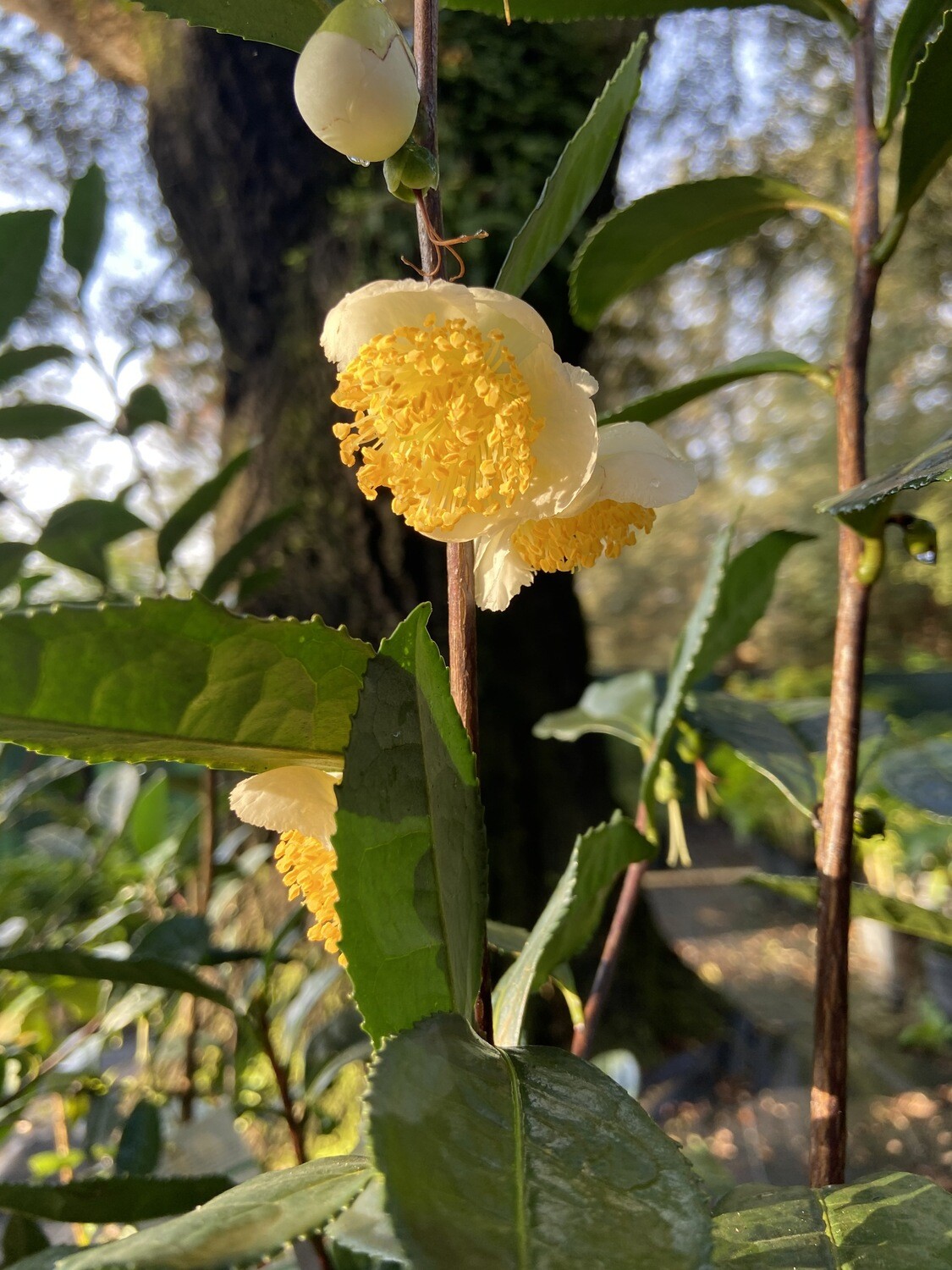
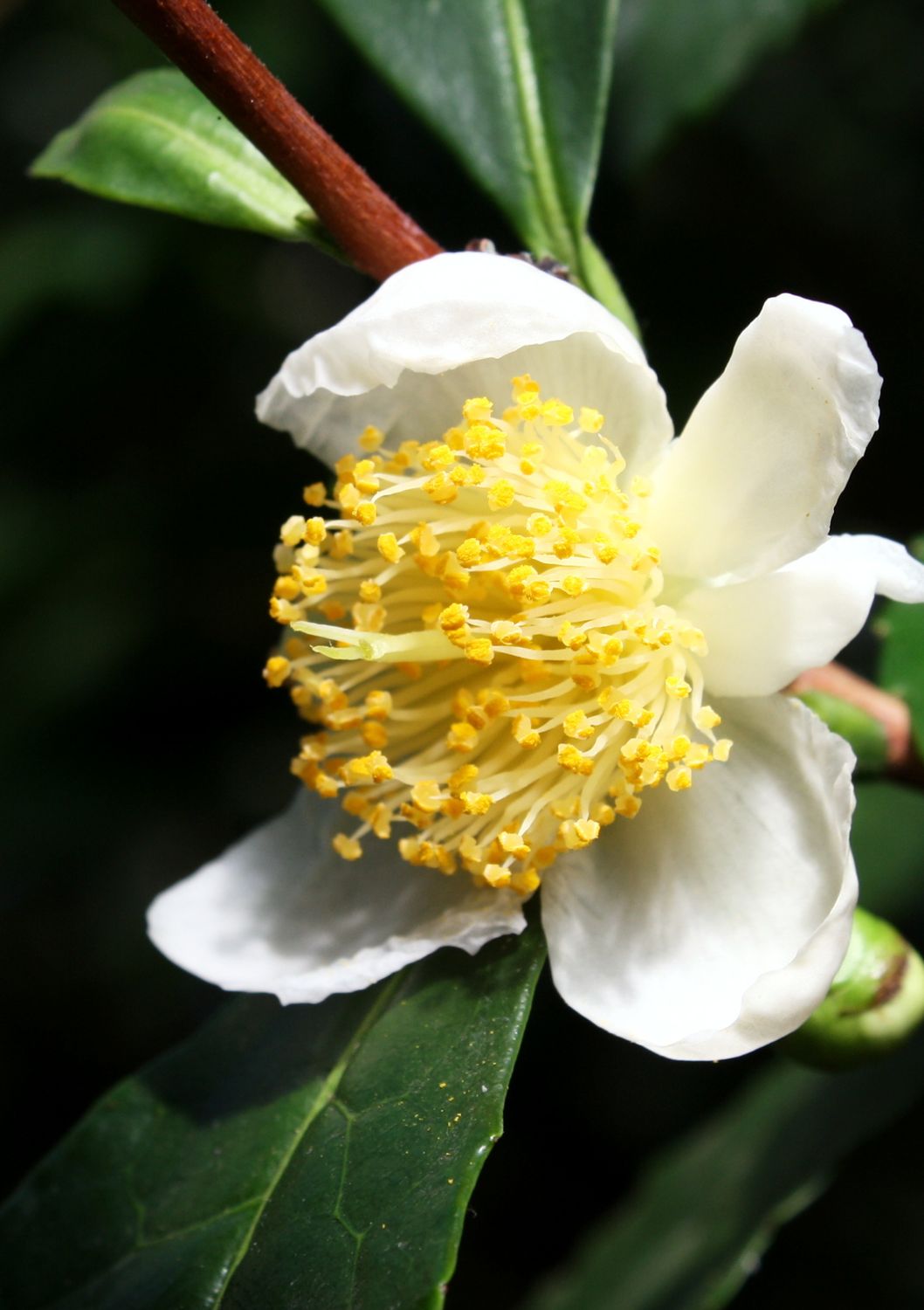
| Flowers | Small white, fragrant camellia-like flowers with prominent yellow-gold stamens |
| Pollination | Insect-pollinated; tea is generally an outcrossing/self-incompatible crop rather than reliably self-fertile |
| Spacing | Approximately 4–6 ft for a managed hedge; allow more room for specimen plants |
| Landscape Use | Edible hedge, understory shrub, tea garden, patio specimen, productive screen |
| Container Growing | Yes |
| Indoor Growing | Possible under excellent light and humidity, but generally better suited to outdoor/patio culture |
| Edible Portion | Primarily tender young leaves and buds used for tea |
| Primary Harvest | Repeated tender growth flushes during the active growing season |
Kew describes var. assamica as the larger-leaved and less-hardy major tea variety and notes that tea can become tree-sized naturally but is maintained much shorter through cultivation and pruning.
🍃 The Classic Harvest: “Two Leaves & a Bud”
Look at the newest tip of an actively growing stem.
That soft terminal bud and the two tender leaves directly beneath it are the classic “two leaves and a bud” plucking standard.
These young tissues are prized because they provide the tender material traditionally used for quality tea production. The American Camellia Society recommends harvesting tender new growth and describes two leaves plus a bud as a useful backyard rule of thumb.
✂️ What Can You Make?
| Tea Style | Backyard Processing Concept | General Cup Character |
|---|---|---|
| 🤍 White Tea | Minimal handling; often very young material/buds, carefully withered and dried | Delicate, light, subtle |
| 💚 Green Tea | Oxidation is stopped early with heat, followed by shaping/drying | Fresh, vegetal, grassy, nutty or sweet depending on processing |
| 🌿 Oolong | Leaves are allowed to oxidize partially before heating and drying | Floral to roasted, layered and aromatic |
| 🖤 Black Tea | Leaves are withered, bruised/rolled and allowed extensive oxidation before drying | Robust, brisk, malty to fruity |
Important: Home tea flavor is not predetermined by the plant alone. Harvest maturity, weather, growing conditions and processing dramatically influence the final cup.
🫖 Simple Backyard Tea Processing
💚 Basic Green Tea
Harvest → Wither briefly → Heat → Roll → Dry
Heating relatively early limits enzymatic oxidation. Home growers commonly experiment with gentle pan heating or steaming before rolling and drying.
🌿 Basic Oolong
Harvest → Wither → Bruise/roll → Partially oxidize → Heat → Dry
This middle ground is where experimentation gets really fun. The degree of oxidation changes aroma, color and flavor.
🖤 Basic Black Tea
Harvest → Wither → Roll/bruise → Oxidize → Dry
Allowing substantially more oxidation produces the darker color and deeper flavors associated with black tea.
🤍 Basic White Tea
Harvest tender material → Wither carefully → Dry
The idea is minimal processing and gentle handling.
💡 Backyard grower tip: Start with tiny batches and keep notes. Harvest time, leaf age, withering duration and processing temperature can all change the finished tea.
That makes a mature tea hedge something more than a crop—it becomes an ongoing craft project.
🌴 Growing Tea in Florida? Yes, Really.
True tea isn't restricted to mist-covered Asian mountainsides.
UF/IFAS specifically recognizes both Camellia sinensis var. sinensis and C. sinensis var. assamica in its guidance for growing tea in the Florida home landscape. Florida growers do, however, need to pay close attention to soil chemistry, drainage, moisture and microclimate.
That makes site selection especially important.
In Central Florida, consider locations with:
- 🌤️ Morning sun and afternoon protection
- 🌳 High filtered canopy
- 🌾 Acidic organic soil
- 💧 Consistent soil moisture
- 🪣 Excellent drainage
- 🌬️ Protection from drying winds
- 🪵 A maintained organic mulch layer
This is a plant for the grower who enjoys learning what the plant is telling them.
🌏 Assam Tea Has a Bigger Story Than Its Name
“Assam Tea” immediately points toward northeastern India—and Assam is enormously important to the history of commercial large-leaf tea.
But the botanical story is broader.
Kew recognizes the native range of Camellia sinensis var. assamica across the eastern Himalaya, southern China and northern Indochina, including Assam, Myanmar, Laos, Thailand and Vietnam.
Tea was already being grown and used by Indigenous communities in Assam when it entered the expanding commercial tea industry of the 1800s. Kew's history describes how knowledge of tea grown by the Singhpho people reached Robert Bruce, and Assam tea subsequently became increasingly important to British commercial tea production in India.
So this plant carries two intertwined histories:
🍃 an ancient regional relationship between people and tea,
and
☕ the later development of one of the world's most commercially important beverages.
Today, Assam-type genetics remain especially associated with vigorous large-leaved tea plants and robust black teas.
🌿 Large-Leaf Assam vs. Small-Leaf China Tea
| Feature | 🌿 var. assamica | 🍃 var. sinensis |
|---|---|---|
| Leaf | Larger, broader | Smaller, narrower |
| Growth | More vigorous; potentially tree-like | Generally more compact |
| Climate Affinity | Warm, humid subtropical/tropical | Greater cool-climate adaptability |
| Cold Tolerance | Lower | Higher |
| Classic Association | Assam and many robust black teas | Chinese green/black tea traditions |
| Backyard Advantage | Large foliage + vigorous production in suitable warm climates | Better choice where winter cold is a major limitation |
Kew specifically distinguishes Assam tea as the larger, taller and less-hardy form, while China-type tea has smaller leaves and greater cold tolerance.
🌟 Why Grow Your Own Tea Plant?
🍵 Harvest a Product You Already Use
Tea is not merely technically edible. It produces one of the world's most culturally and economically important beverages.
🌿 Productive Evergreen Landscaping
Instead of dedicating hedge space exclusively to ornamentals, create a maintained tea hedge that produces harvestable new growth.
🌼 Fall & Winter Interest
Tea is a camellia, bringing glossy foliage and charming white flowers into the edible landscape.
✂️ Pruning Creates the Crop
Unlike many fruit trees where pruning temporarily removes production potential, managing tea as a low branching shrub encourages accessible new shoots—the material you're trying to harvest.
🐝 Pollinator Interest
Tea flowers are insect-pollinated, adding another function to a diversified garden. UF/IFAS documentation notes insect visitation including carpenter bees.
🧑🌾 A Plant That Teaches a Skill
Growing tea is only half the experience.
Learning how to transform fresh leaves into different finished teas makes this one of the most interactive edible plants in the collection.
🌸 Ornamental Appeal — Don't Hide This One in the Vegetable Garden
Camellia sinensis var. assamica belongs comfortably in an ornamental landscape.
Its evergreen foliage, branching form and seasonal white flowers work beautifully as:
- 🍃 An edible privacy hedge
- 🌳 An understory shrub
- 🏡 A foundation planting where soil conditions are appropriate
- 🪴 A large patio container
- 🌿 A productive boundary
- ☕ The centerpiece of a dedicated tea garden
- 🌾 Part of a layered edible landscape or food forest
UF/IFAS recommends camellias generally for screens, accents, background groupings and hedges, provided their drainage and acidic-soil requirements can be met.
This is exactly the kind of plant we love at GreenDreams: ornamental enough for the front yard, productive enough for the food forest, and interesting enough to start a conversation.
🌿 Growing Camellia sinensis var. assamica Successfully
Tea isn't especially interested in being treated like a generic landscape shrub.
Give it the acidic soil, drainage, organic matter, moisture and protected microclimate it wants, and you have the foundation for a productive long-lived plant.
Get those fundamentals wrong and the foliage will usually tell you.
📍 Where to Plant Large Leaf Tea
✅ Best Location
Choose a location with:
- Morning sun
- Bright filtered light
- High shifting shade
- Protection from Florida's harshest afternoon exposure
- Moist but freely draining soil
- Acidic conditions
- Protection from persistent drying wind
Kew describes tea's natural habitat as evergreen forest on acidic soils and notes that it performs beneath taller canopy trees. UF/IFAS likewise emphasizes acidic, well-drained conditions for camellias in Florida.
❌ Avoid
- Standing water
- Depressions that remain saturated after rain
- Highly alkaline soil
- Hot reflective walls
- Extremely exposed windy sites
- Sites receiving intense afternoon sun combined with drought
- Planting beneath rooflines where lime-rich runoff continually raises soil pH
🌾 Soil — This One Matters
Tea is an acid-loving plant.
Think more like a blueberry or camellia grower than a generic tropical-fruit grower.
The root zone should combine:
Acidity + organic matter + moisture retention + oxygen + drainage.
In naturally alkaline landscapes, forcing tea into unsuitable native soil may create recurring nutrient-availability problems.
💡 Container culture can actually be easier where the native soil or irrigation water continually pushes pH upward because you have much greater control over the root environment.
🌿 GreenDreams “High & Tight” Planting Method
After shipping or transporting your plant, do not immediately transplant it.
Allow it to acclimate in its existing nursery container for approximately 30 days or until healthy new growth shows that the plant has recovered from transportation stress.
Keep it appropriately watered and gradually introduce it to the light conditions of its future location.
When it is actively growing and ready for transplant:
1. Prepare the Site
Dig the hole only slightly wider than the nursery container and approximately the same depth as the root ball.
Do not excavate an oversized bathtub-shaped hole in poorly draining soil.
2. Plant High & Tight
Position the root crown slightly high rather than burying it.
Never bury the trunk or root crown beneath additional soil.
3. Backfill Firmly
Use the existing/native soil where appropriate and gently firm it around the root ball to eliminate large air pockets.
Avoid creating an excessively rich pocket completely different from the surrounding soil.
4. Top-Dress
Organic growers can top-dress according to soil-test needs with materials such as:
- Finished compost
- Biochar
- Worm castings
- Appropriate organic nutrients
- Trace minerals when actually needed
5. Mulch
Add approximately 2–3 inches of coarse organic mulch around the surrounding root zone.
We favor hardwood-based organic mulches in ecological landscapes.
🪵 Never volcano-mulch.
Keep mulch pulled away from the woody base and root crown.
6. Water the Root Zone
Water thoroughly at soil level to settle the root zone.
🎥 See the GreenDreams High & Tight planting method:
GreenDreams High & Tight Planting Guide on YouTube
💧 How to Water Large Leaf Tea
Tea likes consistent moisture.
Tea does not like suffocated roots.
Those two ideas have to coexist.
🪴 While Still in the Nursery Container
Container plants can dry rapidly during Florida heat.
Check them daily, particularly during:
- Summer
- Windy weather
- Active growth
- Extended dry periods
Water thoroughly enough that the entire root ball becomes moist.
🌱 Newly Planted
A practical starting point:
Week 1: Check daily and water as needed.
Weeks 2–6: Water deeply approximately 2–3 times weekly when rainfall does not provide sufficient moisture.
After establishment: Adjust irrigation according to soil, weather, canopy exposure and plant response.
Florida's rainy season and sandy soils make fixed schedules imperfect. Check the root zone rather than watering blindly by calendar.
🚫 No Routine Overhead Irrigation
We recommend watering tea at soil level, preferably in the morning.
Drip irrigation or carefully placed low-volume emitters are preferred over overhead sprinklers.
Keeping unnecessary water off foliage also reduces prolonged leaf wetness and splashing between soil and foliage.
💡 Watch the plant and the soil. A schedule is a starting point—not a replacement for observation.
☀️ Florida Seasonal Care Calendar
| Season | What the Plant Is Doing | What the Grower Should Do |
|---|---|---|
| 🌸 Spring | New vegetative flush accelerates | Begin harvesting tender growth; evaluate nutrition; prune strategically to stimulate branching |
| ☀️ Summer | Strong growth with heat/rain | Monitor drainage, moisture, mites and leaf stress; harvest recurring flushes |
| 🍂 Fall | Growth begins changing; flowering may increase | Reduce aggressive pruning/fertilization as winter approaches; enjoy flowers |
| ❄️ Winter | Growth slows; cold becomes primary concern | Reduce harvest pressure; protect young Assam-type plants during significant cold events; avoid keeping roots saturated |
Tea is evergreen, not normally deciduous.
A healthy plant should therefore retain foliage through winter rather than becoming bare as part of a normal dormancy cycle.
Some older foliage turnover is normal. Sudden widespread defoliation should trigger investigation.
✂️ Pruning Tea Is Different — You're Building a Harvest Table
Commercial tea fields develop that iconic flat surface because growers repeatedly manage plants for accessible tender shoots.
Backyard growers can borrow the same concept without turning the garden into a plantation.
🌱 Young Plants
Focus first on:
- Root establishment
- Branch development
- A low, accessible framework
- Multiple growing tips
🌿 Established Plants
Regular light harvesting itself functions as tip pruning.
Repeatedly removing tender terminal shoots encourages branching and creates additional future harvest points.
📏 Great Backyard Height
Maintaining plants around 3–5 ft tall can make hand harvesting comfortable.
You are essentially building a living tea counter.
🌼 Don't Forget the Flowers
If ornamental flowering is important to you, avoid continually removing every potential flowering shoot.
Balance leaf production, shape and bloom according to what you value most.
⚗️ Fertility — More Isn't Better
Tea grown for repeated leaf harvest requires nutrition, but pushing tender growth with excessive fertilizer can create its own problems.
Favor:
- Healthy organic matter
- Biologically active soil
- Appropriate acid-loving nutrition
- Moderate feeding during active growth
- Soil testing when recurring nutrient symptoms appear
Avoid aggressively fertilizing immediately before cold weather when tender new growth may be vulnerable.
🍂 Yellow leaves do not automatically mean “needs fertilizer.”
They may indicate:
- Excess water
- High pH
- Root damage
- Natural older-leaf turnover
- Micronutrient availability problems
- Drought
- Pest pressure
Diagnose first. Feed second.
🪴 Growing Large Leaf Tea in Containers
Yes—and for growers with alkaline or poorly drained native soil, containers may offer a real advantage.
Suggested Progression
A plant should not jump immediately from a modest nursery container into an enormous pot.
Increase container size gradually as roots occupy the available volume.
A typical nursery progression looks something like:
4-inch → 1-gallon → 3-gallon → 7-gallon → 15-gallon → 25-gallon+
Your plant is already being sold in a 3-gallon container, so its next step might eventually be approximately 7 gallons or larger depending on root development.
🧠 When Is It Time?
Look for:
- Roots circling heavily
- Roots exiting drainage holes
- Increasingly rapid drying
- Reduced vigor despite proper care
- A root mass occupying most of the container
Don't up-pot simply because you bought a bigger pot.
🌾 Potting Medium
Use a high-quality acidic potting medium designed for camellias, azaleas, blueberries, or other acid-loving plants, with enough structure to maintain drainage and root-zone oxygen.
Do not use dense garden soil as container media.
Suitable containers and acid-loving potting mixes can typically be found through independent nurseries, garden suppliers, agricultural suppliers, landscape-material businesses, and online horticultural retailers.
🪴 How to Up-Pot Your Tea Plant
- Water the existing root ball before transplanting.
- Select a container only moderately larger than the current pot.
- Confirm generous drainage holes.
- Add enough acidic potting mix to maintain the same root-crown depth.
- Remove the plant carefully.
- Inspect the roots.
- Loosen severely circling outer roots carefully if necessary.
- Position the plant without burying the trunk.
- Backfill evenly.
- Water thoroughly at soil level.
- Keep newly transplanted plants protected from harsh environmental stress while they re-establish.
💡 Never compensate for poor container drainage by simply watering less. Fix the drainage problem.
🏠 Can Large Leaf Tea Grow Indoors?
Technically, yes.
Practically, it is much happier when given excellent outdoor or greenhouse-like conditions.
Indoor growers need:
- Very bright light
- Strong supplemental grow lighting when natural light is insufficient
- Good airflow
- Appropriate humidity
- Consistent moisture
- Excellent drainage
- Protection from HVAC vents
A bright screened porch, greenhouse, sunroom or protected patio will usually offer a more forgiving environment than an ordinary living-room corner.
🌾 Build a Tea-Garden Guild
Rather than growing tea as an isolated specimen, create a layered planting around it.
🌳 Upper Canopy
Light overhead tree canopy can help moderate intense afternoon conditions.
🐝 Pollinator Layer
Add flowering plants that support a diverse beneficial-insect population.
♻️ Biomass Layer
In warm edible landscapes, fast-growing biomass plants can provide material for chop-and-drop management.
Depending on the site, GreenDreams commonly incorporates plants such as:
- Mexican sunflower
- Clumping grasses
- Other locally appropriate biomass species
🌿 Compatible Acid-Loving Plants
Blueberries and compatible acid-loving ornamentals can share similar soil preferences where their individual light requirements can also be accommodated.
🍋 Culinary Tea Garden
Nearby:
- Lemongrass
- Ginger
- Turmeric
- Roselle
- Mints in controlled locations
…and suddenly you don't just have a tea plant.
You have a tea garden.
🔍 Large Leaf Tea Troubleshooting Guide
Icons represent common issues and organic solutions — look for 🌿 for recovery tips!
| ⚠️ Issue | 🧠 Likely Cause | 🌿 What to Do |
|---|---|---|
| 🍂 Yellow foliage | High pH, excess moisture, root stress or nutrient availability | Check drainage and soil pH before adding fertilizer |
| 🫣 Curling/wilting leaves | Dry root ball, wind or heat stress | Check root-zone moisture; protect from harsh exposure |
| ☀️ Bleached/scorched leaves | Excessive abrupt sun exposure | Acclimate gradually and consider afternoon protection |
| 💦 Persistent decline in wet soil | Poor drainage/root stress | Correct drainage; never allow the root crown to remain buried |
| 🪲 Yellow stippling / pale foliage | Tea scale or other sap-feeding pests | Inspect leaf undersides; identify pest before treatment |
| 🕷️ Bronzed or stippled foliage | Spider mites, especially under hot/dry conditions | Inspect closely and improve plant conditions; use an appropriate organic treatment if necessary |
| 🐜 Sticky foliage / sooty coating | Aphids or other honeydew-producing insects | Address the insect population and associated ant activity |
| ❄️ Brown foliage after freeze | Cold injury | Wait until the extent of damage is clear before major pruning |
| 🌱 Little new growth | Root stress, incorrect pH, inadequate light/nutrition or recent transplant | Correct fundamentals and allow recovery |
| 🍃 Some older leaves yellowing | Normal foliage turnover may be occurring | Look for healthy new growth before assuming disease |
Tea scale, aphids and spider mites are among the recognized pest problems affecting camellias in Florida.
Our approach is always:
Identify → understand the cause → correct the growing conditions → treat only when necessary.
A stressed plant does not necessarily need another product.
Sometimes it needs better drainage.
🌿 Organic Growing Philosophy
Healthy tea starts underground.
We favor:
- 🪱 Living soil
- 🧺 Finished compost
- 🪵 Organic mulch
- 💧 Root-zone irrigation
- 🌾 Diverse companion plantings
- 🐝 Beneficial insect habitat
- ✂️ Appropriate pruning
- 🧪 Soil testing when persistent problems occur
Avoid treating every insect as an emergency.
A diverse edible landscape should contain insects.
The goal is ecological balance—not sterility.
⚠️ Important Cautions
☕ This Is a Caffeinated Plant
True tea naturally contains caffeine.
Finished caffeine concentration varies considerably according to leaf material, genetics, growing conditions, processing and brewing.
If caffeine intake is medically relevant to you, treat home-grown true tea just as you would commercially prepared caffeinated tea.
🐕 Pets & Tea Leaves
We do not recommend encouraging pets to consume tea foliage or brewed caffeinated tea.
Keep harvested leaves and concentrated tea products away from animals that may ingest them.
💧 Poor Drainage
One of the easiest ways to lose an acid-loving camellia is to confuse moist soil with waterlogged soil.
Roots need oxygen.
🌡️ Cold
Assam-type tea is the warmer-climate member of the tea family and is less cold tolerant than China-type tea. Kew specifically describes var. assamica as the less-hardy major tea variety.
Growers near the colder edge of its range should prioritize protected microclimates and winter protection, particularly for young plants.
❓ Large Leaf Tea Plant FAQ
Is Large Leaf Tea the real plant used to make tea?
Yes. Camellia sinensis is the species behind true green, white, oolong and black tea. Processing and harvest choices create many of the differences between finished tea styles.
What's special about Camellia sinensis var. assamica?
It is the large-leaf Assam-type tea, characterized by larger foliage, strong growth and greater affinity for warm climates than the smaller-leaved China type. It is historically important to Assam tea production and black tea.
Can I make green tea from an Assam tea plant?
Yes.
Although Assam-type plants are strongly associated with black tea, the harvested leaf can be processed using different methods. Genetics influence flavor, but “black” and “green” do not mean they come from entirely different plant species.
What part do I harvest?
The tender new shoot is prized.
A classic hand-plucking standard is two young leaves and the terminal bud.
How often can I harvest?
During active growth, established healthy tea plants can repeatedly produce new flushes after harvesting.
The American Camellia Society notes that backyard plants may produce another harvest within a week or two under suitable active-growing conditions, although actual timing varies substantially with weather, plant health and season.
Does tea grow in Florida?
Yes.
UF/IFAS has specific guidance covering tea in the Florida home landscape and includes both var. sinensis and var. assamica. Correct soil, drainage, moisture and site selection remain important.
Does Large Leaf Tea need full sun?
Not necessarily.
In hot Florida landscapes, bright filtered light or morning sun with protection from intense afternoon conditions can be an excellent setup. Tea naturally occurs in forest environments, and Kew notes its association with acidic forest soils and canopy conditions.
Is the tea plant evergreen?
Yes. Camellia sinensis is an evergreen shrub/tree rather than a normally deciduous crop.
Does it flower?
Yes.
Expect attractive white camellia-like flowers with yellow stamens. The flowers add ornamental and pollinator value to a plant usually grown primarily for foliage.
Is tea self-pollinating?
Don't count on it for seed production.
Most Camellia sinensis is considered self-incompatible and primarily outcrossing, although researchers have documented exceptional self-compatible genotypes. If producing viable seed matters, genetically different flowering tea plants provide a better strategy than assuming one plant will reliably fertilize itself.
Can I grow Large Leaf Tea in a container?
Absolutely.
Containers are particularly useful where native soil is alkaline, poorly drained, or otherwise unsuitable.
Can it live indoors?
It can survive indoors under sufficiently strong light, but outdoor, greenhouse or bright protected patio conditions are generally easier for long-term culture.
How large should I let it become?
That's up to you.
A tea plant can become a substantial shrub or small tree, particularly the vigorous Assam type. For backyard harvesting, keeping it around 3–5 ft creates a much more convenient picking height.
When should I transplant my GreenDreams tea plant?
We recommend allowing shipped plants to remain in their original nursery containers for approximately 30 days or until healthy new growth indicates recovery from transit stress.
Transplant once the plant is acclimated and the root system warrants the move.
🌟 Is Large Leaf Tea Right for You?
✅ This Plant Is Calling Your Name If You…
- ☕ Drink tea regularly and want to produce some yourself
- 🌿 Love edible landscaping
- 🧪 Enjoy experimenting with food processing
- 🌴 Garden in Florida or another warm humid climate
- 🌳 Have partial shade or filtered canopy
- 🪴 Need an unusual productive container plant
- ✂️ Don't mind pruning and harvesting
- 🌾 Enjoy building food forests and multifunctional landscapes
- 🐝 Want useful plants that also provide flowers
- 🌱 Enjoy learning the relationship between soil and plant health
❌ Think Twice If You…
- Have chronically waterlogged soil
- Have strongly alkaline conditions you cannot modify or bypass with container growing
- Want a zero-maintenance shrub
- Live in a very cold climate and cannot provide winter protection
- Only have a dark indoor location
- Cannot provide consistent irrigation during establishment
- Want a plant that produces a conventional sweet fruit crop
Tea rewards the grower who enjoys the process.
🚚 Shipping Your 3-Gallon Large Leaf Tea Plant
This listing is for a 3-gallon established plant, giving the tea plant considerably more root volume and plant mass than our smallest starter sizes.
📦 GreenDreams Shipping
- Ships from Florida
- UPS Ground
- Plant orders are normally shipped Mondays
- Plants are carefully prepared for transit
- Weather and carrier conditions can affect live plants
- Seasonal shipping holds may be necessary during dangerous temperature conditions
🌡️ Heat & Cold Matter
Live plants are living, respiring material.
Please review the forecast not only where you live but along the likely shipping route when ordering during extreme summer heat or winter cold.
UPS Ground transit to distant northern and western states can be significantly longer than regional delivery.
Buyer discretion is strongly advised during temperature extremes.
California orders can also experience additional transit time associated with agricultural inspection.
🌱 When Your Plant Arrives
Do not immediately repot or plant a stressed shipment.
- Unbox promptly.
- Inspect the root ball.
- Water at soil level if needed.
- Place the plant in bright protected conditions.
- Gradually acclimate it to the intended sunlight.
- Allow approximately 30 days—or wait for healthy new growth—before transplanting.
A few cosmetically damaged leaves after shipping are much less important than the health of the root system and growing points.
🏡 Shop With Us in Person
🌿 GreenDreams Nursery & Farm — Open to the Public
Want to pick out your plant yourself?
Our retail nursery carries larger sizes, seasonal plants, rare edible species, native and ecological plants, and many items that never make it onto the online store.
🌾 18709 US Hwy. 41, Spring Hill, FL 34610
🕘 Tuesday–Friday: 9 AM–5 PM
🌞 Saturday: 8 AM–3 PM
Come walk the nursery, see what's growing, and discover something you probably didn't know you needed.
Because that's usually how plant collecting starts. 🌿
🌿 Beyond the Plant: GreenDreams Services
At GreenDreams, we do more than grow plants—we design, build, and restore ecosystems across Florida.
- 🌳 Onsite consultations & edible landscape design
- 🚜 Edible landscape and food-forest installation
- 🚚 Bulk delivery of compost, mulch, biochar & soil materials
- 🌾 Wholesale & large-scale regenerative solutions
Our goal isn't simply to sell you another plant.
We want to help you build the system where that plant can thrive.
Let our team help turn your property into a productive edible landscape—one plant, one layer, and one ecosystem at a time.
🌿 IMPORTANT INFORMATION BEFORE PURCHASING LIVE PLANTS
Please note: Plants purchased through our online store are not available for pickup at our retail nursery in Spring Hill, Florida.
Online inventory is housed at a separate facility and is priced, prepared, and handled exclusively for shipping.
🌱 Looking for larger plants or more selection?
Our retail nursery location offers far more availability, including larger sizes, specialty plants, and many selections not suitable for nationwide shipping.
Local pickup is available for retail nursery purchases only.
Visit our Spring Hill, FL retail nursery page to explore in-person shopping options.
🚚 LIVE PLANT SHIPPING & TRANSIT EXPECTATIONS
Live plants naturally experience stress during shipping. Temporary leaf drop, mild wilting, or cosmetic stress is normal after transit. Most plants recover quickly with proper watering, gradual light exposure, and basic aftercare. Some plants may require additional attention during the first few weeks.
Despite careful packing, minor cosmetic damage may occur during transit. Small issues such as broken leaves or stems typically resolve with time and proper care.
If your shipping box arrives with significant external damage, please contact UPS within 30 days to initiate a carrier claim.
⏱️ SHIPPING METHOD, TIMING & TRANSIT WINDOWS
All online orders ship via UPS Ground from our Central Florida nursery.
📦 Shipping Schedule: Orders ship once weekly on Mondays to reduce the risk of packages sitting in transit over weekends. A countdown clock on our website displays the next shipping date.
🚚 Typical Transit Times:
-
Florida: 1–2 days
-
Southern U.S.: approximately 2 days
-
Midwest, West & Northern U.S.: 3–5 business days
Long-distance shipments, particularly to the western U.S., may experience additional transit time due to agricultural inspections in states such as Arizona, California, and Texas.
Extended transit times can be more challenging for small or tender plants and may require additional recovery care after arrival.
🌡️ EXTREME WEATHER & SEASONAL RISK
Live plants are sensitive to temperature extremes.
We cannot guarantee plant condition during periods of extreme summer heat or winter cold and freezing temperatures. Weather-related delays, carrier interruptions, or exposure during delivery are beyond our control.
Customers are responsible for:
-
Monitoring tracking information sent via email
-
Retrieving packages promptly upon delivery
-
Preventing plants from being left outdoors in extreme conditions
During unsafe weather, holiday shipping volume, or extended transit risk, orders may be held and shipped the following week to protect plant health.
⚠️ CUSTOMER RESPONSIBILITY & REFUND POLICY
By purchasing live plants, customers acknowledge and accept the risks associated with shipping, weather exposure, transit delays, and regional suitability.
Refunds or replacements are considered only under exceptional circumstances and in accordance with our return and refund policy. We are not responsible for:
-
Weather-related damage
-
Carrier delays
-
Poor plant selection for a given climate or region
-
Improper care after delivery
Upon purchase, customers assume full responsibility for the ongoing care and success of their plants.
✅ CONSENT & AGREEMENT
By completing a purchase, you confirm that you have read, understand, and agree to all shipping policies, responsibilities, and conditions outlined above.
Our goal is transparency, plant health, and long-term growing success — and we appreciate your understanding and care when ordering live plants.


