


🌟 Brown Turkey Fig Tree — The Reliable Backyard Fig for Southern Gardens 🍯🌿
Ficus carica ‘Brown Turkey’
Some fruit trees earn their reputation through rarity.
Brown Turkey earned its reputation through performance.
For generations, gardeners across Florida, Texas, and the Gulf Coast have relied on this classic fig for one simple reason:
It consistently produces fruit where other figs struggle.
Heat, humidity, summer storms, sandy soils — the Southern climate can be challenging for Mediterranean fruit trees. Yet Ficus carica ‘Brown Turkey’ has proven itself to be one of the most adaptable and dependable figs for these conditions.
With vigorous growth, forgiving care requirements, and steady honey-sweet harvests, this cultivar has become a staple in backyard orchards throughout the Southeast.
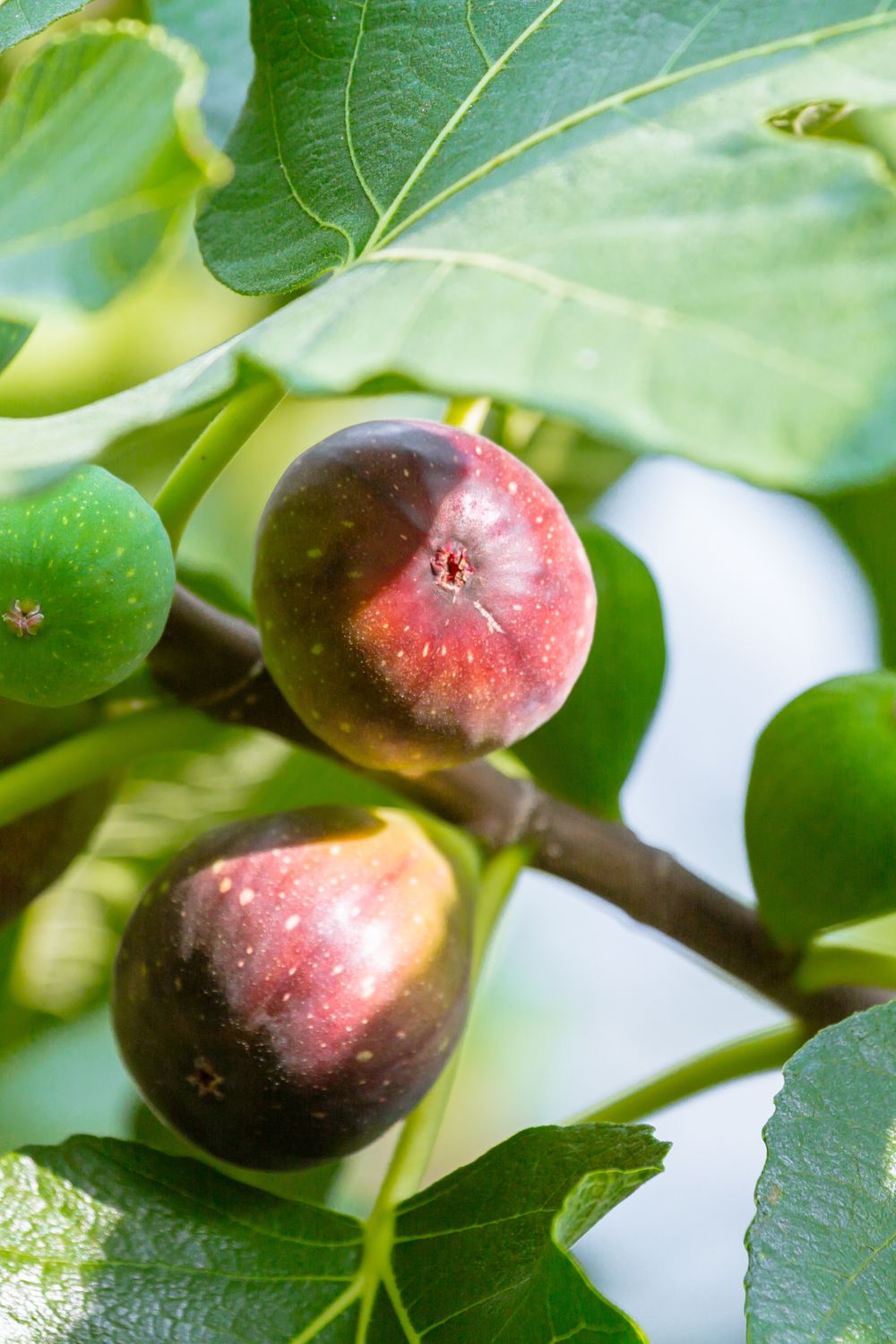
The bronze-purple fruits offer a soft, jammy texture and gentle sweetness with subtle berry notes — best enjoyed fresh from the tree, when fully ripe and bursting with natural sugars.
If you're planting your first fig tree, or simply want a reliable producer that thrives in real-world Southern conditions, Brown Turkey remains one of the safest and most rewarding choices available.
🌿 Quick Facts Guide
| Feature | Details |
|---|---|
| Botanical Name | Ficus carica ‘Brown Turkey’ |
| Plant Type | Deciduous fruit tree |
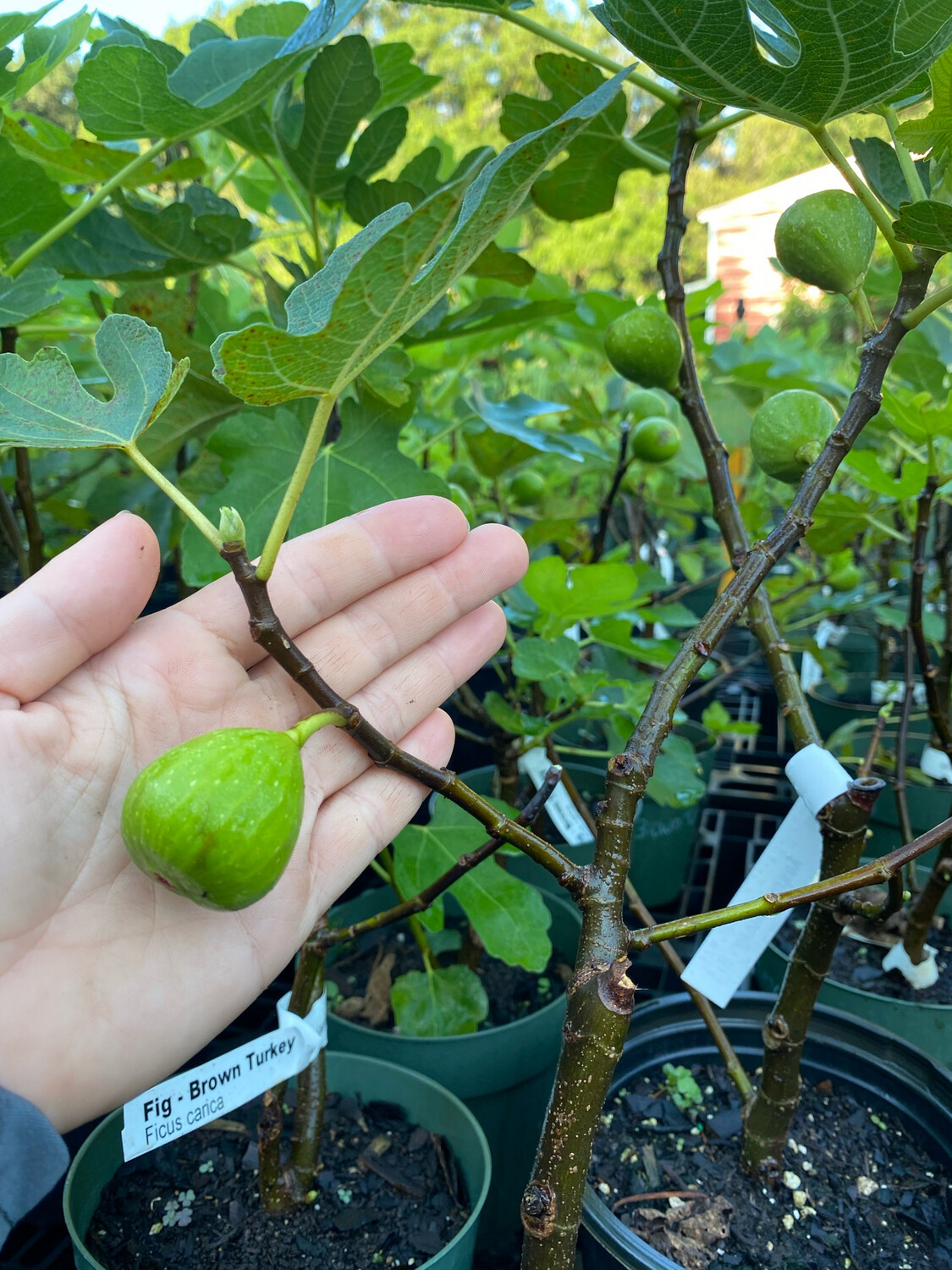
| Size at Sale | 1-Gallon container |
| Estimated Plant Age | ~8–14 months |
| Mature Height (pruned) | 8–12 ft |
| Mature Height (unpruned) | 20–30 ft |
| Mature Width | 12–20 ft |
| USDA Zones | 7–11 |
| Sun Requirements | Full sun (8+ hours) |
| Cold Hardiness | ~10–15°F when dormant |
| Growth Habit | Vigorous, spreading canopy |
| Spacing | 12–20 ft |
| Wind Tolerance | Good once established |
| Salt Tolerance | Moderate |
Figs are among the most adaptable fruit trees for warm climates and perform well in Florida landscapes, backyard orchards, edible gardens, and large patio containers.
🍈 Fruit & Flavor Profile
| Attribute | Description |
|---|---|
| Fruit Size | Medium to large |
| Skin Color | Bronze-brown to purple |
| Flesh Color | Rose-pink to amber |
| Flavor Profile | Mild honey sweetness with subtle berry notes |
| Texture | Soft, jammy interior with tender skin |
When harvested at peak ripeness, Brown Turkey figs become rich, honeyed, and almost dessert-like in flavor.
Common uses include:
- Fresh eating straight from the tree
- Homemade fig jam or preserves
- Baking and pastries
- Roasting with cheeses or meats
- Drying for chewy snacks
Because figs are highly perishable once ripe, homegrown fruit is dramatically better than anything shipped commercially.
🌞 Fruiting Habits & Harvest Season
Brown Turkey is known for consistent production and the potential for two harvest windows per year.
Typical harvest windows:
Florida & Gulf Coast
Breba crop: early summer
Main crop: late summer into early fall
Zones 7–8
Mid-summer through fall
Young trees can begin producing within 1–2 years in warm climates.
Production improves with:
- Full sun
- Rich organic soil
- Consistent moisture
- Moderate annual pruning
Regular pruning can sometimes encourage additional fruiting waves during the growing season.
🌳 Landscape & Ornamental Appeal
Beyond fruit production, fig trees bring a bold Mediterranean aesthetic to the landscape.
Ornamental qualities include:
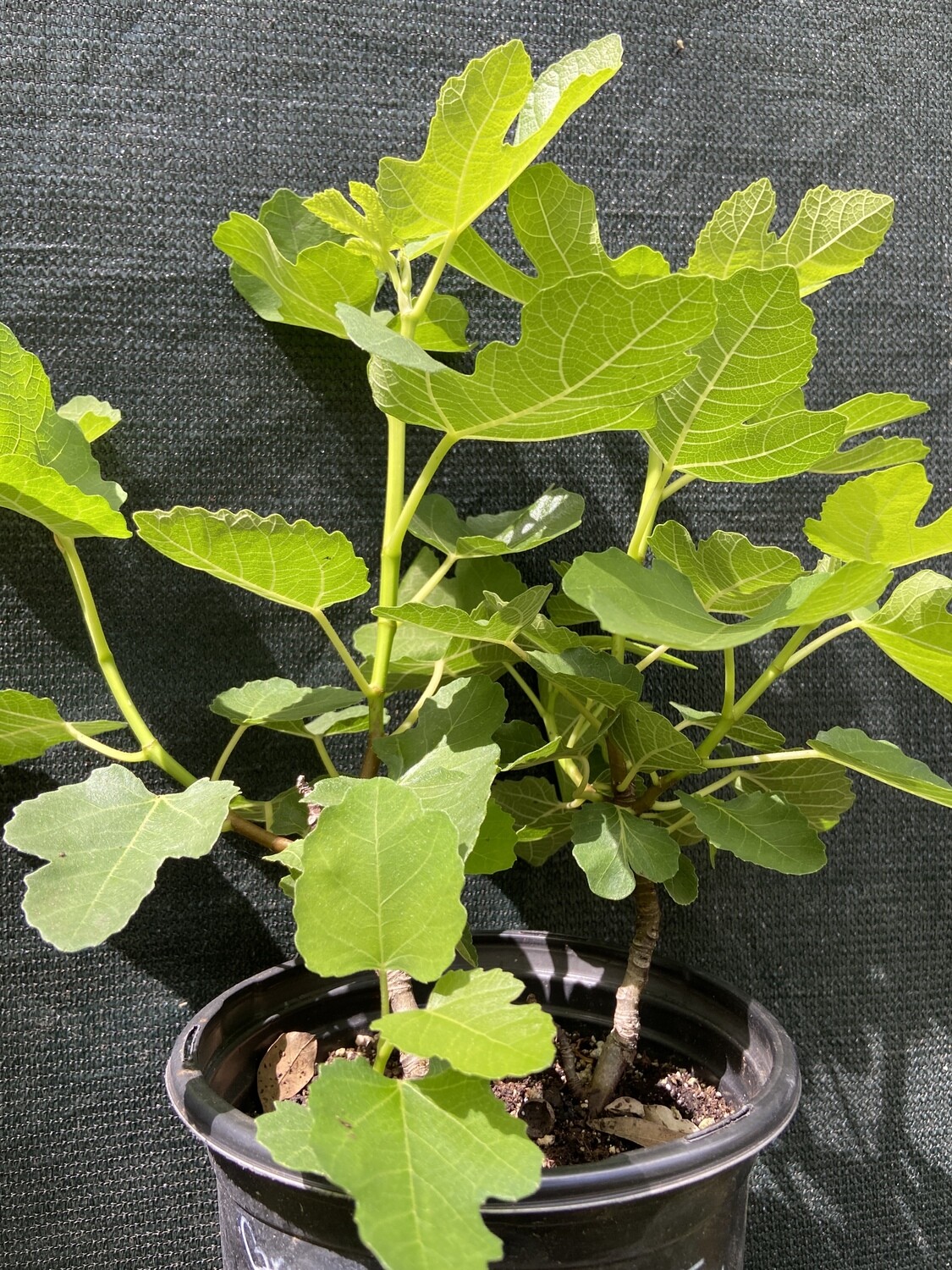
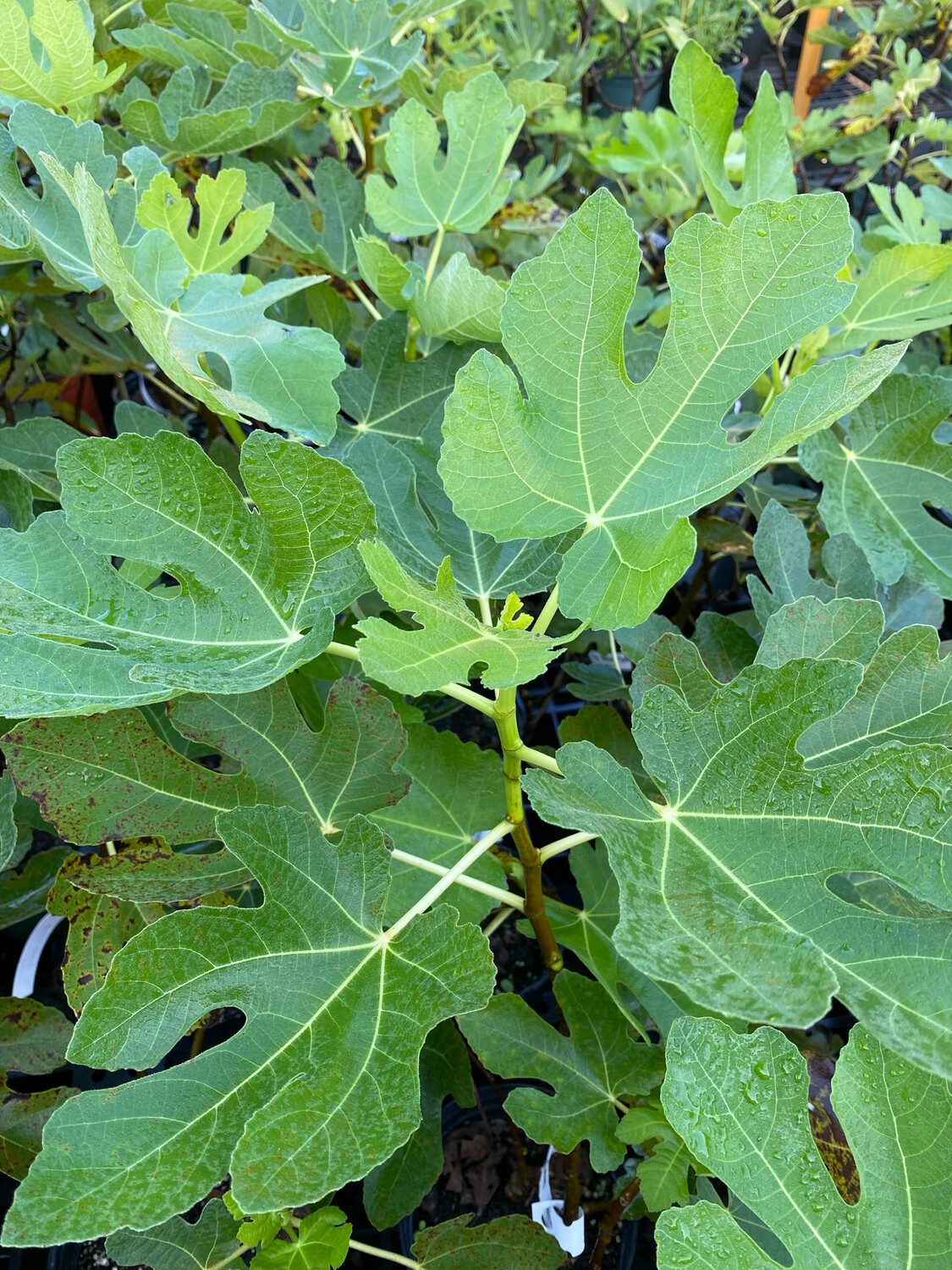
- Large tropical-style foliage
- Sculptural branching form
- Attractive shade canopy
- Distinctive edible landscape presence
Brown Turkey works beautifully in:
- Backyard orchards
- Edible landscapes
- Permaculture food forests
- Patio container gardens
With pruning, trees can easily be maintained around 8–12 feet tall for easy harvesting.
Origin Story & Historical Background
Figs are one of the oldest cultivated fruit crops in human history, with archaeological evidence dating back more than 11,000 years in the Middle East.
The cultivar now known as Brown Turkey is believed to have European origins but became widely adopted in the United States due to its adaptability and dependable fruiting.
By the late 1800s and early 1900s, it had become one of the most widely planted figs in the Southern United States, especially across Texas, Louisiana, and Florida.
Its name likely refers to the brownish-purple coloration of the fruit skin, though the exact origin of the cultivar name remains somewhat uncertain due to centuries of propagation and regional selections.
Today, Brown Turkey remains a backyard orchard classic across the southern half of the United States.
🍂 Important Seasonal Habit — Fig Trees Are Deciduous
A common surprise for new fig growers is that fig trees lose their leaves each winter.
This is completely normal.
Understanding this seasonal cycle helps prevent unnecessary concern.
Winter
🍂 Leaves yellow and drop as the tree enters dormancy.
Early Spring (Feb–Mar in Central Florida)
🌱 Buds break and fresh leaves emerge.
Summer
🌞 Rapid growth and fruit production.
Fall
🍈 Final harvest before dormancy.
During fall, leaves may show:
- spotting
- browning edges
- yellowing
This is a natural part of the dormancy cycle, not a disease.
Because of this seasonal appearance, fig trees are often best placed in the landscape where temporary leaf drop will not affect a focal ornamental space.
🌿 Fig Cultivar Comparison Guide
Ordered by Humid Climate Performance & Rain Resistance
| Cultivar | Flavor & Fruit Color | Tree Size | Humid Climate Performance | Rain / Splitting Resistance | Best For |
|---|---|---|---|---|---|
| Celeste | Sugar-sweet; violet-brown skin, pink interior | Compact–medium | Excellent | Excellent | Top Southeastern fig |
| LSU Purple | Rich sweet fig; purple skin, amber flesh | Compact–medium | Excellent | Excellent | Gulf Coast reliability |
| Alma | Honey-caramel sweetness; brown skin, amber flesh | Medium | Excellent | Good | Southern climates |
| Brown Turkey | Mild honey fig; bronze-purple fruit | Medium–large | Very good | Good | Beginner growers |
| Green Ischia | Berry sweetness; green skin, red interior | Small–medium | Very good | Good | Premium green figs |
| Fignomenal | Sweet brown figs; red interior | Dwarf | Good | Good | Containers |
| Beers Black | Rich berry flavor; dark purple skin | Medium | Good | Moderate | Dark fig lovers |
| Little Ruby | Jammy sweetness; red fruit | Dwarf | Good | Moderate | Small gardens |
| Texas Blue Giant | Large dessert figs | Medium–large | Good | Moderate | Large fruit |
| Olympian | Honey-peach flavor | Medium | Moderate | Moderate | Cooler climates |
| White Marseilles | Classic honey fig | Medium | Moderate | Moderate | Preserves |
| Yellow Long Neck | Sweet melon-honey flavor | Small–medium | Moderate | Moderate | Collectors |
| Di Redo | Honey with pear notes | Medium | Moderate | Moderate | Drier climates |
| White Kadota | Mild honey fig | Medium–large | Moderate | Lower | Preserves |
🌿 Companion Plants for Fig Trees
Companion plants help support soil fertility and ecosystem balance.
Nitrogen Fixers
- Pigeon Pea
- Sunshine Mimosa
- Perennial Peanut
- Flemengia
Dynamic Accumulators
- Mexican Sunflower
- Vetiver Grass
- Fakahatchee Grass
Pollinator Support
- Calliandra
- Sweet Almond Verbena
- Vitex
🪴 Growing Brown Turkey Fig Trees in Containers
Figs adapt extremely well to container growing.
Typical container progression:
| Growth Stage | Container Size |
|---|---|
| Starter | 4" or 1 gallon |
| Developing | 3 gallon |
| Intermediate | 7 gallon |
| Mature container tree | 15–25 gallon |
Container figs require:
- excellent drainage
- consistent watering
- occasional pruning
Many growers maintain productive container trees for 10+ years.
🌱 Transplanting & Potting Progression
Always allow plants to recover from shipping before transplanting.
We recommend waiting:
approximately 30 days or until new growth appears.
Typical container progression:
4″ → 1 gallon → 3 gallon → 7 gallon → 15+ gallon
Signs it’s time to up-pot:
- roots circling the container
- soil drying rapidly
- slowed growth
Containers and potting materials can be found through local garden centers, agricultural supply stores, or online gardening retailers.
🌱 Ideal Soil Mix for Container Figs
Figs prefer soil that balances drainage with moderate moisture retention.
Recommended components:
- pine bark fines
- compost
- perlite or coarse sand
Avoid heavy clay or overly compact soils.
🌿 Best Practices for Planting Brown Turkey Fig Trees
Follow the GreenDreams “High & Tight” planting method for best results.
🎥 Planting demonstration
https://youtu.be/RRQFY30qdA8?si=rRIcsbLlVAVYotfI
Where to Plant
Choose a location with:
- full sun
- good airflow
- well-drained soil
Planting Steps
- Dig a hole slightly wider than the container.
- Place the root ball slightly above grade.
- Backfill with native soil and compost.
- Top-dress with compost, biochar, minerals, and organic nutrients.
- Apply 2–4 inches of hardwood mulch.
Avoid placing mulch against the trunk.
Watering Guidance
Young trees:
Water 2–3 times weekly during establishment.
Established trees:
Deep watering once weekly during dry periods.
Drip irrigation is strongly preferred over overhead watering.
✂️ Pruning Brown Turkey Fig Trees
Figs respond extremely well to pruning.
Best practices:
- remove crossing branches
- thin canopy for airflow
- maintain tree height around 10–12 ft
Major structural pruning is best done during winter dormancy.
⚠️ Important Cautions
Fig trees produce a milky latex sap that can irritate skin.
When pruning:
- wear gloves
- avoid contact with eyes or skin
- wash exposed skin promptly
Some people experience mild skin irritation when exposed to fig sap and sunlight.
🔍 Troubleshooting Guide
| Issue | Cause | Solution |
|---|---|---|
| 🍂 Yellow leaves | Seasonal dormancy | Normal winter cycle |
| 💦 Root rot | Poor drainage | Plant high & tight |
| ⚡ Fruit splitting | Uneven moisture | Maintain consistent watering |
| 🪲 Nematodes | Sandy soils | Add compost & heavy mulch |
| 🍄 Fig rust | Humid climate | Improve airflow and sanitation |
The troubleshooting icon system used here follows the GreenDreams emoji legend for clarity and consistency in plant care guides.
❓ FAQ
Do I need two fig trees to get fruit?
No. Brown Turkey figs are self-fertile.
How soon will my tree produce fruit?
Often within 1–2 years in warm climates.
Can figs grow in containers?
Yes. They are among the best fruit trees for container culture.
Why did my fig tree lose its leaves?
Figs are deciduous and naturally drop leaves during winter dormancy.
🚚 Shipping Information
Plants ship from Florida via UPS Ground every Monday.
Smaller plants ship best to:
- Florida
- Southeastern United States
- Texas
Orders shipped to northern or western states may require additional recovery time after transit.
Shipping during extreme heat or cold is buyer discretion.
California shipments may experience inspection delays.
We recommend waiting 30 days or until new growth appears before transplanting.
🌿 Beyond the Plant: GreenDreams Services
At GreenDreams, we do more than grow plants — we design, build, and restore edible ecosystems across Florida.
Services include:
🌳 edible landscape design
🚜 installation & project management
🚚 compost, mulch, and soil delivery
🌾 regenerative farm consulting
Start your edible landscape with a Brown Turkey Fig Tree.
🏡 Local Pickup
We carry many larger fig trees and rare cultivars not available online.
GreenDreams Nursery & Farm
🌾 18709 US Hwy. 41, Spring Hill, FL 34610
🕘 Tues–Fri 9AM–5PM
🌞 Sat 8AM–3PM
🌿 Stop by our regenerative nursery to see what’s blooming this week.
🌿 IMPORTANT INFORMATION BEFORE PURCHASING LIVE PLANTS
Please note: Plants purchased through our online store are not available for pickup at our retail nursery in Spring Hill, Florida.
Online inventory is housed at a separate facility and is priced, prepared, and handled exclusively for shipping.
🌱 Looking for larger plants or more selection?
Our retail nursery location offers far more availability, including larger sizes, specialty plants, and many selections not suitable for nationwide shipping.
Local pickup is available for retail nursery purchases only.
Visit our Spring Hill, FL retail nursery page to explore in-person shopping options.
🚚 LIVE PLANT SHIPPING & TRANSIT EXPECTATIONS
Live plants naturally experience stress during shipping. Temporary leaf drop, mild wilting, or cosmetic stress is normal after transit. Most plants recover quickly with proper watering, gradual light exposure, and basic aftercare. Some plants may require additional attention during the first few weeks.
Despite careful packing, minor cosmetic damage may occur during transit. Small issues such as broken leaves or stems typically resolve with time and proper care.
If your shipping box arrives with significant external damage, please contact UPS within 30 days to initiate a carrier claim.
⏱️ SHIPPING METHOD, TIMING & TRANSIT WINDOWS
All online orders ship via UPS Ground from our Central Florida nursery.
📦 Shipping Schedule: Orders ship once weekly on Mondays to reduce the risk of packages sitting in transit over weekends. A countdown clock on our website displays the next shipping date.
🚚 Typical Transit Times:
-
Florida: 1–2 days
-
Southern U.S.: approximately 2 days
-
Midwest, West & Northern U.S.: 3–5 business days
Long-distance shipments, particularly to the western U.S., may experience additional transit time due to agricultural inspections in states such as Arizona, California, and Texas.
Extended transit times can be more challenging for small or tender plants and may require additional recovery care after arrival.
🌡️ EXTREME WEATHER & SEASONAL RISK
Live plants are sensitive to temperature extremes.
We cannot guarantee plant condition during periods of extreme summer heat or winter cold and freezing temperatures. Weather-related delays, carrier interruptions, or exposure during delivery are beyond our control.
Customers are responsible for:
-
Monitoring tracking information sent via email
-
Retrieving packages promptly upon delivery
-
Preventing plants from being left outdoors in extreme conditions
During unsafe weather, holiday shipping volume, or extended transit risk, orders may be held and shipped the following week to protect plant health.
⚠️ CUSTOMER RESPONSIBILITY & REFUND POLICY
By purchasing live plants, customers acknowledge and accept the risks associated with shipping, weather exposure, transit delays, and regional suitability.
Refunds or replacements are considered only under exceptional circumstances and in accordance with our return and refund policy. We are not responsible for:
-
Weather-related damage
-
Carrier delays
-
Poor plant selection for a given climate or region
-
Improper care after delivery
Upon purchase, customers assume full responsibility for the ongoing care and success of their plants.
✅ CONSENT & AGREEMENT
By completing a purchase, you confirm that you have read, understand, and agree to all shipping policies, responsibilities, and conditions outlined above.
Our goal is transparency, plant health, and long-term growing success — and we appreciate your understanding and care when ordering live plants.


