


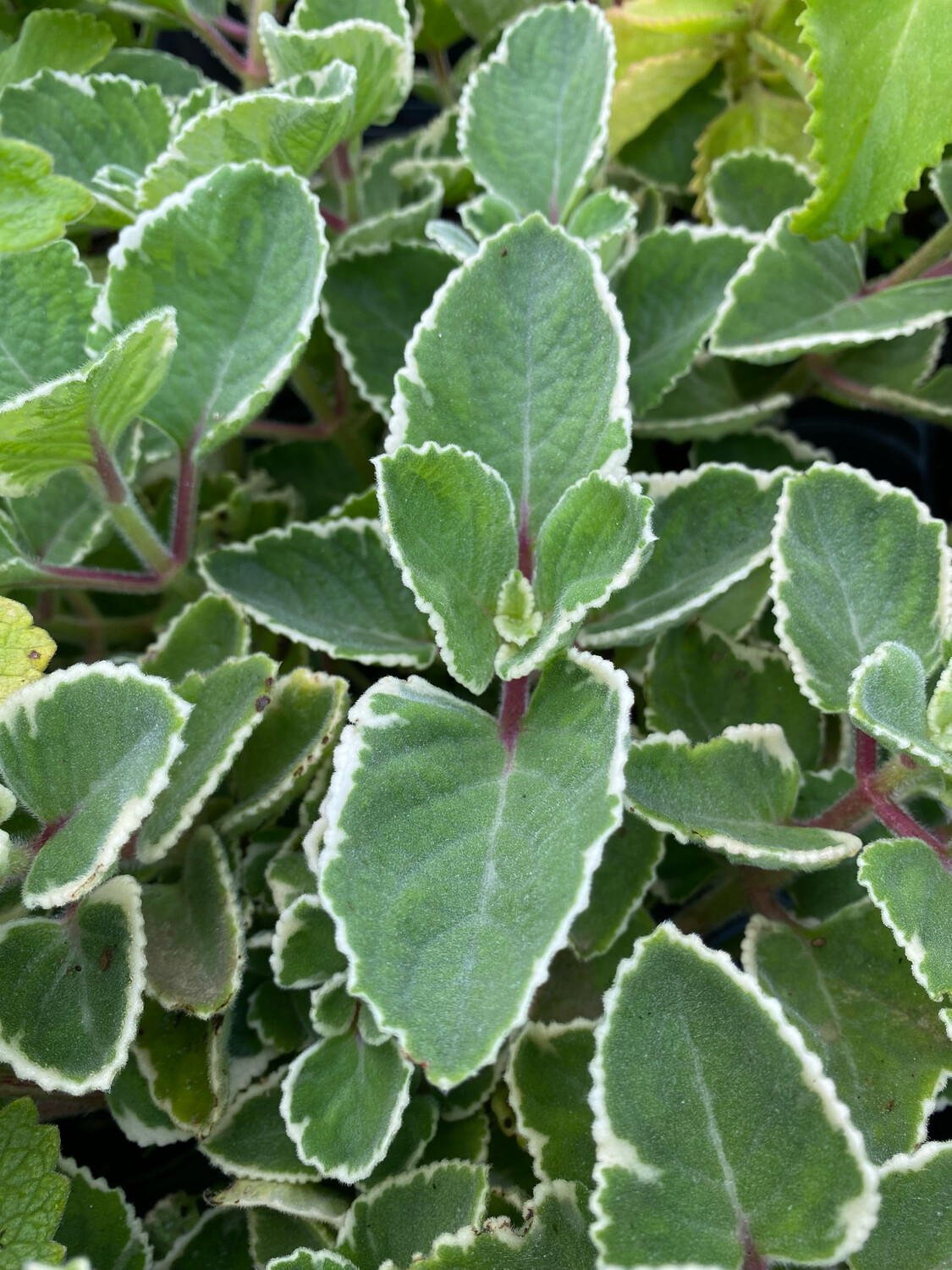
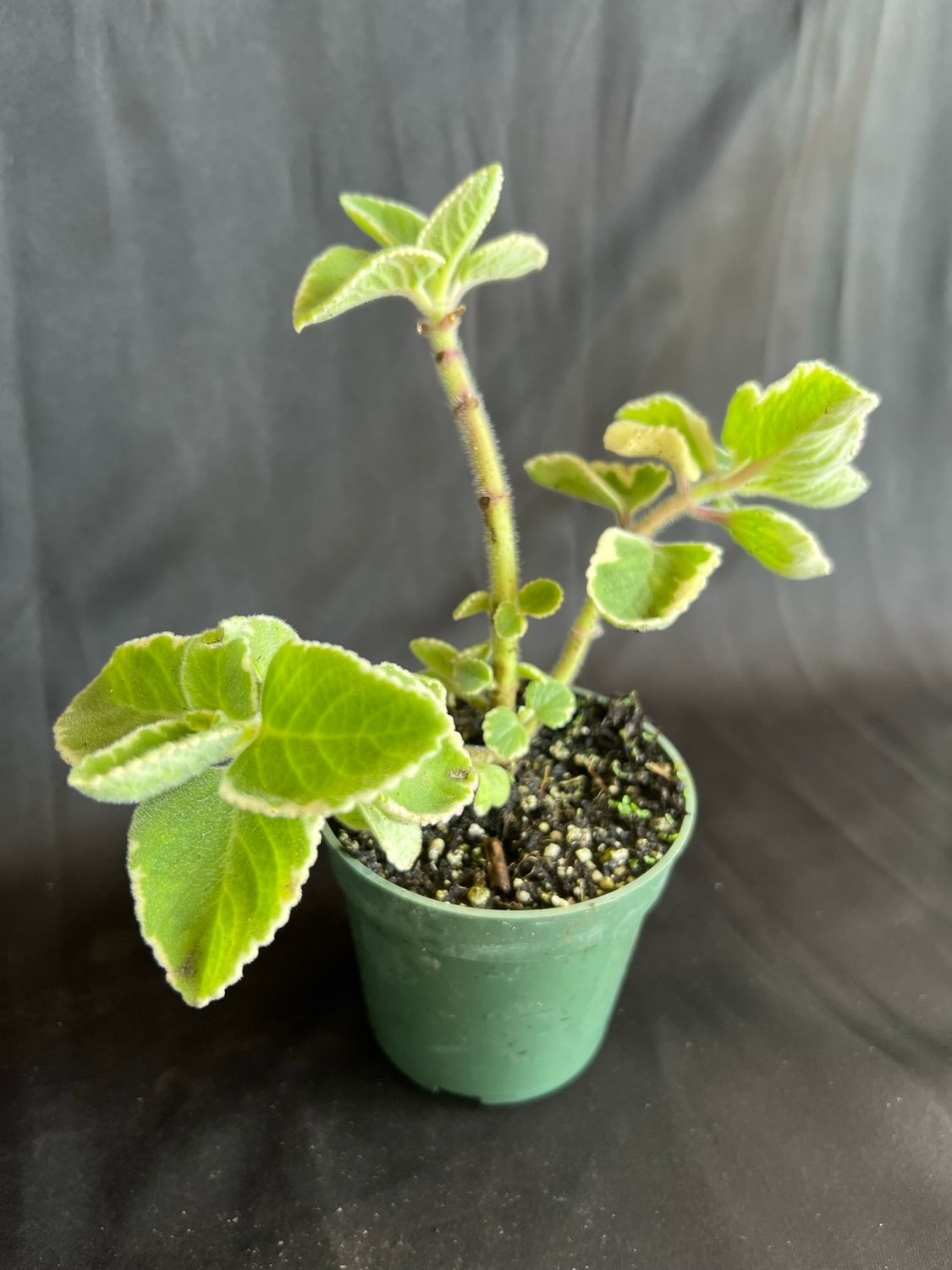
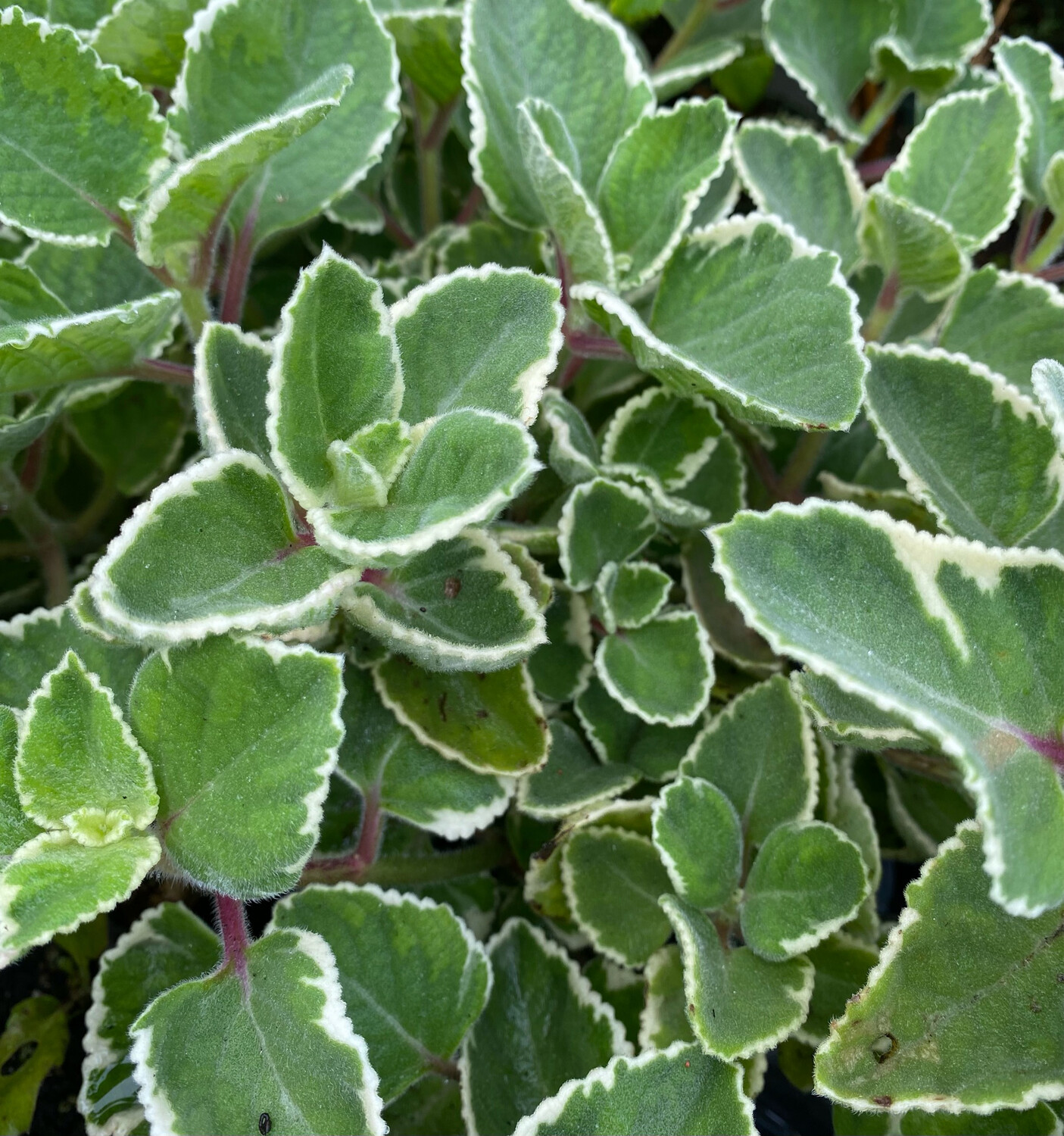
🌿 Variegated Cuban Oregano — Coleus amboinicus ‘Variegatus’ | 4” Live Plant
Also known as Plectranthus amboinicus ‘Variegatus’, Indian Borage, Spanish Thyme, Broadleaf Thyme & Mexican Mint
Some herbs earn their place in the garden because they taste good. Others get planted because they look good.
Variegated Cuban Oregano does both — and it does both loudly.
Cream-edged, velvety foliage spills over containers like an ornamental, while one crushed leaf releases an intensely savory fragrance somewhere between oregano, thyme, mint and camphor. This is a true tropical kitchen-garden classic: easy to harvest, incredibly aromatic and just unusual enough to make visitors ask, “Wait… you can eat that?”
For Florida patios, edible landscapes, herb gardens and sunny windowsills, it is one of those small plants capable of becoming a surprisingly useful part of everyday life.
🌱 Quick Facts — Variegated Cuban Oregano at a Glance
| Category | Details |
|---|---|
| Current Botanical Name | Coleus amboinicus ‘Variegatus’ |
| Widely Used Synonym | Plectranthus amboinicus ‘Variegatus’ |
| Family | Lamiaceae — the mint family |
| Common Names | Variegated Cuban Oregano, Indian Borage, Country Borage, Spanish Thyme, Mexican Mint, Broadleaf Thyme |
| Plant Type | Aromatic, semi-succulent perennial herb/subshrub |
| Size at Sale | 4-inch nursery container |
| Estimated Plant Age | Typically a young, well-rooted starter propagated vegetatively; often approximately 2–6 months into production, depending on season and nursery cycle. Plants are sold by container size and development rather than guaranteed chronological age. |
| Typical Maintained Size | Approximately 8–18 inches tall with regular pinching; width controlled to suit the container |
| Typical Unpruned Size | Approximately 1–2 ft. tall × 2–4 ft. wide, sometimes producing longer sprawling or scrambling stems |
| USDA Growing Range | Best as a dependable outdoor perennial in frost-free zones 10–11; commonly grown with protection in zone 9 and as an annual/container plant farther north |
| Florida Performance | Excellent warm-season growth; cold protection required during frost or freezes |
| Light | Morning sun, filtered sun or partial shade is ideal; hot afternoon sun can stress or scorch foliage |
| Water | Low to moderate once established; allow the upper soil layer to begin drying between waterings |
| Soil | Loose, fertile and very well drained |
| Cold Tolerance | Frost-tender; growth can slow well before freezing. Begin protecting containers as nights approach 40°F |
| Growth Habit | Fast-growing, spreading, trailing to semi-upright; stems are fleshy and somewhat brittle |
| Evergreen? | Yes in frost-free conditions; may suffer major dieback after cold exposure |
| Spacing | Approximately 2–3 ft. when intentionally cultivated in-ground, although managed container culture is preferable in Florida |
| Flowers | Small pale purple, pinkish or white tubular flowers on spikes |
| Typical Florida Bloom | Often late winter through spring, although flowering varies by climate and growing conditions |
| Harvest | Nearly year-round in frost-free conditions; heaviest vegetative production during warm weather |
| Wind Tolerance | Moderate in protected settings; fleshy stems can break in strong wind or storms |
| Salt Tolerance | High salt-spray tolerance is not well documented; use protected coastal locations rather than exposed beachfront conditions |
| Container Friendly | Excellent |
| Indoor Growing | Yes, with strong light and careful watering |
| Florida Ecological Note | UF/IFAS currently assesses the species Coleus amboinicus as High Invasion Risk throughout Florida. Responsible containment is strongly recommended. |
🍃 Not Actually Oregano — And That Is Part of the Story
Its collection of common names reads like the plant has been collecting passports.
Cuban Oregano. Indian Borage. Mexican Mint. Spanish Thyme. French Thyme. Country Borage. Broadleaf Thyme.
Botanically, it is none of those things.
It belongs to the mint family, Lamiaceae, alongside many familiar aromatic herbs, but true oregano belongs to the genus Origanum. Current Kew taxonomy accepts this species as Coleus amboinicus, although Plectranthus amboinicus remains extremely common in horticulture, recipes, research papers and older references.
The species itself has an enormous history of cultivation across tropical regions. Kew currently describes its native range as extending from Kenya through southern Africa, parts of the Arabian Peninsula and India. From there, centuries of human cultivation carried it throughout the Caribbean, Southeast Asia, Pacific islands and tropical Americas.
The variegated form — Coleus amboinicus ‘Variegatus’ — is considered horticultural in origin, selected for those unmistakable cream-edged leaves.
So why “Cuban” oregano?
That name reflects one chapter in a much larger culinary journey rather than a simple botanical birthplace. The herb became deeply integrated into Caribbean cooking and home gardens, just as it developed regional identities in India, Indonesia, Southeast Asia and elsewhere.
Same plant. Many cultures. A lot of names. Serious flavor.
🍃 What Does Variegated Cuban Oregano Taste Like?
If grocery-store oregano whispers, Cuban oregano tends to walk into the kitchen talking.
Flavor Profile
Expect a concentrated combination of:
- 🌿 Oregano-like savory flavor
- 🍃 Thyme-like herbal depth
- 🌱 Minty freshness
- Slightly peppery, resinous and camphoraceous notes
- A powerful aroma that becomes immediately noticeable when leaves are crushed
The exact aroma can vary between individual plants and growing conditions. Research on the species' essential oils has identified several chemical profiles, including plants dominated by carvacrol or thymol, compounds also associated with the characteristic aromas of oregano and thyme.
Texture
The leaves are:
- Thick
- Fleshy
- Semi-succulent
- Softly fuzzy or velvety
- Broadly rounded with scalloped edges
- Cream to white around the margins of the variegated cultivar
Because the leaves are substantially thicker than traditional oregano, they behave differently in the kitchen.
They can be chopped, minced, fried, steeped, simmered or used to infuse a dish.
💡 GreenDreams Flavor Tip
Start small.
One Cuban oregano leaf can contribute much more flavor than its size suggests. Add a little, taste, and build from there.
Cooking softens some of its sharper aromatic character and allows the flavor to blend beautifully into beans, meats, soups and stews.
🍲 How Is Cuban Oregano Used Around the World?
This plant's greatest selling point is not simply that it is edible.
It is that people have actually been cooking with it for generations.
Caribbean & Tropical American Kitchens
Common applications include:
- Black beans and stewed beans
- Chicken, pork and beef
- Stuffings
- Tomato-based dishes
- Rice dishes
- Soups
- Long-simmered stews
- Marinades and seasoning pastes
India & South Asia
Known regionally by names including Indian borage and karpooravalli, the aromatic leaves have been incorporated into:
- Savory fritters
- Chutneys
- Herbal preparations
- Rasam-style dishes
- Soups
- Teas and infusions
Southeast Asia
Fresh leaves have also been documented in regional cuisines, including use with meat dishes and soups.
Fresh or Dried?
Both are possible.
Fresh leaves offer the most vibrant aroma, while dried leaves become an intensely flavored seasoning that can be crushed and used sparingly.
🍽️ GreenDreams Kitchen Starter — Crispy Cuban Oregano Leaf Fritters
This is one of the most fun ways to introduce someone to the plant.
You’ll Need
- Fresh Cuban oregano leaves
- Chickpea flour
- Water
- Pinch of salt
- Cumin
- Optional chili or paprika
- Oil for frying
Simple Method
- Harvest healthy leaves and gently rinse if needed.
- Allow foliage to dry thoroughly.
- Mix chickpea flour, water and seasoning into a light batter.
- Coat individual leaves.
- Fry until golden and crisp.
- Drain and serve warm.
The fleshy leaf softens while the exterior becomes crisp — almost like an edible-herb version of a pakora.
🫘 Another Easy Use — Aromatic Caribbean-Style Beans
Add 1–3 leaves to a pot of beans with garlic, onion, tomato and your favorite seasonings.
Allow the leaves to simmer and infuse the dish.
You can:
- Mince the leaves and eat them with the beans, or
- Add larger pieces for infusion and remove before serving
It is an easy introduction to the herb without allowing the flavor to overpower the meal.
🌿 More Ways to Use Your Harvest
Try Variegated Cuban Oregano in:
- 🍲 Soups
- 🫘 Black beans
- 🌮 Seasoned beans for tacos
- 🍗 Poultry marinades
- 🥩 Beef or lamb
- 🐟 Savory seafood dishes
- 🍚 Rice dishes
- 🥘 Curries
- 🧄 Herb-and-garlic seasoning pastes
- 🫓 Savory fritters
- 🍵 Traditional-style herbal infusions
- 🧈 Herb butter
- 🫒 Infused cooking oil prepared for immediate culinary use
🌱 Harvesting for the Best Plant + Best Kitchen
Harvesting is pruning — and this plant likes both.
Instead of removing random mature leaves throughout the plant, regularly snip young growing tips just above a leaf node.
This encourages:
- More branching
- A fuller plant
- Additional tender harvests
- Less floppy growth
- Better control of an otherwise vigorous herb
In Florida's warm growing season, regular harvesting may be needed simply to keep up.
Morning harvest after foliage has dried is ideal when you want strongly aromatic leaves.
🌿 Why Grow Variegated Cuban Oregano?
1. It Produces Food Again and Again
Instead of harvesting once and replanting, growers in warm climates can repeatedly harvest fresh leaves from the same established plant.
2. One Plant Can Season a Lot of Food
The concentrated flavor means you do not need massive harvests to make the plant worthwhile.
3. It Is Seriously Ornamental
Cream-edged foliage makes this one of the rare kitchen herbs that looks completely at home in a decorative patio planter.
4. It Handles Florida Heat
While many familiar herbs decline during the humid subtropical summer, Cuban oregano is adapted to warm growing conditions.
5. It Loves Containers
That makes it especially valuable for:
- Patios
- Balconies
- Courtyards
- Apartment gardens
- Outdoor kitchens
- Small-space edible gardens
- Cooler-climate gardeners who need to overwinter plants indoors
6. It Is Excellent for Frequent Harvesting
Regular pruning creates more branching and more usable foliage.
Eat the pruning. Grow more pruning. Repeat.
🎨 Ornamental Appeal — The Herb That Doesn't Look Like an Herb
The variegated cultivar deserves space even before considering its culinary value.
Each leaf combines:
- Rich green interior coloring
- Irregular light-green patterning
- Creamy-white margins
- Soft velvet-like texture
- Deep scalloped edges
- Thick semi-succulent structure
Its spreading stems eventually spill over a container edge, making it especially useful as the “spiller” in mixed edible planters.
Try it visually alongside:
- 🌿 Rosemary
- 🍃 Purple or Thai basil
- 🌾 Lemongrass
- 🌺 Dwarf firebush
- 🌱 Culinary herbs with fine-textured foliage
- 🪴 Dark-leaved edible or ornamental plants
That cream variegation pops especially well against deep green, burgundy and purple foliage.
🌿 Standard Green vs. Variegated Cuban Oregano
| Feature | Variegated Form | Standard Green Form |
|---|---|---|
| Botanical Group | Coleus amboinicus ‘Variegatus’ | Coleus amboinicus |
| Leaf Color | Green center with irregular cream/white margins | Primarily gray-green to green |
| Leaf Texture | Thick, fleshy and velvety | Thick, fleshy and velvety |
| Aroma | Strongly aromatic | Strongly aromatic |
| Culinary Use | Yes | Yes |
| Landscape Appeal | Especially strong ornamental contrast | Bold tropical herb appearance |
| Container Use | Excellent | Excellent |
| Cold Tolerance | Frost tender | Frost tender |
| Best Light | Bright partial sun/partial shade | Partial shade to bright filtered sun |
🌿 Traditional Plant Knowledge + Modern Research
Coleus amboinicus has a long record of traditional use across Asia, Africa, the Caribbean and tropical Americas.
Traditional preparations have included leaves used for:
- Cough and respiratory complaints
- Digestive discomfort
- Sore throat
- Herbal infusions
- Soups and postpartum foods in certain cultures
Modern phytochemical research has identified numerous aromatic constituents within the species, including plants rich in carvacrol and thymol.
However, essential-oil composition varies substantially between plants, locations and growing conditions.
Important Perspective
Traditional plant knowledge is fascinating — but traditional use is not the same thing as a clinically proven medical treatment.
We sell Variegated Cuban Oregano as an edible and useful plant, not as a medication. Research involving extracts or concentrated essential oils should also not be treated as equivalent to eating normal culinary quantities of fresh leaves.
🌱 How to Grow Variegated Cuban Oregano
Variegated Cuban Oregano is forgiving about a lot of things.
Wet feet are not one of them.
Its thick leaves and fleshy stems store moisture, so success usually comes from balancing warmth and good light with excellent drainage and avoiding the urge to constantly water it.
📦 First: Let Your New Plant Recover From Shipping
When your Variegated Cuban Oregano arrives, do not immediately transplant it.
Shipping temporarily changes:
- Light exposure
- Airflow
- Humidity
- Temperature
- Water use
- Root activity
We recommend leaving newly shipped plants in their original nursery container for approximately 30 days OR until healthy new growth confirms that the plant has adjusted, whichever provides the better indication of recovery.
During this period:
- Place it in a protected, bright location.
- Avoid intense all-day sun immediately after opening the box.
- Check the soil daily rather than automatically watering daily.
- Water thoroughly at soil level whenever the small root ball begins to dry.
- Gradually acclimate the plant to stronger outdoor light.
A 4-inch container dries considerably faster than a larger nursery pot, especially during Florida summer weather.
Check it frequently — but don’t keep it soggy.
☀️ Where Should You Grow Variegated Cuban Oregano?
Best Location
Choose a location with:
- Morning sun
- Bright filtered light
- Partial shade
- Excellent airflow
- Rapidly draining soil
- Protection from prolonged frost
- Some shelter from violent wind
In Florida, morning sun followed by afternoon shade is an excellent combination.
UF/IFAS specifically describes Cuban oregano as well suited to semi-shaded conditions.
Avoid
Do not intentionally plant it in:
- Low areas that collect rainwater
- Heavy, constantly saturated soil
- Areas irrigated heavily for turfgrass
- Deep shade with poor airflow
- An exposed frost pocket
- Harsh coastal salt spray without protection
- Natural areas where escaped growth cannot be monitored
Because UF/IFAS currently assesses Coleus amboinicus as a High Invasion Risk species throughout Florida, GreenDreams strongly favors managed container growing and responsible pruning over allowing Cuban oregano to spread freely into the landscape.
🌿 Our “High & Tight” Planting Philosophy
For plants that are intentionally established in the ground, do not bury the crown.
How We Plant
- Dig the planting hole only slightly wider than the nursery container.
- Keep the hole approximately the same depth as the root ball — never deeper.
- Set the plant slightly high rather than too low.
- Backfill firmly enough to eliminate major air pockets without crushing the roots.
- Water thoroughly at soil level.
- Top-dress lightly with organic material rather than burying the crown.
- Apply hardwood mulch around the root zone while leaving the stems and crown exposed.
The goal is simple:
Roots in soil. Crown high. Drainage moving.
For the same general principles GreenDreams uses when planting fruit trees and landscape plants, see our High & Tight planting method:
https://youtu.be/RRQFY30qdA8?si=rRIcsbLlVAVYotfI
🌾 Soil — Drainage Wins
Variegated Cuban Oregano prefers a soil that provides both:
moisture when needed + oxygen around the roots.
Heavy muck, compacted clay and permanently wet potting mixes can create ideal conditions for root and stem rot.
For In-Ground Growing
Good options include:
- Sandy loam
- Loamy garden soil
- Raised beds
- Improved sandy Florida soils
- Mounded planting areas
Organic matter can help poor soil, but avoid turning the planting hole into a permanently wet bowl filled entirely with rich compost.
🪴 Recommended Container Mix
For container-grown Variegated Cuban Oregano, use a light, fast-draining mix, roughly:
- 60–70% quality potting mix based on peat moss or coconut coir
- 30–40% coarse aeration material, such as perlite, pumice, aged fine pine bark or another appropriate drainage amendment
A small amount of finished compost or worm castings can provide biological activity and nutrients.
Avoid:
- Dense garden soil in pots
- Pure compost
- Constantly wet moisture-retention mixes
- Containers without drainage holes
💧 Watering Variegated Cuban Oregano
The golden rule:
Check daily. Water according to the soil — not according to the calendar.
4-Inch Nursery Containers
Because the root volume is small, a 4-inch plant can dry quickly.
During hot, sunny or windy weather:
- Check moisture daily
- Water thoroughly when the upper soil begins drying
- Allow excess water to drain freely
It may need daily watering during very hot periods.
During cloudy, cool or humid weather, it may need far less.
Newly Planted In-Ground
For the first 1–2 weeks, monitor closely and water whenever the developing root zone begins drying.
After establishment, gradually transition toward deeper, less frequent irrigation.
Established Plants
Its fleshy foliage provides useful drought resilience.
Once established:
- Allow slight drying between irrigation cycles
- Water deeply rather than giving frequent tiny sips
- Adjust for heat, rainfall, soil and container size
During Florida’s rainy season, the challenge may become too much water rather than too little.
🚫 Avoid Overhead Watering
For best plant health:
Water at soil level.
We recommend:
- 💧 Drip irrigation
- 🪣 Direct hand watering at the root zone
- 🌅 Morning irrigation
Avoid routinely wetting the foliage with overhead sprinklers or misters.
Prolonged leaf moisture, especially with high humidity and limited airflow, can increase disease pressure.
Never rely on late-afternoon overhead watering during intense sun and heat.
🌿 Fertilizing — More Is Not Better
Cuban oregano does not need aggressive fertility to grow rapidly.
Excess nitrogen can create:
- Long floppy stems
- Soft growth
- Wider node spacing
- Reduced compactness
- Greater pruning requirements
GreenDreams Approach
During active spring and summer growth:
- Top-dress lightly with finished compost
- Add worm castings if desired
- Use a mild organic fertilizer according to label directions
- Supplement trace minerals only when appropriate for your soil or growing system
For containers, a light feeding approximately every 6–8 weeks during strong active growth is generally more useful than frequent heavy fertilization.
Reduce feeding considerably during winter or when the plant is growing slowly.
✂️ Pruning = Harvesting
Regular pruning is one of the best things you can do for this plant.
Without intervention, stems often become:
- Long
- Heavy
- Sprawling
- Uneven
For a Dense Plant
Pinch or cut the growing tip just above a healthy node.
Each pruning point encourages branching below the cut.
Repeat throughout warm weather.
Rejuvenating an Overgrown Plant
If growth becomes loose or floppy:
- Remove weak or damaged stems.
- Shorten healthy stems by approximately one-third.
- Make cuts just above healthy nodes.
- Allow fresh branches to rebuild the canopy.
Avoid repeatedly keeping the plant soaking wet after a major pruning.
Want More Leaves Instead of Flowers?
Flower spikes are attractive and may be visited by insects, but flowering uses plant energy.
For maximum leafy growth, flower spikes may be removed as they develop.
For ornamental interest, leave some flowers and enjoy them.
🌸 Flowers + Pollinator Value
Although this plant is usually grown for foliage, mature specimens can produce spikes of small:
- Pale purple
- Lavender-pink
- White
flowers.
Florida plants may flower around late winter through spring, although timing is variable.
The flowers can be visited by bees and other small beneficial insects.
They are a bonus rather than the primary reason to grow the plant.
🪴 Growing Variegated Cuban Oregano in Containers
This may actually be the best way to grow it, particularly in Florida.
Containers provide:
- Growth control
- Easier harvesting
- Easier frost protection
- Improved drainage
- Attractive patio display
- Reduced potential for unwanted landscape spread
Container Progression
A sensible nursery progression looks like:
4-inch → 1-gallon → 3-gallon → 7-gallon or decorative final container
Do not assume that jumping directly from a tiny starter into a massive pot is always better.
An oversized container can hold much more wet soil than a small root system can use, increasing the possibility of overwatering.
When Is It Time to Up-Pot?
Look for:
- Roots reaching drainage holes
- Soil drying dramatically faster than before
- Dense roots visible around the root ball
- Plant becoming top-heavy
- Water moving unusually quickly through a root-packed pot
- Healthy growth slowing despite adequate care
How to Transplant Into a Larger Container
- Choose a container approximately one practical size larger.
- Make sure it has generous drainage.
- Add an appropriate fast-draining potting mix.
- Remove the plant carefully.
- Inspect roots.
- Loosen only severely circling outer roots if necessary.
- Maintain the original crown depth.
- Backfill around the root ball.
- Water thoroughly at soil level.
- Return it to protected light while it adjusts.
Containers and potting materials can generally be found through:
- Independent garden centers
- Local nurseries
- Farm and garden suppliers
- Landscape suppliers
- Hydroponic/grow stores
- Online garden retailers
Search for nursery pots, breathable planters, fast-draining potting mix, coconut coir, perlite, pumice or pine-bark soil amendments according to what is locally available.
🏠 Can Variegated Cuban Oregano Grow Indoors?
Yes.
In colder states, indoor culture is one of the easiest ways to keep the plant from year to year.
Best Indoor Placement
Use:
- A very bright east-facing window
- Bright southern exposure
- A sunroom
- Supplemental full-spectrum grow lighting
Indoor plants tend to stretch when light is inadequate.
Indoors, Watch for:
- Leggy growth
- Overwatering
- Mealybugs
- Spider mites
- Aphids
- Reduced air circulation
Rotate the container periodically for more even growth.
Because water use generally decreases indoors during winter, do not keep the pot on the same summer watering schedule.
🌴 Florida & Southeastern U.S. Seasonal Care Guide
| Season | What the Plant Is Doing | GreenDreams Care Priorities |
|---|---|---|
| 🌱 Spring | Growth accelerates with warmer temperatures. Flowering may still occur. | Prune winter damage after cold risk passes; refresh container soil/top-dressing; begin light feeding; increase watering as growth increases. |
| ☀️ Summer | Peak vegetative growth in heat and humidity. | Harvest and pinch often; monitor small pots daily; protect variegated foliage from punishing afternoon sun; watch drainage during heavy rainfall. |
| 🍂 Fall | Strong growth can continue until nights cool. | Continue harvesting; reduce fertilizer as temperatures fall; inspect plants before moving indoors; prepare cold-protection strategy. |
| ❄️ Winter | Growth slows substantially; frost can damage foliage and stems. | Move containers into protection before severe cold; reduce irrigation and fertilizer; do not encourage soft new growth immediately before a freeze. |
❄️ Zone-by-Zone Winter Expectations
USDA Zone 8
Treat Cuban oregano primarily as:
- A warm-season annual, or
- A container perennial overwintered indoors
Outdoor survival should not be expected through a typical zone 8 winter.
USDA Zone 9
This is a cold-protection climate for Cuban oregano.
A mild winter may allow substantial persistence, while a significant freeze can damage or kill exposed growth.
Containers offer far more control.
USDA Zones 10–11
These climates are best suited to outdoor perennial culture.
Plants may remain leafy throughout winter unless an unusual cold event occurs.
🌿 Is Cuban Oregano Deciduous?
No.
It is an evergreen tropical/subtropical perennial rather than a naturally winter-deciduous plant.
If a plant loses foliage after winter cold, that is generally cold stress or dieback, not a normal deciduous dormancy cycle.
Wait until consistently warm weather before deciding whether damaged stems are truly dead.
Healthy surviving tissue can resume growth when conditions improve.
🌬️ Wind + Storm Care
Cuban oregano’s foliage looks substantial, but its water-filled stems can be surprisingly brittle.
Before tropical storms:
- Move containers against a protected structure
- Avoid elevated ledges
- Remove excessively long top-heavy stems
- Secure hanging baskets
In permanently windy landscapes, provide some structural shelter.
🌊 Coastal Growing
Cuban oregano tolerates warm maritime climates, but reliable evidence for direct, high-level salt-spray tolerance is limited.
For coastal growers, use:
- Protected patios
- Courtyards
- Areas behind structures or vegetation
- Containers that can be relocated
Avoid assuming that a tropical plant is automatically beachfront salt tolerant.
🌿 Companion & Guild Ideas
Because controlled cultivation is preferable in Florida, think of these as plants surrounding your Cuban oregano container or managed garden area, rather than encouragement to allow it to naturalize.
Biomass + Soil-Building Partners
Depending on your site:
- Mexican sunflower
- Pigeon pea
- Vetiver
- Lemongrass
- Other managed chop-and-drop species
Pollinator + Beneficial-Insect Partners
- Blue porterweed
- Dwarf firebush
- Pineapple sage
- Culinary basil
- African blue basil
- Other flowering herbs
Beautiful Contrasts
Pair the cream-variegated foliage with:
- Deep-green rosemary
- Purple basil
- Burgundy foliage
- Fine-textured grasses
- Dark decorative containers
- Tropical edible foliage
The contrast makes the plant look far more like a designed landscape feature than a utilitarian kitchen herb.
⚠️ Important Cautions for Variegated Cuban Oregano
🌿 Florida Ecological Caution — Important 2026 Update
This deserves clear disclosure.
In February 2026, the UF/IFAS Assessment of Non-Native Plants in Florida’s Natural Areas classified Coleus amboinicus — synonymous with Plectranthus amboinicus — as:
HIGH INVASION RISK in North, Central and South Florida
The UF/IFAS assessment states that the species is predicted to be invasive and is not recommended by IFAS.
That is different from saying the plant is automatically illegal to possess or sell. However, it is highly relevant to how responsible Florida gardeners should manage it.
The assessment evaluates the species and does not separately establish a different ecological rating for the variegated cultivar.
GreenDreams Recommendation
We strongly recommend controlled cultivation, particularly:
- 🪴 Containers
- Raised planters where escape can be monitored
- Regular pruning
- Preventing stems from spreading into unmanaged areas
- Keeping the plant away from conservation lands and natural areas
Because broken stems root readily, do not toss living cuttings into moist garden beds, woods, roadside areas or unmanaged compost piles where they could establish.
Dispose of unwanted living material responsibly.
For a regenerative landscape, the goal isn’t simply:
“Can this plant grow here?”
The better question is:
“Can we grow it here responsibly?”
⚠️ Other Cautions
💦 Overwatering
This is one of the most common ways to lose Cuban oregano.
Fleshy stems and leaves hold moisture. Constantly saturated soil can lead to:
- Root decline
- Yellow foliage
- Mushy stems
- Crown rot
- Fungal problems
Good drainage is essential.
❄️ Cold
This is a frost-tender tropical herb.
Growth may slow significantly well before freezing. Protect containers during cold weather and do not rely on claims that young plants will tolerate hard freezes.
🍃 Strong Flavor
A little goes a long way.
Start conservatively when cooking and adjust upward.
🐕 Pets
Online pet-toxicity references for this species are inconsistent, and species-specific veterinary evidence is less clear than many secondary websites imply.
Because other plants marketed under “coleus” or Plectranthus names may cause gastrointestinal upset in pets, GreenDreams does not recommend treating Cuban oregano as a pet-safe chew plant.
Keep large quantities out of reach of animals that routinely eat foliage and contact your veterinarian or an animal poison specialist if a pet consumes an unusual quantity and develops symptoms.
🌿 Medicinal Claims
The plant has a fascinating history in traditional medicine, and researchers have investigated extracts and essential oils.
That does not mean fresh culinary leaves diagnose, prevent or treat disease.
Concentrated essential oils and extracts should never be assumed to have the same safety profile as normal culinary use.
🔍 GreenDreams Troubleshooting Guide
Icons represent common issues and organic solutions — look for 🌿 for recovery tips!
| ⚠️ Issue | 🧠 Likely Cause | 🌿 What to Do |
|---|---|---|
| 🍂 Yellow leaves | 💦 Soil staying too wet | ✅ Allow soil to begin drying; inspect drainage holes; reduce watering frequency |
| 💦 Mushy base or collapsing stems | Root/crown rot from saturation | ✅ Remove damaged material, improve drainage and avoid burying crown |
| ☀️ Bleached or crispy patches | Intense afternoon sun or sudden light change | ✅ Move to morning sun/bright shade and acclimate gradually |
| 🫣 Long, stretched stems | Low light, lack of pruning or excess nitrogen | ✂️ Increase light gradually, pinch growing tips and reduce heavy feeding |
| 🍃 Very small new leaves | Root congestion, nutritional stress or environmental stress | 🪴 Inspect roots; up-pot if root-bound; resume light feeding during active growth |
| 🌱 Solid-green shoots appearing | Variegated growth reverting | ✂️ Remove fully green reverted shoots if maintaining the variegated form is the goal |
| 🪲 Sticky leaves / insects clustered on tips | Aphids or whiteflies | ✅ Inspect undersides; use appropriately labeled insecticidal soap or horticultural oil |
| 🪲 Cottony white clusters in nodes | Mealybugs | ✅ Isolate affected container; physically remove pests and use labeled organic controls |
| 🕷️ Fine stippling or webbing | Spider mites, often under hot/dry indoor conditions | ✅ Improve monitoring and airflow; use appropriately labeled soap/oil treatments |
| 🍄 Leaf spotting after prolonged wet weather | Fungal pressure + wet foliage + poor airflow | ✅ Water at soil level, increase airflow and remove badly affected foliage |
| ❄️ Blackened or translucent leaves after cold | Frost/cold injury | ✅ Protect from further cold; wait for warm weather before major corrective pruning |
| 🌬️ Broken or flopped stems | Wind or top-heavy growth | ✂️ Prune back, relocate containers to shelter and encourage branching |
| 🌱 Plant suddenly wilts despite wet soil | Potential root failure rather than drought | ⚠️ Check roots before adding more water |
Organic Pest Strategy
Start with the least disruptive approach:
- Inspect the plant closely.
- Remove badly infested tips.
- Correct stress factors such as low light or saturated soil.
- Encourage airflow.
- Physically remove small pest populations.
- Use insecticidal soap or horticultural oil only according to the product label when necessary.
- Avoid spraying oil products during intense midday heat.
Healthy plants growing in appropriate conditions usually require far fewer interventions.
🌟 Is Variegated Cuban Oregano Right for You?
✅ Ideal For:
- Florida and warm-climate herb gardeners willing to manage growth responsibly
- Cooks who enjoy Caribbean, South Asian or tropical flavors
- Growers looking for heat-tolerant edible foliage
- Patio and balcony gardeners
- Container gardeners
- Tropical edible-plant collectors
- People who want ornamental plants to earn their keep
- Northern gardeners with space to overwinter containers indoors
- Gardeners who enjoy frequent harvesting and pruning
- Anyone whose herb garden could use a little more personality
❌ Probably Not Ideal For:
- Unmanaged naturalized landscapes in Florida
- Plantings adjoining conservation or environmentally sensitive areas
- Gardens with constantly wet soil
- Anyone seeking a freeze-hardy perennial
- Very dark indoor rooms without supplemental lighting
- Gardeners who want a plant they can place in the landscape and completely ignore
- Homes where pets routinely chew accessible plants unless the container can be kept safely away
❓ Variegated Cuban Oregano FAQ
Q: Is Variegated Cuban Oregano edible?
Yes. Coleus amboinicus has a long history as a culinary herb across multiple tropical cultures. The aromatic leaves are used to flavor soups, beans, meat dishes, stuffings, fritters and other savory foods.
Its flavor is concentrated, so begin with small amounts.
Q: Is Cuban Oregano the same thing as regular oregano?
No.
True oregano usually belongs to the genus Origanum.
Cuban oregano belongs to the mint family and is currently accepted botanically as Coleus amboinicus.
The “oregano” name comes from its intensely aromatic culinary character.
Q: Why do some labels call it Plectranthus amboinicus?
Because botanical classification has changed.
Current Kew taxonomy accepts Coleus amboinicus and treats Plectranthus amboinicus as a synonym.
Both names remain widely used, so we include both to help growers research their plant accurately.
Q: How much sun does Variegated Cuban Oregano need?
Bright partial sun or partial shade is excellent.
In Florida, morning sun with protection from the strongest afternoon heat often produces attractive foliage.
Q: Can Cuban Oregano grow in full sun?
It can tolerate substantial light under suitable conditions, but the variegated foliage may scorch during intense heat, particularly after abrupt changes in exposure.
Acclimate gradually.
Q: Can Cuban Oregano grow indoors?
Yes.
Place it in one of the brightest locations available or provide supplemental grow lighting.
Indoor plants require less water than plants experiencing outdoor summer heat.
Q: Is Cuban Oregano drought tolerant?
Relatively so once established.
Its fleshy leaves and stems store moisture, but a young 4-inch starter can still dry rapidly because there is very little soil volume surrounding its roots.
Q: Why is my Cuban Oregano turning yellow?
The first thing to investigate is excess moisture.
Check whether the container drains properly and allow the upper soil to begin drying before watering again.
Q: How cold can Variegated Cuban Oregano tolerate?
It is frost tender.
Rather than testing the plant’s absolute survival limit, GreenDreams recommends beginning cold-protection planning as nighttime temperatures approach approximately 40°F.
Q: Does Cuban Oregano come back after winter?
That depends heavily on climate and severity of cold exposure.
In frost-free climates it can remain evergreen.
Zone 9 growers may see cold damage or major dieback during freezes. Zone 8 and colder gardeners should treat it as an annual or overwinter containers indoors.
Q: Is Cuban Oregano invasive in Florida?
UF/IFAS currently classifies the species Coleus amboinicus as High Invasion Risk across North, Central and South Florida.
Florida growers should manage it carefully, preferably in containers, and prevent discarded stems or unwanted growth from establishing outside cultivation.
📦 Shipping & Handling — Please Read Before Ordering
Your Plant
This listing ships as a live plant in our economy 4-inch nursery container.
The 4-inch size is lightweight and economical to ship, but it also has:
- Less soil volume
- A smaller moisture reserve
- Greater sensitivity to extended shipping time
- Less resilience to temperature extremes than larger nursery plants
🌿 Best Shipping Region
Our 4-inch plants are most ideally suited for shipping to:
- Florida
- The Southeastern United States
- Texas
We ship plants across the continental United States, but growers outside our regional climate should purchase with realistic expectations.
🚚 UPS Ground Shipping
GreenDreams currently ships live plants from Florida using UPS Ground.
Our regular live-plant shipping day is:
MONDAY
This gives packages the greatest opportunity to travel during the business week rather than remaining unnecessarily stationary over a weekend.
🌡️ Northern + Western U.S. Buyers
UPS Ground transit from Florida can become considerably longer for destinations in:
- The Northeast
- Upper Midwest
- Mountain states
- Pacific Northwest
- Western United States
Small plants may arrive stressed, dehydrated, cosmetically damaged or in need of a significant recovery period after a long trip.
Buyer discretion is especially important when ordering a 4-inch plant over long distances.
If a 1-gallon or larger plant is available, we generally recommend the larger size for longer-distance shipping because it has greater soil volume and a larger established root system.
☀️ Peak Summer Heat
Packages can experience extreme temperatures:
- Inside UPS vehicles
- At distribution facilities
- On porches
- In direct sun after delivery
Consider your local forecast before purchasing.
❄️ Winter Cold
The same applies during winter.
Cuban oregano is particularly sensitive to cold, and lengthy transport through freezing regions creates additional risk.
We cannot control temperatures encountered while a package is traveling through the UPS Ground network.
Buyer assumes weather-related transit risk.
🌴 California Orders
California agricultural inspection can occasionally add additional processing time to plant shipments.
An additional day in transit can be meaningful for a small 4-inch tropical plant.
Please take this into consideration when choosing plant size and season.
🌱 When Your Plant Arrives
Do not immediately transplant.
We recommend waiting approximately:
30 days OR until the plant demonstrates healthy new growth
before disturbing the roots.
Provide:
- Bright protected light
- Appropriate moisture
- Good airflow
- Time to recover
Minor shipping stress does not always indicate permanent plant damage. Cuban oregano is capable of recovering strongly once environmental conditions stabilize.
📍 Shop With Us in Person
🌿 GreenDreams Nursery & Farm — Retail Nursery Open to the Public
Want a larger plant?
Want to see what else is growing?
Come shop the nursery.
Our retail collection regularly includes plants in sizes and varieties that never make it onto the online store.
You can explore:
- Edible plants
- Fruit trees
- Tropical crops
- Native plants
- Medicinal and useful species
- Pollinator plants
- Ecological landscape plants
- Larger nursery sizes
- Seasonal specialties
🌾 Visit GreenDreams
18709 US Hwy. 41
Spring Hill, FL 34610
Tues–Fri: 9AM–5PM
Saturday: 8AM–3PM
🌿 Stop by our regenerative nursery to see what is blooming, fruiting and ready to grow this week.
🌿 Beyond the Plant: GreenDreams Services
At GreenDreams, we do more than grow plants — we design, build and restore ecosystems across Florida.
Our team offers:
- 🌳 Onsite consultations & edible landscape design
- 🚜 Ecological landscape installation & project management
- 🌱 Assistance bringing food forests and regenerative garden projects to life
- 🚚 Bulk delivery of compost, mulch, biochar and soil materials
- 🌾 Wholesale & large-scale regenerative landscape solutions
- 🍃 A diverse nursery collection supporting edible, ecological, native and useful landscapes
Whether you’re starting with one pot of herbs or rethinking an entire property, our goal is the same:
help people create landscapes that actually do something.
Let our team help you build your own thriving edible ecosystem — starting with Variegated Cuban Oregano.
🌿 IMPORTANT INFORMATION BEFORE PURCHASING LIVE PLANTS
Please note: Plants purchased through our online store are not available for pickup at our retail nursery in Spring Hill, Florida.
Online inventory is housed at a separate facility and is priced, prepared, and handled exclusively for shipping.
🌱 Looking for larger plants or more selection?
Our retail nursery location offers far more availability, including larger sizes, specialty plants, and many selections not suitable for nationwide shipping.
Local pickup is available for retail nursery purchases only.
Visit our Spring Hill, FL retail nursery page to explore in-person shopping options.
🚚 LIVE PLANT SHIPPING & TRANSIT EXPECTATIONS
Live plants naturally experience stress during shipping. Temporary leaf drop, mild wilting, or cosmetic stress is normal after transit. Most plants recover quickly with proper watering, gradual light exposure, and basic aftercare. Some plants may require additional attention during the first few weeks.
Despite careful packing, minor cosmetic damage may occur during transit. Small issues such as broken leaves or stems typically resolve with time and proper care.
If your shipping box arrives with significant external damage, please contact UPS within 30 days to initiate a carrier claim.
⏱️ SHIPPING METHOD, TIMING & TRANSIT WINDOWS
All online orders ship via UPS Ground from our Central Florida nursery.
📦 Shipping Schedule: Orders ship once weekly on Mondays to reduce the risk of packages sitting in transit over weekends. A countdown clock on our website displays the next shipping date.
🚚 Typical Transit Times:
-
Florida: 1–2 days
-
Southern U.S.: approximately 2 days
-
Midwest, West & Northern U.S.: 3–5 business days
Long-distance shipments, particularly to the western U.S., may experience additional transit time due to agricultural inspections in states such as Arizona, California, and Texas.
Extended transit times can be more challenging for small or tender plants and may require additional recovery care after arrival.
🌡️ EXTREME WEATHER & SEASONAL RISK
Live plants are sensitive to temperature extremes.
We cannot guarantee plant condition during periods of extreme summer heat or winter cold and freezing temperatures. Weather-related delays, carrier interruptions, or exposure during delivery are beyond our control.
Customers are responsible for:
-
Monitoring tracking information sent via email
-
Retrieving packages promptly upon delivery
-
Preventing plants from being left outdoors in extreme conditions
During unsafe weather, holiday shipping volume, or extended transit risk, orders may be held and shipped the following week to protect plant health.
⚠️ CUSTOMER RESPONSIBILITY & REFUND POLICY
By purchasing live plants, customers acknowledge and accept the risks associated with shipping, weather exposure, transit delays, and regional suitability.
Refunds or replacements are considered only under exceptional circumstances and in accordance with our return and refund policy. We are not responsible for:
-
Weather-related damage
-
Carrier delays
-
Poor plant selection for a given climate or region
-
Improper care after delivery
Upon purchase, customers assume full responsibility for the ongoing care and success of their plants.
✅ CONSENT & AGREEMENT
By completing a purchase, you confirm that you have read, understand, and agree to all shipping policies, responsibilities, and conditions outlined above.
Our goal is transparency, plant health, and long-term growing success — and we appreciate your understanding and care when ordering live plants.


